A banner ad is a rectangular digital graphic that advertises properties or property services and links directly to a campaign landing page. Banner ads display on websites, apps, and social feeds. They include images, headlines, offers, and a single clickable destination URL.
Banner ads are visual advertising units that use images, brief text, and tracking pixels. They appear in standard sizes such as 300×250, 728×90, and 320×50 pixels. Real estate firms use them to showcase listings, highlight neighbourhood features, or drive registrations for viewings. Banner ads run via display networks, programmatic exchanges, or publisher placements. They deliver impressions, clicks, and measurable conversion events to analytics platforms.
How do banner ads generate high-quality leads for real estate firms?
Banner ads generate high-quality leads by targeting specific audience segments, delivering relevant creative, and routing clicks to optimised landing pages that capture buyer intent. This process produces tracked inquiries and verifiable lead data.
Effective lead generation begins with defining target audiences by location, income band, age group, and behaviour signals such as property search activity. Targeting uses first-party data, contextual signals, and advertising platform filters. Creative aligns with audience needs: photos of the property, precise pricing, and clear value statements such as “3-bedroom near central transport.” Ads include tracking mechanisms: UTM parameters, pixels, and server-to-server event forwarding.
Users who click arrive on landing pages with single-purpose forms, property details, and scheduling options. Conversion events record contact details, viewing requests, or brochure downloads. Quality measurement uses metrics: conversion rate, cost per lead, and lead-to-sale ratio. Higher-quality leads show intent signals such as repeated ad engagement, long landing page time, and completed scheduling forms.
What targeting options improve lead quality in banner ad campaigns?
Targeting options include geographic targeting, demographic filters, interest and intent segments, and contextual placements that align ad content with relevant web pages. Each option narrows audience reach to increase relevance and conversion probability.
Geographic targeting confines impressions to specific postal codes, towns, or regions. For UK campaigns, firms target city boroughs or radius ranges such as 5 km around a property. Demographic filters specify age ranges, household income bands, and family status. Interest and intent segments use search behaviour, property-related site visits, and content consumption histories.
Contextual placement matches the ad with articles about moving, local schools, or property law. Device targeting separates desktop, tablet, and mobile experiences and allocates creative accordingly. Time-of-day and day-of-week scheduling concentrates spend when users are most active for property search. Audience layering combines multiple filters—geography plus interest plus recent property searches—to yield smaller, higher-value audiences.
What creative elements increase lead conversion from banner ads?
Creative elements that increase conversion include high-resolution property images, concise headlines with price or key feature, legible call-to-action text, and consistent visual branding across ad sizes. These elements improve click relevance and landing page continuity.
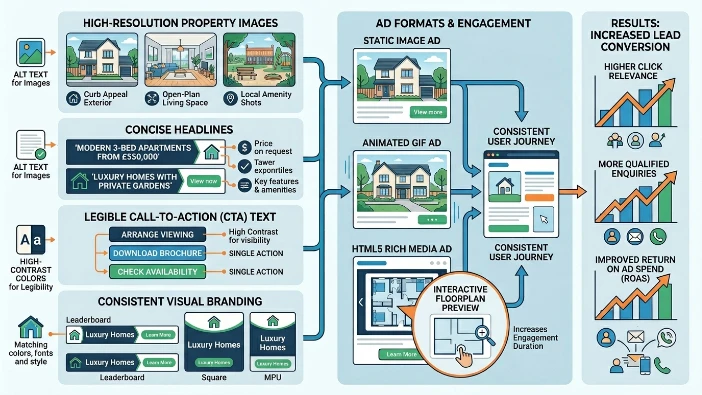
Image selection focuses on primary selling points: exterior façade for curb appeal, open-plan living for space, or local amenity shots for location. Headlines state specific facts, for example price range or number of bedrooms. Supporting text highlights unique attributes: private garden, leasehold length, or energy rating. Call-to-action text uses single actions: “Arrange viewing,” “Download brochure,” or “Check availability.” Ad formats include static images, animated GIFs, and HTML5 rich media. Rich media supports interactive floorplan previews that increase engagement duration.
All creative sizes maintain the same messaging so users see consistent information after clicking. Accessibility practices include alt text for images and high-contrast colours for legibility.
How should landing pages be designed to turn banner clicks into high-quality leads?
Landing pages must match banner messaging, present essential property facts immediately, and use a single conversion goal such as a contact form or booking widget. Clean layout and fast load time preserve intent and increase conversion rates.
Top-of-page content repeats the headline and image from the ad and lists critical facts: price, number of bedrooms, square metre area, tenure type, and council tax band. Contact forms ask for minimal information: name, phone number, and preferred viewing time. Alternative conversion paths include downloadable PDF brochures and direct call links on mobile. Embedded scheduling widgets show available viewing slots and confirm bookings instantly.
Page speed targets under 3 seconds on mobile. Privacy notices explain data use and link to the firm’s privacy policy. Tracking tags signal conversion events back to ad platforms and CRM systems for lead qualification. Post-conversion pages confirm next steps and set expectations about response times.
Which metrics define a high-quality lead from banner campaigns?
High-quality leads show conversion actions plus intent indicators: scheduled viewings, multiple page visits, and verified contact details; relevant metrics include conversion rate, cost per lead, lead-to-viewing rate, and lead-to-sale ratio. These metrics measure both acquisition efficiency and downstream value.
Conversion rate equals the number of leads divided by clicks. Cost per lead divides total ad spend by number of leads. Lead-to-viewing rate calculates the percentage of leads that book and attend viewings. Lead-to-sale ratio measures sales closed from generated leads. Engagement indicators include time on landing page, pages per session, and repeat ad interactions. Lead quality scoring uses fields such as buyer budget, timeframe for purchase, and property requirements. Verification methods include automated phone validation and CRM enrichment. Reporting cycles run weekly for active optimisation and monthly for strategic evaluation.
What ad delivery methods and buying strategies do firms use?
Ad delivery uses programmatic buying, direct publisher placements, and social display buys; buying strategies include CPM for reach, CPC for efficiency, and CPA for conversion focus. Strategy selection aligns with campaign goals: awareness, engagement, or lead capture.
Programmatic buying auctions inventory across exchanges in real time and uses audience data to bid for impressions. Direct publisher placements secure premium positions on high-traffic local news and property portals. Social display buys place banners within social feed environments and on social networks that support display inventory. CPM (cost per mille) buys optimisation for impressions at scale. CPC (cost per click) buys prioritise pay-per-click efficiency. CPA (cost per acquisition) buy using performance-based pricing to control cost per lead. Frequency caps limit exposure to prevent ad fatigue.
Bid adjustments raise bids for high-value audiences such as users who visited multiple property pages. Dayparting concentrates delivery during high-intent times, for example evening hours when users research properties.
Explore More Expert Insights:
How Healthcare Businesses Drive Patient Growth Using Display Ads
How Telemedicine Platforms Acquire Users Using Banner Ads
What are the main legal and data-privacy requirements in the UK for banner ad lead capture?
UK requirements include compliance with GDPR for personal data, ePrivacy rules for cookies, and transparent consent collection for tracking and remarketing. Firms must document lawful basis for processing and enable data subject rights.
Consent banners double as cookie notices and must record consent choices. Legitimate interest assessments justify some processing but firms document and balance interests. Personal data captured in forms requires secure storage and retention policies. Firms provide clear privacy notices that list data controllers, processing purposes, and contact details. Email marketing after lead capture requires explicit opt-in for promotional communications, while service-related messages use a different lawful basis. Third-party pixels and tag management require consent capture before activation. Data transfers outside the UK need appropriate safeguards such as standard contractual clauses.
What real use cases show banner ad success for real estate lead generation?
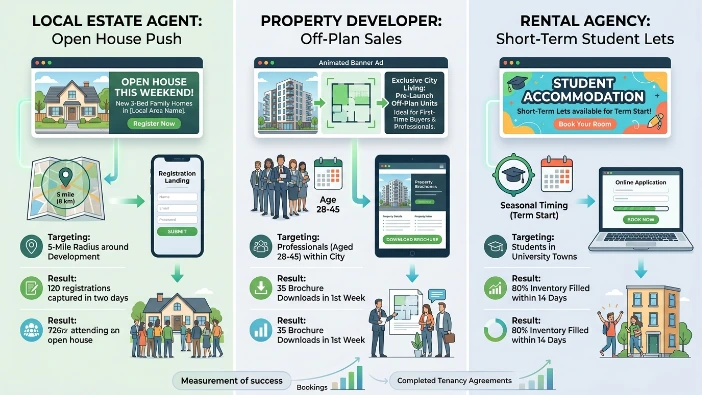
Use cases include local estate agents promoting new developments, developers marketing off-plan units, and rental agencies filling short-term lets; each use case uses tailored targeting and landing experiences to generate qualified enquiries. Real examples include targeting a 5 km radius around a new development, promoting a five-unit block to first-time buyer segments, and running short-term rental banners to students during term start.
An estate agent launches banners to announce a weekend open house, targets a five-mile radius, and captures 120 registrations in two days. A developer uses animated banners showing floorplans, targets professionals aged 28–45 within the city, and records 35 brochure downloads in the first week. A rental agency runs seasonal banners to students in specific university towns and fills 80% of inventory within 14 days. Each campaign measures lead quality by bookings and completed tenancy agreements.
For guidance on campaign structure and creative best practices see:
How Real Estate Firms Build Buyer Interest Using Property Banner Ads
For converting interest into direct inquiries see:
Real Estate Banner Ads That Convert Buyer Interest Into Property Inquiries