
Property banner ads are graphic advertisements placed on websites or apps that display property images, price, location, and a call-to-action to attract potential buyers. They deliver targeted impressions and clicks measured by view-through and click-through metrics.
Property banner ads are digital display units sized to industry standards such as 300×250, 728×90, and 300×600 pixels. Advertisers upload image assets and short copy that highlight the listing. Ad servers place banners on publisher inventory or programmatic exchanges. Targeting parameters include location radius, demographic segments, behavioural signals, and contextual keywords. Performance is measured through impressions, clicks, view-through rate (VTR), click-through rate (CTR), and conversions (property inquiry or viewing booking). Real estate firms use tracking pixels and UTM parameters to attribute traffic from a banner to a specific listing or campaign.
How do firms define objectives for banner-ad campaigns?
Firms set measurable objectives such as 10–30% increase in listing page visits, a 1–3% CTR target, or 50–200 qualified inquiries per month per market. Objectives guide creative, targeting, and bidding.
Objective definition begins with business goals. Sales teams provide target conversion rates and lead quality criteria. Marketing teams translate sales goals into digital objectives: awareness (impressions), interest (CTR and time on page), and transactions (inquiries and viewings). Budgets allocate spend across prospecting and retargeting. Campaign length is typically 14–90 days depending on inventory turnover. Firms select bidding strategies—CPM for awareness, CPC for traffic, CPA for lead acquisition. Firms implement analytics dashboards that report daily and weekly against targets.
Which audience segments should real estate firms target with banner ads?
Firms target high-intent segments including in-market buyers, local renters converting to buyers, and previous website visitors. Use first-party data, third-party signals, and geo-fencing to reach these segments.
First-party data includes newsletter subscribers, CRM contacts, and prior website visitors. Third-party signals include in-market buyer segments from data providers and property-search behaviour from vertical marketplaces. Geo-fencing targets users near the property or within commuting catchment areas, for example within 5–20 kilometres. Demographic layers include age bands 25–55, household income bands relevant to property price, and family status when relevant. Retargeting uses sequential creative for past site visitors who viewed a listing but did not inquire. Lookalike audiences scale outreach by finding users similar to high-value leads.
What creative elements drive buyer interest in banner ads?
High-resolution property images, a clear headline with price or USP, concise supporting copy, and a visible call-to-action (inquiry or view booking) drive engagement and lead submission.
Images must show the primary selling point: exterior façade, living space, kitchen, or view. Include panoramic or staged photos sized for clarity at small resolutions. Headlines use direct statements such as “3-Bed Home in South London, £450,000.” Supporting copy uses one short benefit phrase such as “Close to Tube; New Kitchen.” CTAs state the action: “Book Viewing,” “Request Brochure,” or “View Floorplan.” Add trust elements where space allows: agency accreditation icons or number of viewings to date. Include microcopy for urgency when applicable: “Available from June” or “Open House Sat 12–2.” Ensure accessibility with sufficient colour contrast and alt text for programmatic environments.
How does targeting and frequency control affect campaign performance?
Precise targeting increases relevance and CTR; frequency caps prevent ad fatigue by limiting impressions per user to 3–7 per week, improving overall conversion efficiency.
Targeting reduces wasted impressions and raises signal quality for algorithms. Geo-targeting narrows exposure to likely buyers. Interest and behavioural targeting increases relevance. Frequency caps ensure users encounter the creative enough to develop interest without becoming annoyed. For new listings, set higher initial frequency for three days to build awareness, then reduce to maintain presence. Use dayparting to run ads during high-engagement hours such as evenings 18:00–22:00 and weekends. Measure marginal CTR against frequency; lower marginal returns beyond the chosen cap indicate fatigue and require creative rotation.
How do firms use creative rotation and A/B testing?
Firms run concurrent creative variants to test headlines, images, and CTAs, measuring CTR, view-through rate, and conversion rate to identify top-performing assets within 7–14 days.
A/B tests isolate one variable per test. For example, test two headlines with the same image and CTA to determine headline impact. Use multivariate tests for image-plus-copy combinations when traffic is high. Stop underperforming creatives and scale winners. Rotate creatives every 14–30 days for long campaigns to maintain freshness. Track performance by device type; mobile and desktop often require different compositions and CTAs. Record statistical significance thresholds (95% confidence) before declaring a winner.
What landing pages and measurement practices improve conversion?
Landing pages must match ad content, load under 3 seconds, and include a single lead action form plus visible contact details to maximise form submissions and phone calls.
Consistency between ad and landing page reduces drop-off. The landing page headline should mirror the banner headline and image. Use a concise lead form asking for name, email, phone, and preferred viewing times. Offer alternative contact options such as click-to-call and instant chat. Implement tracking with server-side analytics, UTM parameters, and conversion pixels. Attribute leads by source to calculate cost-per-lead (CPL) and return on ad spend (ROAS). Use session recordings and heatmaps to diagnose friction points.
What budget allocation and bidding strategies work for property banners?
Allocate 40–60% of spend to prospecting and 40–60% to retargeting; use CPM for awareness, CPC for traffic, and target CPA for lead acquisition to optimise cost per inquiry.
Prospecting extends reach to new buyers; retargeting re-engages interested visitors. Start with a 50/50 split, then shift 10–20% toward retargeting as data shows higher conversion yield. Use programmatic bidding tools to adjust bids by audience segment, device, and location. Set manual bids for high-value neighbourhoods and automated bids for broad segments. Monitor CPL weekly and reset bids if CPL increases by more than 20% versus target.
What analytics and KPIs should firms track?
Essential KPIs include impressions, CTR, CPL, conversion rate, view-through rate, and quality metrics such as appointment-to-inquiry ratio and qualified lead percentage.
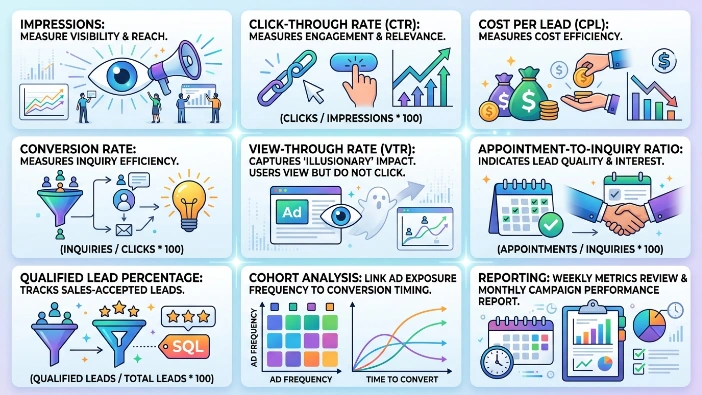
Impressions measure reach. CTR measures engagement. CPL measures cost efficiency. Conversion rate equals inquiries divided by clicks. View-through rate captures illusionary impact when users view but do not click. Appointment-to-inquiry ratio indicates lead quality. Qualified lead percentage tracks sales-accepted leads. Use cohort analysis to link ad exposure frequency to conversion timing. Report metrics weekly and produce a monthly campaign performance report.
Explore More Expert Insights:
How Healthcare Brands Improve Service Consideration Using Banner Ads
How Telemedicine Platforms Build User Trust Using Display Remarketing Ads
What legal and privacy considerations apply in the UK?

Comply with the UK GDPR, obtain lawful bases for processing personal data, provide clear privacy notices, and ensure cookie consent for tracking and retargeting.
Collect only necessary personal data. Record lawful bases such as legitimate interest or consent. Implement a consent management platform that captures granular cookie preferences. Provide data retention windows and deletion processes. For third-party data and programmatic partners, verify data processor agreements and international transfer safeguards when applicable. Maintain transparent opt-outs for marketing communications.
How do firms scale successful banner campaigns across markets?
Scale by replicating proven creative and targeting in similar market segments, increasing budget in increments of 10–30%, and localising creative for each neighbourhood and device type.
Identify markets with similar price bands, commuting patterns, and buyer demographics. Test scaled creatives in a control subset before full rollout. Increase budget gradually to maintain yield. Localise headlines, imagery, and USP statements for each neighbourhood. Use lookalike audiences seeded from high-value leads to expand reach. Maintain performance monitoring as volume scales and adjust bids and frequency caps in response to CPL trends.
Property banner ads combine precise targeting, high-quality creative, and measurement to generate buyer interest and qualified inquiries. Firms that set clear objectives, target high-intent segments, run disciplined A/B tests, and link ads to optimised landing pages achieve lower CPL and higher appointment rates.
For guidance on campaign structure and creative best practices, see:
How Real Estate Firms Generate High-Quality Leads Using Banner Ads
For converting interest into direct inquiries see:
Real Estate Banner Ads That Convert Buyer Interest Into Property Inquiries