
UK GDPR compliance for published research surveys requires organizations to establish a lawful basis for processing, secure explicit consent where necessary, apply strict data minimisation principles, and remove all personally identifiable information before public release.
The Data Protection Act 2018 and the UK General Data Protection Regulation govern all processing of personal data relating to living individuals within the United Kingdom. When researchers collect survey responses to compile a published report, they act as data controllers. This legal status imposes direct accountability for how survey participant data travels from collection forms into public-facing documents.
Research surveys frequently capture demographic details, occupational history, and behavioral opinions. If these individual data points trace back to a specific natural person, they constitute personal data under Article 4 of the UK GDPR. Compliance mandates that researchers protect these data subjects throughout the data lifecycle, spanning survey design, collection, analysis, aggregation, and final publication.
The Role of Data Controllers in Research
A data controller determines the purposes and means of processing personal data. Academic institutions, market research agencies, and corporate publishing departments operating within the United Kingdom hold this legal responsibility.
Controllers must implement technical and organizational measures to ensure compliance. These safeguards protect participant rights, including the right to be informed, the right of access, and the right to erasure. Failure to meet these statutory thresholds exposes publishing entities to substantial monetary penalties issued by the Information Commissioner’s Office.
What Lawful Bases Apply to Survey Data Collection?
The primary lawful bases for collecting survey data under UK GDPR are explicit consent, legitimate interests, and public task, depending entirely on the sector conducting the research and the sensitivity of the collected topics.
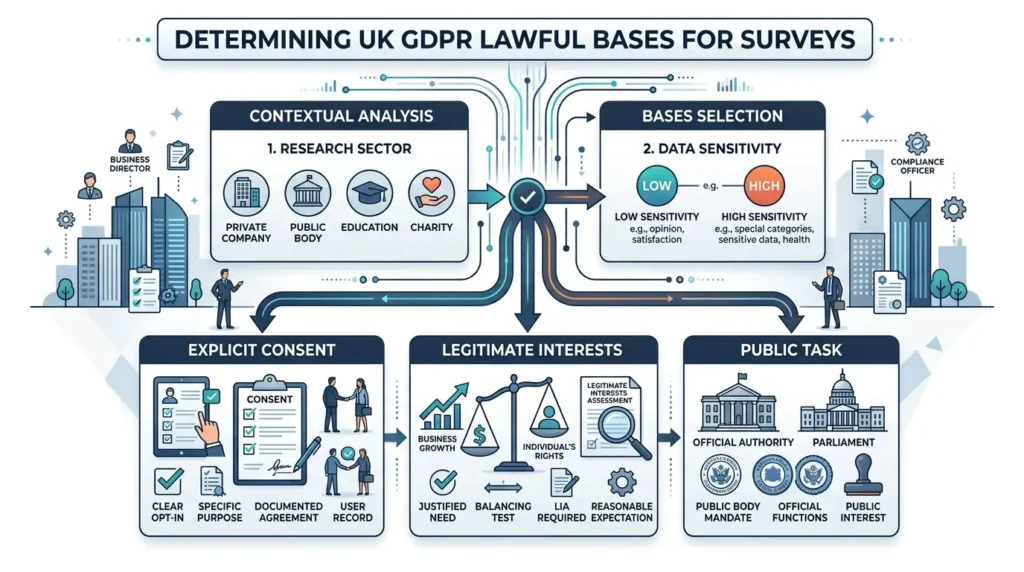
Selecting the correct lawful basis determines the legal validity of the entire research project. Article 6 of the UK GDPR lists six lawful bases, but only a subset applies to survey research methodologies.
- Explicit Consent: Required when researchers collect special category data, such as health records, political opinions, or religious beliefs.
- Legitimate Interests: Used frequently by commercial entities conducting market research, provided the interests of the controller do not override the fundamental rights of the data subjects.
- Public Task: Utilized by universities and government bodies conducting research in the public interest.
Evaluating Legitimate Interests vs. Consent
Commercial research projects often rely on legitimate interests to streamline survey deployment. This basis requires a three-part test: identifying a legitimate interest, establishing that the processing is necessary to achieve it, and balancing it against individual privacy rights.
When surveys touch upon sensitive topics, consent remains the safest legal mechanism. Consent must be freely given, specific, informed, and unambiguous. Researchers cannot use pre-ticked boxes or bundled terms of service to secure valid consent for published reports.
Explore More Expert Insights:
How Financial Services Build Trust Using Educational Banner Advertising
How Agencies Increase Buyer Engagement Using Display Remarketing Ads
How Does Anonymisation Protect Survey Respondents Before Publication?
Anonymisation permanently strips survey datasets of all direct and indirect identifiers, rendering data recovery impossible and exempting the resulting dataset from UK GDPR restrictions.
Publishing a research report inherently exposes data to the public domain. Under UK GDPR recital 26, the regulation does not apply to anonymous information, which means data that does not relate to an identified or identifiable natural person. However, true anonymisation requires rigorous transformation techniques.
Researchers often confuse pseudonymisation with anonymisation. Pseudonymisation replaces direct identifiers like names with ID numbers, but the data remains personal data because a key links the identifier back to the individual. Published reports require true anonymisation to prevent re-identification attacks.
Techniques for Effective Data Transformation
Achieving compliance for published metrics involves specific mathematical and structural transformations. For example, a dataset containing exact annual salaries and specific job titles in a niche industry allows for participant re-identification.
- Generalization: Grouping specific numeric ages into wider brackets, such as transforming exact ages into cohorts like 30 to 39.
- Cell Suppression: Removing statistical cells from published cross-tabulation tables where the respondent count falls below a threshold, typically five individuals.
- Top and Bottom Coding: Capping extreme numerical values, such as reporting incomes above one hundred thousand pounds as a single category.
What Are the Mandatory Participant Disclosures and Privacy Notices?
Mandatory participant disclosures require researchers to provide a comprehensive privacy notice prior to survey initiation that details data retention periods, third-party sharing, and the intended public release of the final report.
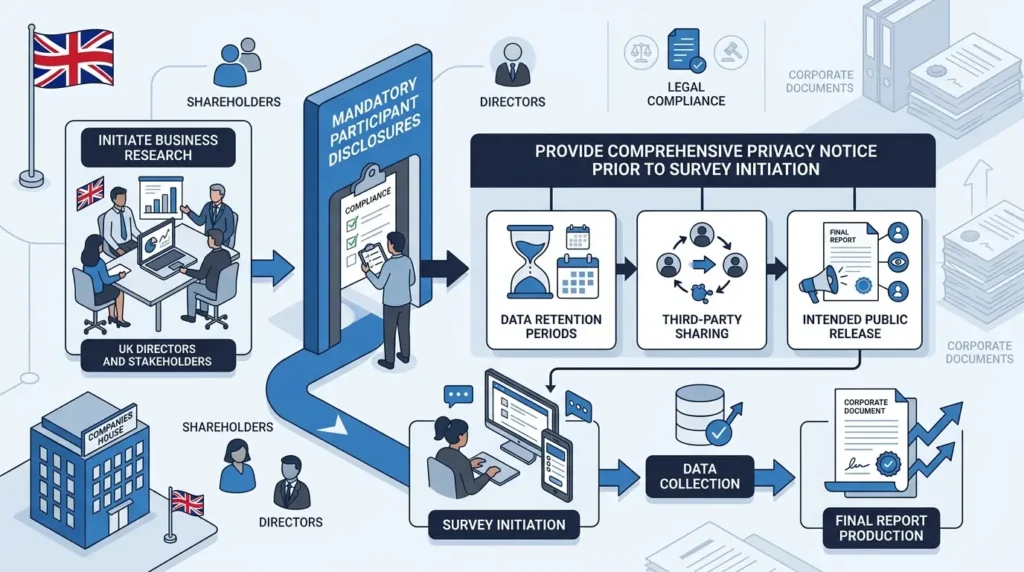
Transparency is a cornerstone of the UK GDPR under Articles 12, 13, and 14. Respondents possess the absolute right to understand how their survey submissions will influence published findings.
The initial survey screen or invitation email must feature a direct link to a privacy notice. This document must avoid vague legal jargon and state precisely how survey responses will be aggregated and analyzed.
Essential Elements of a Research Privacy Notice
A compliant research privacy notice outlines specific operational details that govern data handling. For instance, notice documents utilized by UK research bodies typically specify exact retention schedules, such as deleting raw identifiable files twelve months after report publication.
- Identity of the Controller: The legal name and contact details of the organization publishing the report.
- Purpose of Processing: Clear statements explaining that data feeds into a public research report or whitepaper.
- Data Subject Rights: Instructions on how participants can exercise their right to withdraw or request data deletion prior to aggregation.
What Rights Do Survey Participants Retain After Submission?
Survey participants retain the right to access, rectify, or erase their personal data up until the point of data aggregation and anonymisation, after which deletion becomes technically impossible.
Managing data subject access requests presents unique logistical challenges for research projects. Because raw survey files contain personal identifiers, participants can legally request copies of their specific responses.
If a participant exercises their right to erasure before the data is aggregated, researchers must purge that specific record from the primary database. However, once data is fully anonymised and merged into aggregated statistical tables for a published report, individual identification ceases.
Managing Post-Publication Withdrawal Requests
When a report enters the public domain, retroactive removal of individual data points from static PDF documents or online dashboards is unfeasible. To mitigate this compliance risk, researchers establish clear cutoff dates communicated within the initial participant disclosure.
- Pre-Aggregation Window: A defined two-week window post-survey close where withdrawal requests are fully processed.
- Irreversible Aggregation: The procedural milestone where raw datasets are destroyed, leaving only aggregated percentages and summaries that cannot be reverse-engineered.