
Survey data anonymisation removes all direct identifiers and indirect quasi-identifiers from individual respondent records so that living persons cannot be identified, directly or indirectly, ensuring compliance with the UK GDPR and the Data Protection Act 2018 before report publication.
Publishing survey reports based on primary research requires rigorous data transformation to protect participant privacy. Under UK data protection laws, raw survey data containing personal data cannot be published openly. Organisations must process datasets to eliminate disclosure risks. This technical transformation converts identifiable survey entries into safe, aggregated statistical metrics suitable for public consumption.
The Role of Direct Identifiers
Direct identifiers include explicit data points such as full names, email addresses, telephone numbers, and postal addresses. These fields point uniquely to a specific individual. Removing these variables is the mandatory first step in survey data preparation. Without this removal, any data release constitutes an immediate breach of privacy regulations.
The Impact of Quasi-Identifiers
Quasi-identifiers consist of attributes that, when combined, narrow down an individual’s identity. Examples include job titles within specific small companies, exact geographic postcodes, birth dates, and niche demographic combinations. Attackers link these data points with external datasets to re-identify survey participants. Effective anonymisation addresses both direct identifiers and quasi-identifiers through systematic suppression or generalisation techniques.
How do you transition from raw survey datasets to published aggregated metrics?
Transitioning from raw survey datasets to published aggregated metrics involves a five-stage technical pipeline: removing direct identifiers, evaluating disclosure risks, applying generalisation and suppression rules, grouping responses into aggregate categories, and verifying data utility against statistical disclosure control standards.
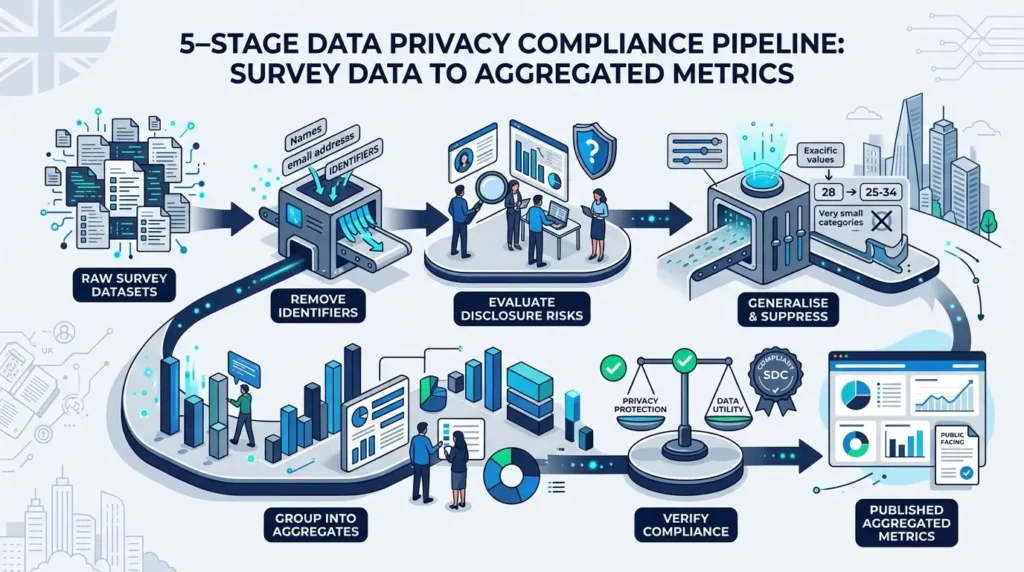
Transforming survey data requires a repeatable methodology. Researchers follow strict protocols to ensure that published percentages, means, and cross-tabulations reveal market trends without exposing individual identities. Readers interested in foundational compliance principles can review [What Does UK GDPR Require When You Collect Survey Data for a Published Research Report?] for baseline regulatory requirements.
Stage One: Data Extraction and Cleaning
Data extraction pulls completed survey responses from collection platforms into secure analytical environments. Researchers remove incomplete submissions, spam entries, and technical metadata. This cleaning phase isolates the substantive qualitative and quantitative variables required for the final research report.
Stage Two: Risk Assessment and Disclosure Control
Risk assessment evaluates the uniqueness of records within the dataset. Statisticians apply disclosure control models, such as k-anonymity and l-diversity, to measure re-identification vulnerability. If a demographic combination matches only one respondent in the entire UK population sample, that record poses a high disclosure risk.
Explore More Expert Insights:
How Investment Firms Build Awareness Using Market Insight Ads
How Finance Brands Improve Conversion Intent Using Retargeting Ads
What are the core techniques for masking and aggregating respondent attributes?
Core masking and aggregation techniques include cell suppression, top and bottom coding, data generalisation, and threshold-based grouping, which together prevent reverse-identification in cross-tabulated research tables.
Publishing complex cross-tabulations increases re-identification risks because multiple data filters intersect. Researchers implement mathematical masking techniques to protect cell values in tables containing small sample sizes.
Cell Suppression and Threshold Rules
Cell suppression removes numerical values from report tables when the underlying respondent count falls below a defined threshold. For instance, the Office for National Statistics frequently applies a threshold rule where any table cell representing fewer than 10 individuals is suppressed or replaced with a disclosure flag. This prevents readers from isolating single-participant responses in niche sub-sectors.
Data Generalisation and Binning
Data generalisation converts precise numerical values into broader categories. Instead of publishing exact annual salaries or precise employee counts, researchers use statistical binning. For example, specific annual incomes of GBP 42,500 and GBP 48,000 are grouped into a single broader bracket spanning GBP 40,000 to GBP 50,000. Similarly, exact ages are grouped into five-year or ten-year age cohorts.
Top and Bottom Coding
Top and bottom coding caps extreme outliers in numerical datasets to prevent the identification of unique respondents. If a survey captures company revenues ranging from GBP 100,000 to GBP 85,000,000, researchers code all values exceeding GBP 50,000,000 into a single open category labelled “GBP 50,000,000 and above”. This technique protects high-value outliers from reverse-identification.
Why is data aggregation essential for lawful and ethical research publication?
Data aggregation is essential because it strips out individual variance, transforms personal data into anonymous statistical information outside the scope of the UK GDPR, and safeguards brand reputation by eliminating compliance penalties.
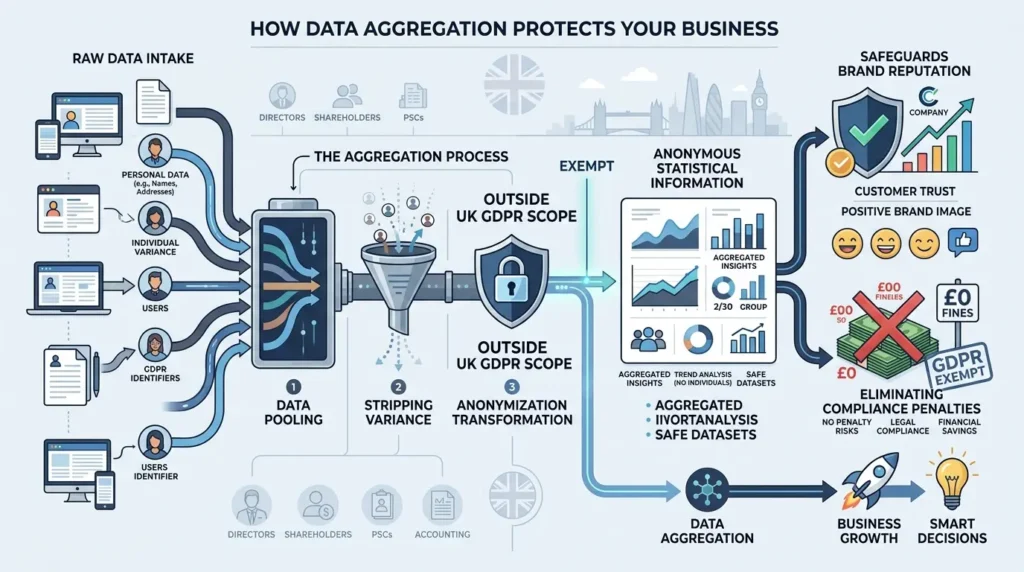
When survey data is successfully aggregated, the resulting metrics represent population trends rather than individual behaviours. This legal distinction shifts the dataset outside the remit of data protection legislation, as anonymous information falls entirely outside the definition of personal data under Section 3 of the Data Protection Act 2018.
Eliminating Regulatory Enforcement Risks
The Information Commissioner’s Office possesses powers to issue substantial financial penalties for unauthorised disclosures of personal data. Publishing unmasked survey tables containing identifiable quotes or granular cross-tabulations triggers regulatory investigations. Proper aggregation eliminates these liabilities before publication.
Maintaining Participant Trust and Data Integrity
Survey respondents provide candid feedback under assurances of strict confidentiality. When reports feature transparent data anonymisation practices, trust in the research methodology increases. Stakeholders, regulators, and industry peers accept the published findings as methodologically sound and ethically robust.
How do professional research workflows handle anonymisation in practice?
Professional research workflows handle anonymisation by embedding automated disclosure control algorithms into analysis software, enforcing strict access controls during data coding, and partnering with specialised analytics agencies.
Executing large-scale B2B or consumer surveys requires sophisticated data handling infrastructure. Organisations balance the need for granular statistical insights with strict legal adherence through structured operational workflows. Organisations seeking comprehensive support for compliant report creation can explore [Time Intelligence Media Group Research and Reports Services With Data Protection Built In] for end-to-end management solutions.
Automated Disclosure Testing in Analytical Software
Modern research teams utilise statistical packages equipped with automated disclosure limitation modules. Software scripts scan cross-tabulation matrices for small cell counts, missing values, and unique respondent signatures. These tools flag vulnerable data points before report layouts are finalised for print or digital distribution.
Independent Review and Sign-Off
Before any market report enters the public domain, a designated data protection officer or independent methodologist reviews the aggregated tables. This final verification step confirms that qualitative verbatim comments contain no identifying markers, company names, or internal jargon that could trace back to a specific survey respondent. Systematic oversight guarantees that published research maintains absolute compliance with UK regulatory standards.