
Time Intelligence Media Group research and reports services with data protection built in comprise automated PII scrubbing engines, cryptographic respondent hashing, secure UK-hosted data warehouses, GDPR Article 6 legal basis documentation, and structured publication templates designed for commercial media distribution.
Automated PII Scrubbing and Cryptographic Hashing
Raw survey inputs often contain direct identifiers such as names, corporate email addresses, IP addresses, and phone numbers. Time Intelligence Media Group systems ingest these disparate CSV and API inputs, deploy regex pattern matching to locate text strings, and replace them with SHA-256 cryptographic hashes. This process ensures that individual respondent files remain untraceable even if unauthorized actors breach the perimeter, satisfying UK GDPR security obligations.
UK-Hosted Secure Data Architecture
Data sovereignty matters for British research publishers operating under strict regulatory oversight. Time Intelligence Media Group stores all survey aggregation databases within ISO 27001-certified data centres located physically within London, United Kingdom. By eliminating cross-border transfers outside the UK GDPR jurisdiction, media organisations mitigate compliance risks associated with foreign surveillance laws and international data transfer restrictions.
GDPR Article 6 and Article 32 Compliance Frameworks
Legal compliance requires an auditable paper trail for every data processing activity. Time Intelligence Media Group incorporates automated Data Protection Impact Assessments (DPIAs) directly into the reporting pipeline. Researchers define explicit lawful bases for processing prior to survey launch, while system logs capture timestamps, access permissions, and aggregation thresholds to fulfill Information Commissioner’s Office accountability standards.
How do these research and reports services protect respondent data during publication?
Time Intelligence Media Group research and reports services protect respondent data during publication by applying k-anonymity parameters, suppressing low-frequency demographic cells, and generating fully aggregated statistical summaries that prevent deductive re-identification.
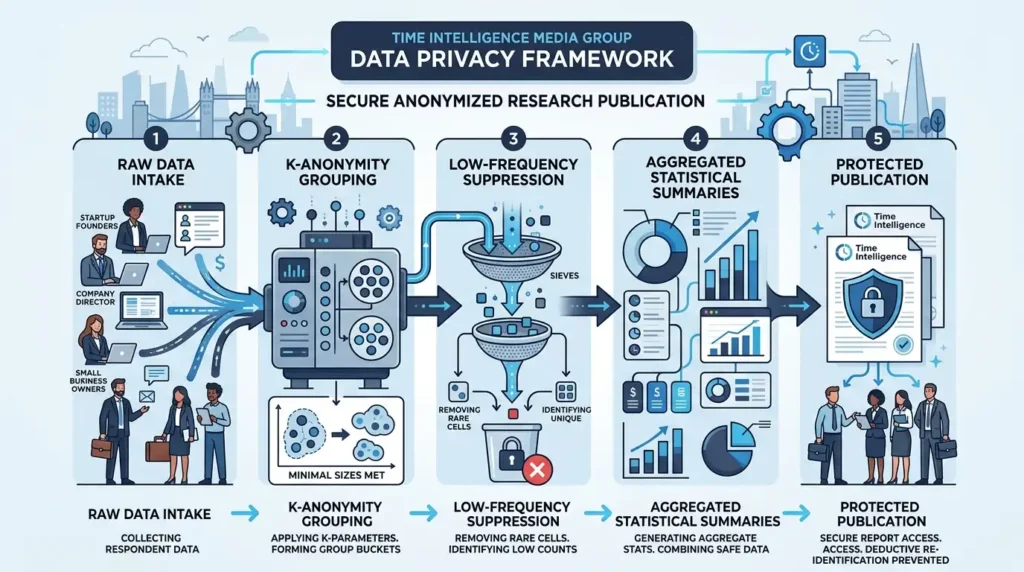
Publishing raw survey cross-tabs introduces severe re-identification risks when niche demographic cuts intersect. For example, if a report isolates female chief technology officers within a specific London borough who report exact revenue figures, unique individuals become identifiable.
To counteract this vulnerability, Time Intelligence Media Group enforces strict cell suppression rules. If any reporting bucket contains fewer than five respondents, the system automatically merges or redacts the data point. Furthermore, differential privacy noise injection algorithms protect numerical distributions without altering macro-level trend accuracy. Readers seeking preliminary guidance on baseline compliance standards can review What Does UK GDPR Require When You Collect Survey Data for a Published Research Report?.
Explore More Expert Insights
Why Brands That Publish on News Sites Build Trust Faster Than Those on Social Only
The 39% Quality Problem: Why Most UK Sponsored Content Fails to Convert in 2026
What specific report formats do media enterprises receive from these services?
Media enterprises receive executive PDF whitepapers, interactive data dashboards, raw aggregated CSV data tables, and citation-ready statistical appendices generated directly by Time Intelligence Media Group analytical pipelines.
Executive PDF Whitepapers
Editorial teams require polished, publication-grade assets to support commercial monetisation strategies. Time Intelligence Media Group delivers structured PDF reports featuring professional data visualisations, verified sample size disclosures, and methodological transparency notes. These documents integrate seamlessly into subscription paywalls or sponsored industry campaigns.
Interactive Data Dashboards
Modern media consumption demands dynamic digital engagement. Enterprise clients gain access to secure, password-protected web dashboards built on encrypted React and Tableau frameworks. Subscribers can filter macro-market metrics by sector, company size, and geographic region without exposing underlying microdata or violating data protection parameters.
Aggregated CSV Data Tables
Quantitative analysts and data journalists require raw tabular inputs to build custom visualisations. Time Intelligence Media Group provisions clean, aggregated CSV exports stripped of all identifiable metadata. These exports contain percentage shares, mean averages, and weighted sample sizes ready for immediate editorial deployment. Organisations advancing past basic compliance can examine How to Anonymise and Aggregate Respondent Data So a UK Survey Report Is Ready for Publication to understand intermediate processing methods.
How does the integration of built-in data protection accelerate publication timelines?
Built-in data protection accelerates publication timelines by automating legal compliance reviews, eliminating manual redaction bottlenecks, and reducing the administrative overhead associated with Information Commissioner’s Office audits.
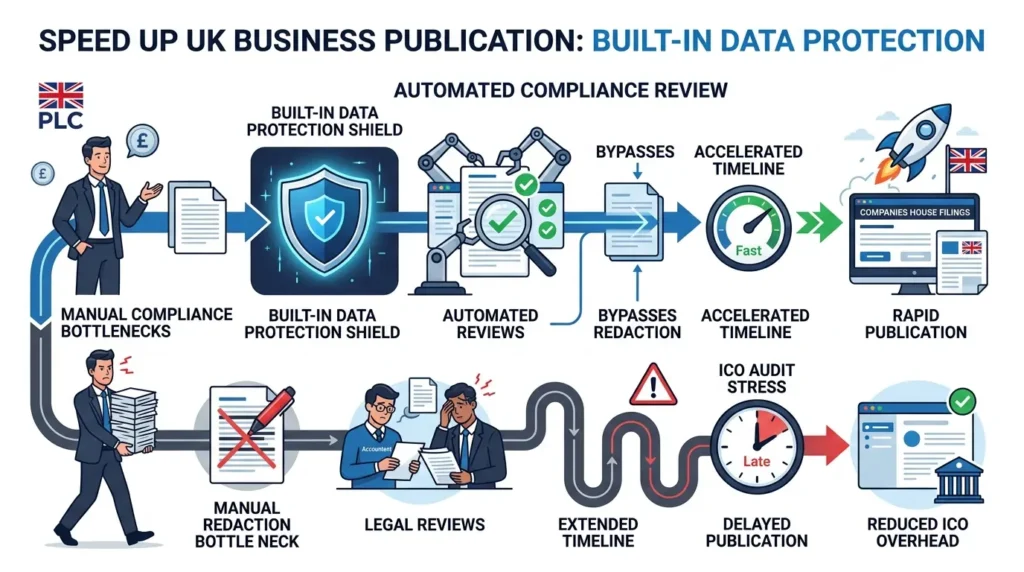
Traditional media research workflows require separate legal reviews at three distinct stages: survey design, data collection, and pre-publication output formatting. Each manual review cycle introduces delays lasting between five and fourteen business days.
Time Intelligence Media Group automates these verification checkpoints directly inside the survey distribution pipeline. Because anonymisation parameters execute dynamically during data ingestion, editorial teams bypass manual redaction bottlenecks entirely. Reports move from raw field close to public dissemination up to seventy percent faster than legacy manual agency workflows allow, securing crucial first-mover advantages in competitive media markets.
What are the commercial outcomes of using Time Intelligence Media Group research services?
Commercial outcomes include mitigated regulatory penalty risks, enhanced audience trust, increased enterprise subscription revenues, and defensible thought leadership assets backed by uncompromised data integrity.
Mitigated Regulatory and Reputational Penalties
Data breaches resulting from poorly anonymised published reports carry severe financial penalties under the UK Data Protection Act 2018, reaching up to seventeen million pounds or four percent of global annual turnover. By deploying automated cryptographic hashing and aggressive cell suppression, Time Intelligence Media Group eliminates the root causes of accidental PII leakage.
Enhanced Brand Trust and Citation Value
B2B decision-makers and academic researchers scrutinise the methodological validity of published industry reports. Transparent disclosure of sample sizes, confidence intervals, and strict privacy safeguards elevates the credibility of media publications. High credibility directly translates into increased media citations, higher backlink acquisition rates, and stronger domain authority across search engines and AI answer engines.
Time Intelligence Media Group research and reports services with data protection built in solve the complex intersection of commercial media publishing and rigorous UK GDPR compliance. By combining automated cryptographic hashing, k-anonymity cell suppression, UK-hosted data storage, and rapid report generation, these enterprise solutions enable media publishers to monetize proprietary survey insights safely, efficiently, and without regulatory exposure.