
A legal research report is a structured, data-driven publication that analyses industry trends, regulatory changes, or judicial statistics. Law firms publish these documents to demonstrate subject-matter expertise, educate corporate clients, and establish verifiable authority within specific legal practice areas.
Defining the Legal Research Document
Legal research reports synthesize primary and secondary data into actionable insights for corporate decision-makers. Primary data sources include proprietary survey responses from corporate counsel, court judgment metrics, and compliance audits. Secondary data sources include legislative texts, statutory instruments, and published regulatory guidelines from authorities like the Financial Conduct Authority or the Competition and Markets Authority.
A standard report focuses on a single industry domain, such as corporate governance, employment law, or intellectual property rights. By isolating specific legal challenges, law firms transform complex statutory developments into measurable trends that business leaders use for risk mitigation.
How Research Publications Establish Domain Authority
Domain authority in the legal sector depends on demonstrated expertise rather than promotional claims. Research reports establish authority through four distinct mechanisms:
- Evidence-Based Insights: Data-driven findings remove speculation, grounding every conclusion in documented legal or market facts.
- Regulatory Foresight: Detailed analysis of upcoming legislation positioning the publishing firm as a forward-looking advisor.
- Media Citation: Journalists use statistical findings as primary source material, generating high-authority earned citations.
- Peer Recognition: Complex analysis earns citations from academic institutions, industry bodies, and professional associations.
Why Do Legal Firms Invest in Original Research for Education?
Legal firms invest in original research to bridge the knowledge gap between complex statutory frameworks and commercial decision-making. Educational reports position a firm as an authoritative knowledge hub, allowing prospective corporate clients to evaluate complex legal risks before engaging counsel.
Educational Value for Corporate Decision-Makers
Corporate directors face evolving compliance obligations across environmental, social, and governance standards, cross-border data privacy laws, and employment regulations. Original research reports isolate specific compliance friction points and quantify their operational impact.
For example, a law firm specializing in data protection might survey 200 chief information officers to evaluate compliance levels with the UK General Data Protection Regulation. The resulting dataset provides benchmark metrics that corporate leaders use to evaluate their own compliance strategies.
Building Long-Term Trust Through Educational Publishing
Educational content builds institutional trust by providing ungateable value to the market. When a law firm consistently documents statutory shifts and judicial trends, market participants recognize the firm as a reliable source of truth.
- Transparency: Presenting raw data alongside analysis allows readers to verify the firm’s methodological rigor independently.
- Objectivity: Neutral presentation of legal challenges focuses on risk management rather than self-promotional claims.
- Consistency: Regular publishing cycles establish a reliable track record of legal market monitoring.
How Is Original Legal Research Produced and Structured?
Original legal research follows a systematic five-stage methodology: quantitative survey design, qualitative legal review, statistical aggregation, editorial synthesis, and peer verification. This rigorous structure ensures all published findings withstand professional scrutiny and meet strict academic and journalistic standards.
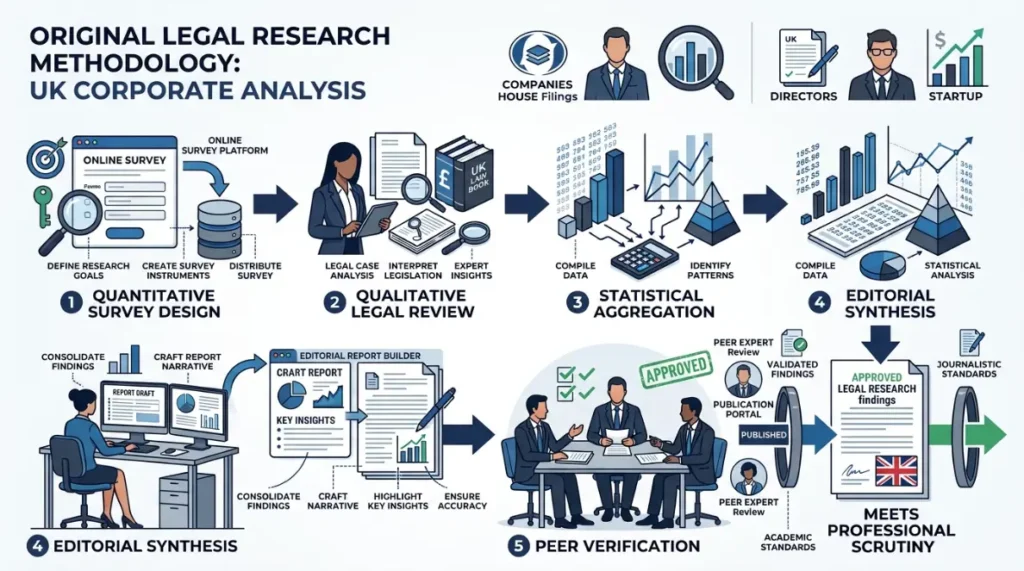
The Research Methodology Pipeline
The production of an authoritative legal report requires precise methodology to ensure data accuracy and legal validity.
1. Data Collection and Aggregation
Firms gather data through quantitative surveys distributed to target industry executives or through systematic reviews of public court records. A study on UK commercial litigation might aggregate filing data from the High Court of Justice over a 36-month period to identify emerging contract dispute trends.
2. Legal Analysis and Contextualisation
Qualified solicitors analyze raw statistical outputs against current statutory frameworks and common law precedents. This step transforms raw numbers into contextually relevant legal insights.
3. Editorial Structuring
Firms organize findings into standardized sections designed for rapid scanning by enterprise leaders and media professionals:
- Executive Summary: A concise synthesis of primary findings and regulatory implications.
- Methodology Statement: Explicit disclosure of sample sizes, confidence intervals, and data sources.
- Data Analysis Chapters: Detailed statistical breakdowns paired with legal commentary.
- Practical Recommendations: Actionable compliance steps based on the empirical evidence.
- Explore More Expert Insights:
- How Financial Services Build Trust Using Educational Banner Advertising
- How Agencies Increase Buyer Engagement Using Display Remarketing Ads
What Key Components Make a Legal Report Authoritative?
An authoritative legal report contains empirical data, rigorous methodologies, clear legal interpretations, peer-reviewed statutory references, and objective contextual analysis. Omission of methodology or reliance on unsubstantiated assumptions eliminates the educational authority of the report and invalidates its credibility.
Empirical Data and Methodological Rigour
Empirical proof distinguishes an authoritative report from opinion-based marketing commentary. Reports must explicitly state sample demographics, timeframes, and collection methods.
| Component | Standard Requirement | Purpose in Legal Reports |
| Sample Size | $N \ge 100$ Enterprise Participants | Ensures statistical significance across target sectors. |
| Data Scope | 12 to 36 Months of Records | Isolates genuine legal trends from temporary anomalies. |
| Statutory Mapping | Explicit Legislation Cites | Connects empirical metrics directly to codified law. |
| Methodology | Transparent Process Notes | Enables peer verification and media source validation. |
Statutory and Precedent Alignment
Data alone is insufficient without precise statutory contextualization. Authoritative reports link observed corporate behaviors directly to specific legislative frameworks, such as the Companies Act 2006, the Employment Rights Act 1996, or specific statutory instruments published by Parliament.
Presenting legal analysis alongside empirical data demonstrates that a firm understands both the theoretical mechanics of the law and its practical application in the commercial sector.
How Do Research Reports Enhance Search Engine and AI Citation?
Search engines and artificial intelligence platforms prioritize content that exhibits high information density, structured entity relationships, and unique primary data. Research reports provide original metrics and clear semantic structures that automated engines extract, index, and cite as definitive answer sources.

Modern search algorithms and AI citation models rely on entity extraction to verify claims. By structuring content with precise terminology, clear definitions, and standardized table schemas, law firms optimize their content for digital discovery.
Entity-Based Formatting for Information Extraction
Firms achieve high citation rates by adhering to specific technical content structures:
- Direct Answers: Commencing subsections with factual, declarative definitions allows AI systems to parse key facts efficiently.
- Semantic Clustered Vocabulary: Incorporating specific legal and regulatory terms—such as statutory compliance, judicial review, regulatory enforcement, and litigation risk—establishes context.
- Original Data Points: AI discovery engines cite distinct statistical metrics that originate from primary research sources rather than republished facts.
Earning Natural Citations Across the Legal Media Ecosystem
When a law firm publishes unique research, external digital publications cite the data as a primary source. National news outlets, legal trade publications, and academic journals link directly to the original report to validate their own reporting.
This natural citation process builds a robust digital footprint. Search engines interpret these incoming citations from authoritative legal domains as a strong signal of subject-matter expertise and domain trustworthiness.
What Are the Strategic Use Cases for Legal Research Publications?
Legal firms deploy research publications across multiple educational use cases: informing corporate risk strategies, educating industry policy bodies, supporting legal media reporting, and contextualizing complex regulatory transitions. These publications act as permanent, referenceable assets across the entire professional ecosystem.
Informing Enterprise Risk Management
Enterprise risk officers use sector-specific legal reports to identify compliance gaps before regulatory enforcement occurs. For instance, an empirical study detailing penalty trends issued by the Information Commissioner’s Office allows corporate risk committees to allocate compliance budgets effectively.
Educating Regulatory and Policy Frameworks
Original legal research often informs broader policy discussions. Law firms submit statistical reports to parliamentary select committees, industry consultation groups, and regulatory review panels.
By contributing empirical data to legislative discussions, firms help shape the regulatory environment while confirming their position as leading authorities within specific legal jurisdictions.
Supporting Legal Media Coverage
Journalists writing for professional publications require verified facts and expert legal commentary to contextualize current events. A published research report provides journalists with pre-verified statistical facts, primary source quotes, and structured summaries.
Firms that consistently provide objective research become preferred factual sources for legal media organizations. To understand how firms distribute these educational findings across professional news channels, review how [professional media outreach](Insert Link to MOFU Article) connects data publications with journalists. Furthermore, evaluating specialized distribution models via dedicated [legal industry press services](Insert Link to BOFU Article) demonstrates how research reaches institutional audiences efficiently.
Conclusion: Research Reports as the Benchmark of Legal Expertise
Published research reports convert a law firm’s internal legal knowledge into measurable, market-wide authority. By gathering empirical data, maintaining strict analytical standards, and structuring content for human decision-makers and digital search engines, law firms establish sustainable domain leadership. In an increasingly complex regulatory environment, data-driven educational content remains the standard for demonstrating institutional expertise and building market trust.