
Legal research reports reach UK professional media by translating complex industry data into exclusive news angles, pitching direct to legal journalists, and aligning findings with active legislative debates, regulatory changes, sector-specific market trends, and established editorial schedules.
UK professional media outlets—such as The Law Society Gazette, The Lawyer, Legal Business, and national business desks—maintain strict editorial standards. They do not publish promotional material. To secure coverage, a research report must present original, verifiable data that addresses a clear gap in professional knowledge.
Media Selection and Audience Alignment
Targeting the correct publication depends on the nature of the data. Professional media in the UK falls into three primary categories:
- Primary Legal Trade Press: Outlets like The Law Society Gazette and The Lawyer focus on law firm management, partner moves, billing rates, and legal technology adoption.
- Sector-Specific Business Outlets: Publications like Health Investor UK or Property Week cover legal research that impacts specific commercial industries.
- National Business Desks: Outlets like The Financial Times or The Times (Legal section) select macro-economic legal data that affects broader UK commerce.
Understanding these distinctions ensures that research reports reach the specific editors responsible for those beats, increasing the likelihood of publication.
Strategic Timing and Regulatory Alignment
Journalists prioritize timeliness. A report on corporate governance yields higher coverage when released alongside relevant parliamentary bill readings or major regulatory updates from bodies like the Financial Conduct Authority (FCA) or the Solicitors Regulation Authority (SRA). Aligning publication schedules with external industry catalysts gives editors a clear reason to publish immediately.
What Is the Process for Distributing Legal Research Reports to Media Outlets?
The distribution process involves four distinct phases: synthesizing raw data into journalistic press releases, establishing embargo timelines, targeting beat-specific journalists, and executing follow-ups supported by subject-matter expert interviews and raw data access.
Executing a successful media campaign requires structured project management. The distribution workflow transforms dense legal technicalities into accessible, highly quotable news stories.
Data Synthesis and Angle Extraction
Raw research data rarely interests a journalist in its original format. Law firms must extract the primary narrative—known as the “lead”—from the dataset.
A report titled A Study on Mid-Tier Law Firm Operational Metrics becomes a media asset when framed around a specific finding: 64% of UK Mid-Tier Law Firms Increase AI Expenditure to Counter Rising Salary Costs. Journalists require clear statistics that demonstrate change, challenge, or emerging risks within the sector.
Managing Embargoes and Exclusive Pitching
Distribution relies on two primary pitching methods:
- The Exclusive Pitch: Offering the full report and lead interview to a single tier-one publication (such as The Financial Times) 48 to 72 hours before general release. This secures high-authority, detailed coverage.
- Under-Embargo Distribution: Sending the report to a broader list of journalists with a strict, agreed-upon publication date and time. This ensures synchronized coverage across multiple trade outlets.
Using structured media management ensures that journalists have adequate time to verify data, draft articles, and conduct interviews before the release date. Organizations looking to refine their broader authority-building strategy can analyze [Why Legal Firms Use Research Reports to Build Authority] to understand how initial data gathering sets up effective media outcomes.
What Are the Essential Components of a Media-Ready Legal Report?
A media-ready legal report contains a clear methodology statement, a summary of key findings, statistically significant survey sample sizes, digestible data visualizations, actionable industry commentary, and direct contact details for qualified subject-matter experts.
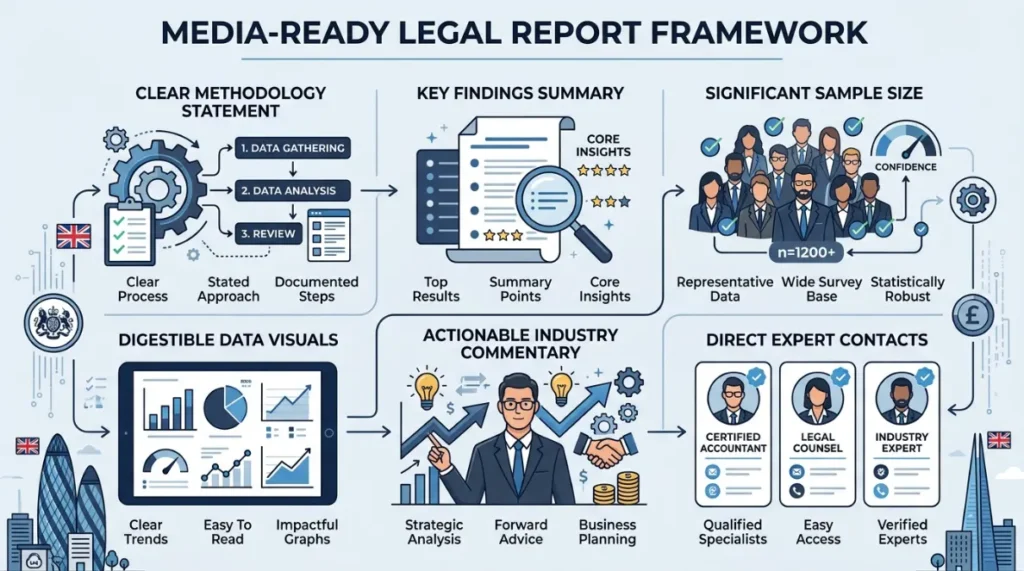
To pass the verification checks of UK trade editors, a research report must include specific structural elements that validate its credibility.
Rigorous Methodology and Sample Sizing
UK journalists reject reports with vague sourcing. The methodology section must clearly state:
- Sample Size ($n$): For UK B2B legal surveys, a sample size of 100 to 500 qualified respondents (such as General Counsel, Managing Partners, or FTSE 100 Executives) is standard.
- Demographics: The exact roles, geographic distribution within the UK, and revenue sizes of participating organizations.
- Collection Period: The exact timeframe during which data was collected.
Quoted Expertise and Data Visualizations
Journalists require context for numbers. Including direct quotes from senior legal partners translates raw data into professional insight. Furthermore, providing clean, high-resolution visual charts enables digital publications to embed assets directly into their online articles, increasing total coverage volume.
Explore More Expert Insights:
How Investment Firms Build Awareness Using Market Insight Ads
How Finance Brands Improve Conversion Intent Using Retargeting Ads
Why Do UK Professional Media Outlets Publish Third-Party Legal Reports?
UK professional media outlets publish third-party legal reports because these reports provide cost-effective, high-authority industry data, offer proprietary market insights, fulfill audience demand for benchmark metrics, and supply content that independent editorial teams lack resources to generate independently.
Media business models require a constant stream of high-value news, yet newsrooms frequently lack the budget or capacity to execute large-scale industry research independently. Third-party reports fill this analytical gap.
Fulfilling the Need for Sector Benchmarking
Professional readers subscribe to legal and business trade press to benchmark their own operations against market standards. Reports covering partner pay, technology adoption, ESG compliance strategies, or litigation trends provide essential commercial intelligence. Outlets rely on expert third parties to supply these insights.
Third-Party Objectivity and Authority
When a law firm commissions independent research using structured sampling techniques, the resulting data acts as an objective industry standard. Media outlets value this neutrality. It allows them to report on broader market conditions without appearing to promote a single firm’s services.
Firms seeking assistance with specialized data packaging and media execution often evaluate expert media partners; analyzing options like [Legal Sector Reports by Time Intelligence Media Group] demonstrates how professional campaign management bridges the gap between raw data generation and publication placement.
What Are the Primary Challenges in Securing Legal Report Coverage?
The primary challenges include overly promotional language, technical jargon, weak survey methodologies, lack of clear news hooks, failure to meet media editorial deadlines, and pitch saturation across major UK trade desks.
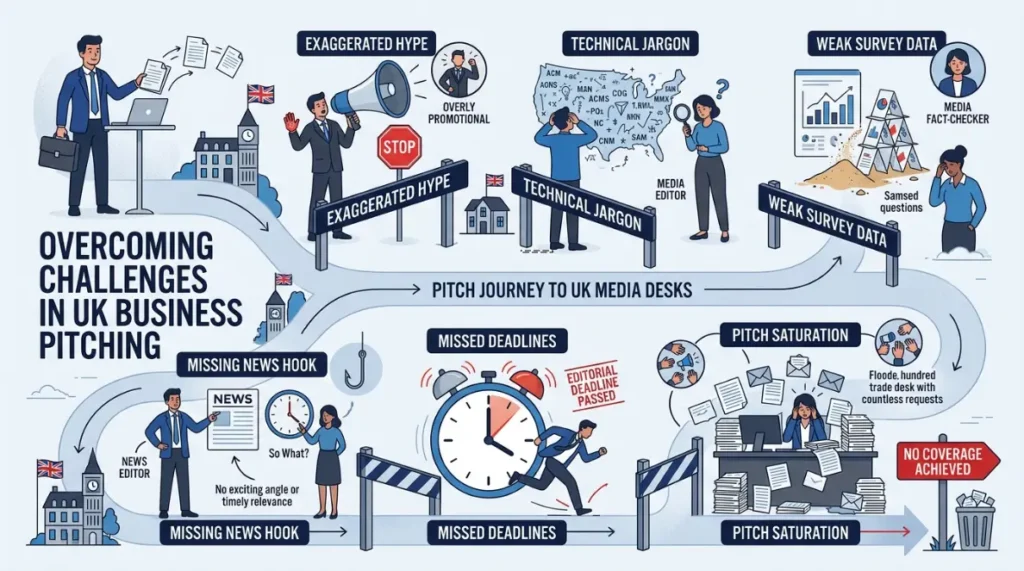
Securing media space is highly competitive. Pitching errors frequently lead to immediate rejection by busy editors.
Eliminating Promotional Bias
The most common point of failure in legal PR is promotional tone. Press releases that focus on the firm’s awards, capabilities, or service excellence rather than the research data are routinely discarded. The narrative must remain entirely focused on the report’s findings and their broader implications for the UK market.
Overcoming Technical Complexity
Legal professionals frequently write in highly dense, academic prose filled with jurisdictional caveats. Journalists require concise, declarative statements. Translating legal complexity into plain, factual language ensures that busy editors grasp the core message within seconds of opening an email pitch.
How Is the Success of a Legal Research Report Campaign Measured?
Campaign success is measured using key quantitative metrics, including total earned editorial placements, domain authority of coverage outlets, referral website traffic, qualitative audience reach, digital engagement, and downstream legal brand search query volume.
Evaluating media impact requires tracking both immediate press coverage and long-term search engine visibility.
Key Performance Metrics for Legal Media Campaigns
- Earned Media Placements: The total count of published articles across trade, national, and regional media outlets.
- Publication Tier and Reach: Categorizing coverage by audience authority, distinguishing between top-tier national titles like The Financial Times and niche trade publications like Solicitors Journal.
- Digital Referral Traffic: Tracking direct user visits originating from back-links embedded within online news articles.
- Brand Search Lift: Measuring increases in direct organic search volume for the firm’s brand name and key partners following the media release.
By tracking these indicators, legal marketing teams can continuously refine report topics, survey design, and media targeting strategies to maximize ROI on future research investments.
How Legal Reports Build Long-Term Digital Authority
Publishing research reports in UK professional media delivers immediate visibility and creates lasting digital assets. When reputable media sites cite and link to legal research, search engines recognize the publishing firm as a primary authority in that legal domain.
This authority improves organic search engine rankings for competitive legal keywords, ensures inclusion in AI-driven search summaries, and establishes firm partners as go-to experts for future media comment.
By systematically transforming legal expertise into structured research reports, pitching beat-specific journalists, and adhering to strict media editorial standards, UK law firms consistently turn complex legal insights into high-value professional media coverage.