
A B2B research report is a data-driven publication that analyses industry trends, benchmark metrics, or proprietary survey findings. UK organisations use these reports to establish authority, educate corporate buyers, and capture contact information from high-intent business decision-makers.
Primary Characteristics of Business Research Publications
A B2B research report relies on primary data collected through surveys, platform telemetry, or industry interviews. Unlike blog posts or opinion pieces, a research report provides verifiable evidence regarding specific business challenges.
In the United Kingdom, corporate procurement teams evaluate vendors using objective performance metrics. A research report satisfies this requirement by providing empirical proof of industry shifts. The core components include:
- Primary survey data from verified industry professionals
- Statistical analysis of operational trends
- Benchmarks for performance comparison
- Actionable interpretations for decision-makers
Role in the Early Stage Evaluation Process
During the initial research phase, business buyers seek solution-neutral information. They require quantitative data to justify strategic shifts or budget allocations to executive boards.
Research reports function as foundational reference material during this stage. By delivering clear industry benchmarks, the publisher earns trust before initiating sales conversations. Business buyers share these reports internally, which expands the reach of the content across cross-functional buying committees without extra distribution effort.
Why do B2B research reports generate higher quality leads than standard ebooks?
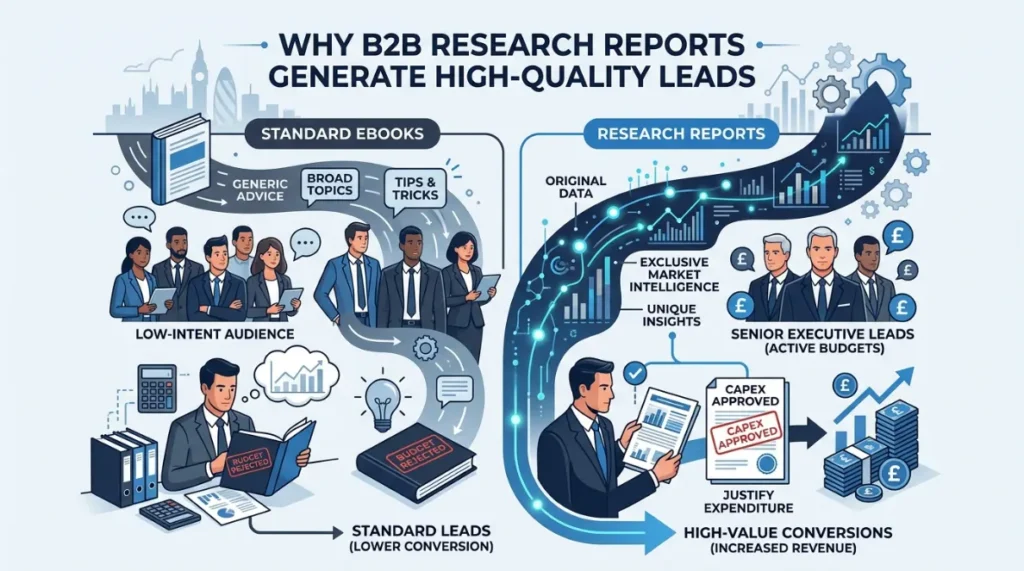
B2B research reports generate higher quality leads because decision-makers require original data to justify capital expenditure. Standard ebooks offer generic advice, whereas research reports deliver exclusive market intelligence that attracts senior executives with active purchasing budgets.
Educational Value and Authority Building
Senior executives in the UK rarely download promotional ebooks or broad introductory guides. They seek proprietary data that is unavailable through public search queries. Original research provides immediate value by revealing how peer organisations solve operational bottlenecks.
When a publication delivers exclusive statistics, the perceived value of the content increases. Decision-makers willingly exchange their verified contact details, job titles, and company sizes for access to proprietary data.
Filtering Out Unqualified Audience Traffic
Standard marketing content often attracts students, entry-level staff, or general researchers. Research reports filter for intent by focusing on strategic, high-level business challenges.
A report examining specific supply chain metrics or software adoption rates naturally limits its audience to professionals managing those systems. The resulting leads represent target accounts with explicit operational needs rather than casual readers. Understanding how these assets capture demand is crucial when planning to convert leads through structured content nurture workflows.
How do UK companies capture qualified leads using original research?
UK companies capture qualified leads by placing original research reports behind targeted landing pages, enforcing strict form fields, distributing through professional channels, and using gated executive summaries to convert senior decision-makers actively seeking market data.
Strategic Content Gating Mechanisms
Capturing qualified leads requires a clear value exchange on the landing page. UK organisations maximize conversion rates by revealing key findings in an ungated executive summary while requiring business details to download the full report.
Form fields must request specific qualifying attributes to separate general traffic from target accounts:
Targeted UK Distribution Channels
Publishing a research report is insufficient without precise distribution across relevant UK business networks. High-performing distribution strategies combine direct professional outreach, targeted industry newsletters, and programmatic promotions.
- Professional Social Networks: LinkedIn campaigns targeted by UK region, job title, and company size drive high-intent traffic to the landing page.
- Industry Trade Publications: Partnering with established UK trade media outlets ensures placement in front of existing vertical audiences.
- Direct Executive Outreach: Account-based marketing teams share tailored report extracts directly with target accounts to open sales dialogues.
- Explore More Expert Insights:
- How Online Retailers Recover Abandoned Carts Using Banner Advertising
- How E-commerce Stores Boost Sales Using Retargeting Banner Ads
What core components make a research report commercially effective?
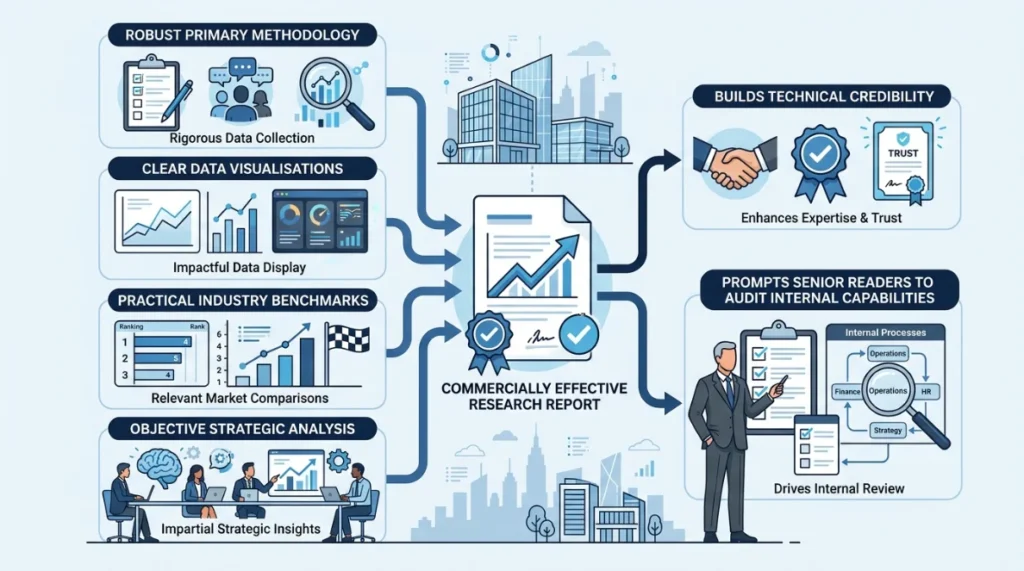
A commercially effective research report requires robust primary methodology, clear data visualisations, practical industry benchmarks, and objective strategic analysis. These components build technical credibility and prompt senior readers to audit their internal capabilities.
Rigorous Research Methodology
The credibility of a research report depends entirely on its sample size and respondent demographics. A survey of 10 UK business owners lacks statistical weight, whereas a survey of 300 UK Chief Technology Officers offers actionable industry standards.
Reports must transparently detail the sample size, survey timeframe, industry distribution, and respondent roles within the methodology section. Transparent methodology prevents skepticism from analytical readers and establishes the publisher as a reliable source of market intelligence.
Data Visualisation and Benchmark Structures
Dense text reduces reader engagement. Effective research reports translate complex statistical tables into structured visual graphics and clear benchmarks.
Visual clarity ensures that busy UK executives quickly grasp the commercial implications of the data, increasing the likelihood that they share the report with internal stakeholders.
What are the primary business benefits of publishing primary research?
The primary business benefits of publishing primary research include increased brand trust, higher lead conversion rates, accelerated sales cycles, organic media mentions, and strong inbound link profiles from authoritative UK business domains.
Inbound Link Acquisition and Search Engine Visibility
Authoritative websites, news outlets, and industry publications regularly cite primary research. When third-party websites reference data points from a research report, they link back to the original source URL.
This process builds high-authority inbound links organically. Search engines recognise these links as signals of domain authority, improving organic search visibility across the entire website domain.
Shortening the Sales Cycle
Sales teams use primary research assets throughout prospect conversations. Providing a prospect with objective data regarding industry benchmarks addresses buyer hesitation faster than standard sales messaging.
- Demonstrates immediate understanding of the prospect’s operating environment
- Validates the existence of specific industry challenges using empirical evidence
- Positions the seller as a consultative advisor rather than a product vendor
How do different industries use research reports for lead generation?
Different industries use research reports by tailoring survey topics to specific operational risks, regulatory shifts, or technology adoptions relevant to their vertical, forcing target buyers to review their current operational performance.
Financial Services and FinTech
Financial institutions in the UK use research reports to address regulatory changes, fraud trends, and digital transformation benchmarks.
A research report analyzing UK banking compliance costs attracts Chief Risk Officers seeking to control expenditure. The data forces the reader to evaluate their internal compliance efficiency against peer institutions.
Enterprise Technology and Software
Enterprise software vendors publish state-of-the-industry reports focusing on automation rates, cybersecurity vulnerabilities, or cloud infrastructure costs.
A report detailing cloud security incidents across 500 UK enterprises attracts Chief Information Security Officers. The findings highlight operational risks that prompt IT leaders to review their existing infrastructure protocols. Organizations evaluating delivery options can review cost comparisons when deciding between internal production and specialized media partners.
Professional Services and Consulting
Consulting firms rely on research reports to showcase domain expertise and analytical capability.
A management consultancy publishing a study on UK manufacturing supply chain resilience attracts Operations Directors. The report establishes the firm’s strategic capabilities without relying on explicit promotional pitches.
Summary of B2B Research Report Lead Generation Mechanics
B2B research reports generate qualified leads by delivering original, methodology-backed data that senior UK decision-makers require for strategic planning. By offering proprietary market intelligence, organizations attract high-intent buyers, filter out unqualified traffic, build durable domain authority, and create reusable sales enablement assets that accelerate corporate acquisition cycles.