Event promotion in the United Kingdom uses two distinct coverage models: earned media and paid media. Earned coverage comes from independent editorial decisions. Paid coverage comes from purchased advertising or sponsored placements. Both models deliver visibility, but they produce different forms of value, measurement, credibility, and audience engagement.
For event organisers, marketers, communications teams, and PR professionals, the key decision is not simply whether coverage is valuable. The decision is which coverage model delivers the strongest return on investment for a defined event objective.
Earned event coverage focuses on editorial recognition. Paid event coverage focuses on guaranteed placement. Understanding this distinction creates a stronger basis for allocating event marketing budgets.
What is the difference between earned and paid event coverage?
Earned event coverage is editorial exposure secured because journalists or publications select an event as relevant news, while paid coverage is purchased promotional space with controlled messaging, placement, timing, audience targeting, and campaign duration.
Earned media includes news articles, editorial mentions, event previews, interviews, reviews, features, and post-event reports published by independent media organisations. The event organiser does not purchase the editorial space.
Paid media includes display advertising, sponsored articles, promoted event listings, advertorials, social advertising, and other placements where the organisation pays for distribution or exposure.
The distinction affects control. Paid placements provide greater control over the message, creative format, publication timing, and campaign duration. Earned coverage provides less control because editorial teams determine whether the story meets their publication standards.
The distinction also affects audience interpretation. Editorial coverage appears within a publication’s normal news environment. Paid content is identified as advertising, sponsorship, or promotional content according to the publication’s commercial disclosure practices.
Businesses therefore evaluate the two models against different objectives rather than treating them as interchangeable forms of event promotion.
What does earned media mean for an event?
Earned media refers to unpaid editorial attention generated by an event’s news value. Examples include a London technology conference receiving coverage in a business publication, a healthcare summit appearing in trade media, or a charity event being reported by regional news outlets.
What does paid media mean for an event?
Paid media refers to promotional exposure purchased from a media owner or advertising platform. Examples include a sponsored event article, a paid newspaper advertisement, a LinkedIn campaign promoting conference registration, or a display advertising campaign targeting professionals in a defined sector.
How is ROI measured for earned and paid event coverage?
ROI measurement compares event-related investment with measurable outcomes such as qualified traffic, registrations, leads, media reach, referral visits, conversions, brand visibility, and attributed revenue across earned and paid coverage channels.
Return on investment requires a defined measurement framework. Media reach alone does not establish financial return.
For earned coverage, measurement starts with identifying where coverage appeared and what audience it reached. Tracking then connects media exposure to website traffic, branded searches, registrations, enquiries, backlinks, social engagement, and other defined outcomes.
For paid coverage, measurement typically uses campaign metrics such as impressions, clicks, click-through rate, cost per click, conversions, cost per acquisition, and revenue attributed to advertising.
A useful comparison separates media performance from business performance.
Media performance answers questions such as:
- How many publications covered the event?
- How many impressions did paid advertising generate?
- How much referral traffic reached the event website?
- How many backlinks resulted from editorial coverage?
- How many registrations came from tracked campaigns?
Business performance answers different questions:
- How many registrations resulted?
- How many qualified leads entered the pipeline?
- What revenue was attributed to the event?
- What was the acquisition cost?
- How much post-event engagement continued?
This approach prevents a high impression count from being treated as equivalent to commercial ROI.
What costs need to be included?
Earned coverage includes costs associated with PR planning, media relations, content creation, spokesperson preparation, press materials, distribution, photography, and campaign management.
Paid coverage includes advertising spend plus creative production, campaign management, landing-page development, tracking, and optimisation costs.
The total investment provides the denominator for ROI calculations.
Why does earned event coverage often produce different value from paid advertising?
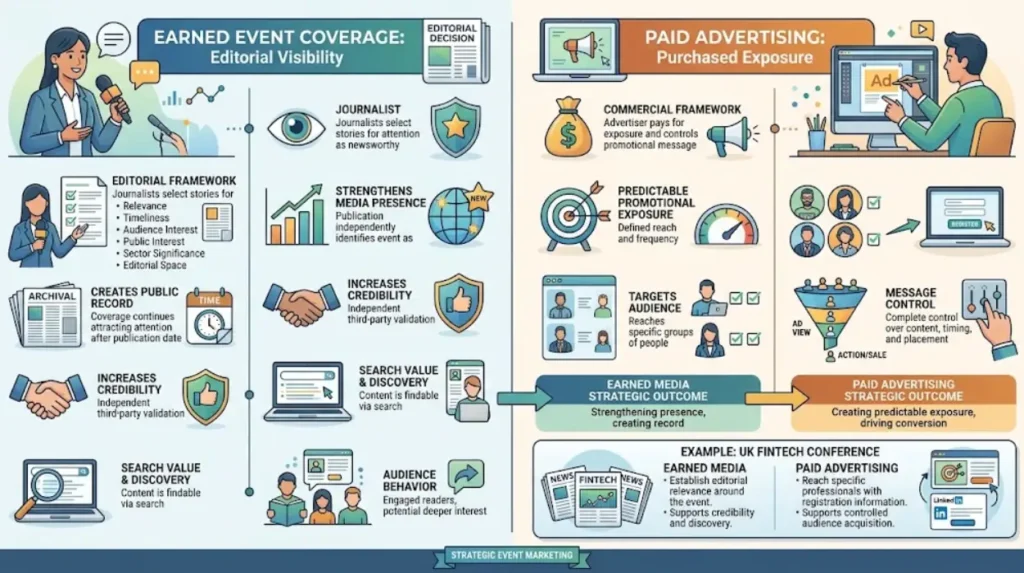
Earned coverage produces editorial visibility through independent publication decisions, while paid advertising provides purchased exposure; the difference influences credibility, message control, search value, audience behaviour, and the type of evidence marketers use to evaluate performance.
Earned coverage operates within an editorial framework. Journalists select stories based on relevance, timeliness, audience interest, public interest, sector significance, and available editorial space.
Paid advertising operates within a commercial framework. The advertiser pays for defined exposure and controls the promotional message within the publisher’s advertising requirements.
This creates different strategic outcomes.
Earned coverage can strengthen an organisation’s media presence because the publication independently identifies the event as newsworthy. Coverage also creates a public record that can continue attracting attention after the original publication date.
Paid advertising creates predictable promotional exposure. A campaign can target a defined audience, direct users towards a registration page, and support conversion-focused messaging.
The two models therefore serve different stages of an event marketing programme.
For example, a UK fintech conference can use earned media to establish editorial relevance around the event and paid advertising to reach specific professionals with registration information. The earned campaign supports credibility and discovery. The paid campaign supports controlled audience acquisition.
For a broader explanation of why editorial exposure can outperform advertising in specific event contexts, see:
What are the main benefits of earned event coverage?
Earned coverage provides editorial credibility, third-party validation, discoverability, media relationships, potential referral traffic, and durable online references.
A single article can also create multiple downstream assets. A media mention can support social content, sales materials, investor communications, event reports, and post-event communications.
Coverage from relevant publications also creates contextual associations between the event, its subject matter, and the organisation hosting it.
What are the main benefits of paid event coverage?
Paid coverage provides message control, predictable placement, defined targeting, campaign scheduling, measurable delivery, and repeat exposure.
A paid campaign is useful when an organiser needs a specific call to action. Examples include “register for the conference”, “download the agenda”, or “book a place”.
When does paid event coverage deliver stronger ROI?
Paid event coverage delivers stronger ROI when the primary objective requires controlled reach, measurable acquisition, precise audience targeting, rapid promotion, or repeated exposure, particularly when registration activity and conversion costs provide reliable performance data.
Paid coverage is particularly relevant during registration campaigns.
An organiser promoting a three-day business conference in Manchester can target professionals by location, industry, job function, interests, or previous website interaction. The campaign can direct users to a dedicated registration page.
The organisation can then calculate cost per registration.
For example, if £5,000 in paid promotion produces 250 registrations, the direct media acquisition cost is £20 per registration. Further analysis evaluates registration quality, attendance rate, ticket value, and revenue.
Paid media also provides greater control over campaign timing. An organiser can increase promotional activity four weeks before an event, intensify activity during the final seven days, and stop the campaign after registration closes.
This makes paid coverage particularly suitable for conversion-focused objectives.
Paid media also works well when the event has a narrow target audience. A specialist engineering conference requires access to a defined professional segment rather than maximum general awareness.
When does earned event coverage deliver stronger ROI?
Earned event coverage delivers stronger ROI when an event needs editorial credibility, third-party recognition, long-term discoverability, media authority, referral traffic, or broader public awareness beyond the immediate advertising campaign.
Earned coverage becomes valuable when the event itself contains a legitimate news angle.
Examples include a major industry announcement, a new research finding presented at a conference, a high-profile speaker attending an event, a significant business partnership, or an event addressing a major UK industry development.
The editorial story extends beyond a direct sales message.
This distinction affects longevity. Paid advertising generally stops delivering impressions when the campaign ends. Editorial coverage remains accessible on the publisher’s website after publication.
Earned coverage also supports search visibility when publications provide relevant links and when the content becomes discoverable through search engines and AI-driven information systems.
The value therefore extends beyond immediate event registrations.
A London sustainability conference, for example, can generate coverage around new environmental research, speaker announcements, or sector commitments. The resulting articles can continue attracting readers interested in those subjects after the conference has finished.
How should marketers compare earned and paid event coverage?
Marketers should compare earned and paid coverage against the same business objectives, then assess investment, reach, engagement, conversions, credibility, longevity, targeting, and attributable revenue rather than comparing headline impression figures alone.
A structured comparison creates clearer decisions.
| Measurement factor | Earned coverage | Paid coverage |
|---|---|---|
| Editorial credibility | High | Commercially identified |
| Message control | Limited | High |
| Audience targeting | Publication-dependent | Highly controllable |
| Placement control | Limited | Defined by purchase |
| Conversion tracking | Requires attribution systems | Usually direct |
| Campaign duration | Publication-dependent | Budget-dependent |
| Registration objective | Indirect or direct | Direct |
| Long-term visibility | Often persistent | Ends with campaign |
| Cost structure | PR and production costs | Media spend plus production |
| SEO contribution | Relevant editorial links and mentions | Depends on advertising format |
| Third-party validation | Stronger | Limited |
| Scalability | Depends on editorial interest | Budget-dependent |
This comparison shows why one model does not replace the other.
A campaign focused entirely on registrations requires strong conversion measurement. A campaign focused on reputation and market visibility requires media quality and editorial relevance.
The correct ROI framework therefore starts with the event objective.
Which metrics matter most?
For earned coverage, relevant metrics include publication quality, number of placements, estimated audience, referral traffic, backlinks, branded search activity, engagement, registrations, and attributed conversions.
For paid coverage, relevant metrics include impressions, reach, clicks, click-through rate, cost per click, conversion rate, cost per registration, customer acquisition cost, and attributed revenue.
The metrics become meaningful when connected to a defined commercial outcome.
Can earned and paid event coverage work together?
Earned and paid event coverage work together when each channel has a defined role: earned media establishes editorial visibility and third-party recognition, while paid media provides controlled reach, targeted promotion, measurable acquisition, and consistent registration messaging.
A combined campaign begins with audience and objective definition.
Earned media can introduce the event through newsworthy announcements, speaker stories, industry developments, and editorial features. Paid media can then reinforce the event with registration messages, agenda details, audience targeting, and deadline-based campaigns.
This creates a multi-channel event promotion structure.
For example, a Birmingham healthcare conference can secure trade-media coverage around its speakers and industry agenda. Paid advertising can target healthcare professionals with registration information. Website analytics can then measure referral traffic from editorial articles and conversions from paid campaigns.
The campaign evaluation separates the two acquisition paths.
This prevents paid conversions from being incorrectly attributed to earned media and prevents earned media value from being reduced to direct-click performance alone.
The approach also supports more efficient budget allocation. Channels that generate registrations receive conversion-focused evaluation. Channels that generate visibility and authority receive media-performance evaluation.
How should organisations choose between earned and paid event coverage?
Organisations should choose based on the event objective, audience, timeline, budget, news value, required message control, measurement requirements, and desired longevity, using earned, paid, or combined coverage according to those defined conditions.
The first question is the objective.
If the objective is editorial credibility, prioritise earned media.
If the objective is targeted registration acquisition, prioritise paid promotion.
If the objective is broad awareness, combine relevant earned and paid channels.
If the objective is long-term visibility, evaluate earned coverage for its continuing publication and discovery value.
If the objective is rapid audience acquisition, paid promotion provides stronger control over timing and targeting.
The second question is newsworthiness. Events with strong editorial angles have greater potential for earned coverage.
The third question is measurement. Paid campaigns generally provide more direct conversion tracking, while earned campaigns require structured attribution using referral data, campaign URLs, analytics, registration forms, and post-event surveys.
The fourth question is distribution scale. Event organisers evaluating multi-publication coverage can compare distribution models based on publication count, audience relevance, geographic reach, industry relevance, reporting, and attribution.
For organisations evaluating specific multi-site event distribution options,
15-site event coverage provides a relevant next-stage comparison.
What is the best ROI approach for UK event marketers?
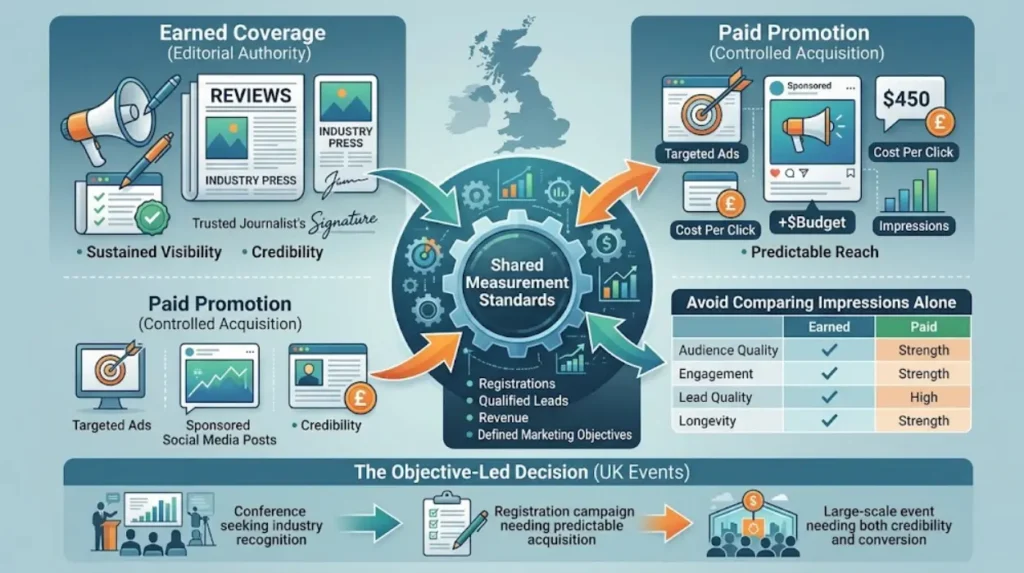
The strongest ROI approach uses earned coverage for editorial authority and sustained visibility, paid promotion for controlled acquisition, and shared measurement standards that connect both channels to registrations, qualified leads, revenue, and defined event marketing objectives.
Earned and paid event coverage are different media assets.
Earned coverage is built through editorial relevance and independent publication. Paid coverage is purchased for controlled promotional exposure. Each produces different performance signals.
ROI becomes clearer when marketers avoid comparing impressions alone. The evaluation needs investment, audience quality, traffic, engagement, registrations, lead quality, revenue, longevity, and attribution.
For UK events, the practical decision is therefore objective-led.
Explore More Expert Insights:
How Event Coverage Builds 15 Quality Backlinks for Brands
How Webinar Coverage Turns Sessions Into UK News Articles
A conference seeking industry recognition needs editorial visibility. A registration campaign requiring predictable acquisition needs paid reach. A large-scale event requiring both credibility and conversion needs a coordinated model.
The most effective evaluation framework measures each channel according to the business outcome it is designed to produce. This turns earned versus paid event coverage from a media-format comparison into a measurable event marketing decision.