

Webinar coverage is the process of converting useful webinar content into news-focused articles for UK media audiences. It identifies reportable insights, extracts evidence, structures a news angle, and distributes the resulting article through relevant publication channels for wider visibility.
A webinar is a live or recorded online session designed to share information with an audience. Businesses, organisations, researchers, founders, and industry specialists use webinars to discuss market developments, research findings, product developments, policy changes, and professional issues.
Webinar coverage transforms this event content into a media asset. The resulting article is not simply a transcript. It presents the webinar’s strongest information in a format suitable for news readers.
The process connects webinar content, news angles, editorial structure, and UK media distribution.
This makes webinar coverage different from publishing a recording on a website or uploading presentation slides. A recording serves attendees. A news article serves readers searching for information about a specific development, finding, announcement, or industry issue.
For organisations exploring the wider media process,
Webinar coverage provides additional context on how webinar sessions gain exposure across UK news publications.
How is a webinar converted into a UK news article?
A webinar becomes a UK news article through content extraction, news-angle selection, factual verification, editorial restructuring, headline development, and publication preparation. Each stage removes presentation-focused material while retaining information that has clear relevance to news audiences.
1. Extract the strongest information
A typical webinar contains introductions, speaker biographies, audience questions, promotional statements, technical explanations, examples, and conclusions.
Not every section has equal news value.
The first stage identifies information such as:
- New research findings
- Industry statistics
- Business announcements
- Policy developments
- Market trends
- Expert statements
- New product or service developments
- Survey results
- Regulatory changes
- Customer or sector insights
For example, a 60-minute fintech webinar discussing digital payments can produce a news article centred on a specific payment trend, a new statistic, or an expert assessment of regulatory changes.
2. Select a news angle
A news angle is the specific development or insight that gives an article editorial relevance.
A webinar can contain several possible angles. The strongest angle normally provides a clear answer to what changed, what was discovered, who is affected, or why the information matters.
3. Restructure the material
The article then moves from webinar presentation structure to news structure.
A webinar often follows:
Introduction → speaker presentation → discussion → questions → conclusion
A news article generally follows:
Headline → key development → supporting evidence → expert context → relevant details
This restructuring makes the content easier for UK news audiences to scan and understand.
What information from a webinar has the strongest news value?
The strongest webinar material contains specific facts, measurable findings, timely announcements, expert commentary, or developments affecting a defined audience. These elements create identifiable news angles and provide evidence that supports a concise, informative UK news article.
Statistics and research findings
Numbers provide strong factual anchors.
For example, a webinar presenting survey results on UK consumer behaviour can produce an article focused on a specific percentage, change, or emerging pattern.
Specific figures also improve article clarity. “Consumer demand increased” is less precise than “62% of surveyed consumers reported increased demand.”
Expert commentary
Webinars frequently feature specialists with relevant professional knowledge.
A speaker’s commentary becomes more useful when it explains a specific development. General statements about an industry provide weaker editorial material than commentary connected to a measurable event or current issue.
Announcements
A webinar can introduce:
- A new report
- A company initiative
- A partnership
- A product development
- A research project
- A sector programme
- A policy response
Announcements provide a defined event around which an article can be structured.
Audience questions
Questions from webinar attendees can reveal practical concerns.
For example, repeated questions about new UK compliance requirements demonstrate a specific information need. A resulting article can address that issue while using expert responses from the session.
How does the editorial process shape webinar news coverage?
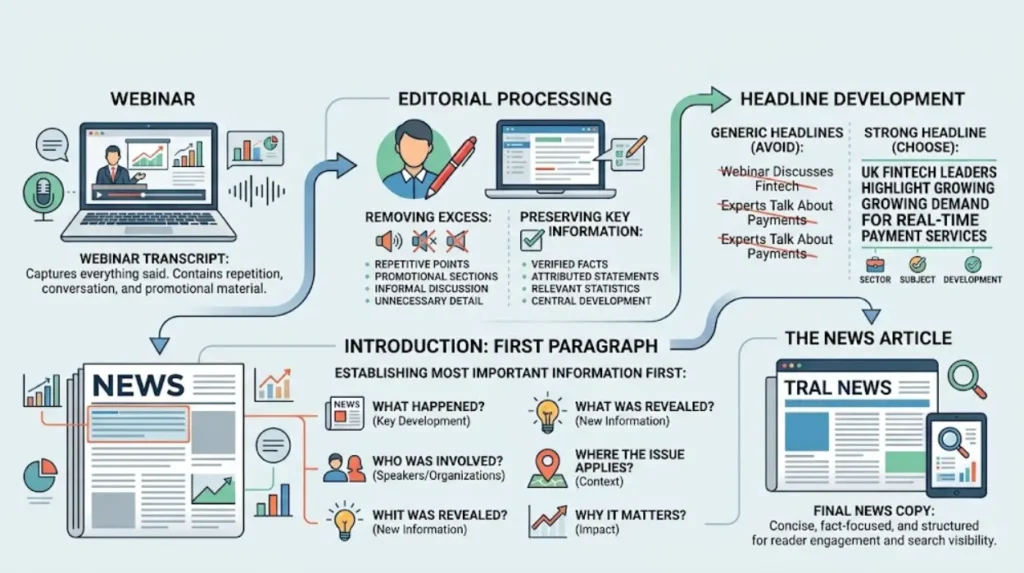
Editorial processing converts presentation language into concise news language. It removes repetition, promotional sections, informal discussion, and unnecessary detail while preserving verified facts, attributed statements, relevant statistics, and the central development identified from the webinar.
From transcript to news copy
A transcript captures everything said during a webinar. A news article requires selection.
The transcript can contain repeated points, incomplete sentences, conversational language, and audience interaction. Editorial processing removes these elements.
The final article retains information that supports the central news angle.
Headline development
The headline identifies the main development.
A strong headline uses specific information rather than generic terms such as “webinar discusses” or “experts talk about”.
For example:
UK Fintech Leaders Highlight Growing Demand for Real-Time Payment Services
This headline identifies the sector, subject, and development.
Introduction
The opening paragraph establishes the most important information first.
A news introduction can identify:
- What happened
- Who was involved
- What was revealed
- Where the issue applies
- Why the development matters
This structure supports search visibility and AI retrieval because the article’s primary subject is clearly defined near the beginning.
What makes webinar articles suitable for UK news audiences?
UK webinar articles require clear local relevance, accurate terminology, specific evidence, and an editorial structure suited to British readers. Relevant references include UK markets, regulations, institutions, consumer behaviour, regional developments, business conditions, and sector-specific issues affecting audiences.
UK-specific context
A webinar discussing international developments needs UK relevance when targeting UK publications.
For example, a global cybersecurity discussion can focus on UK organisations, British regulatory requirements, or the implications for UK businesses.
Local context creates a clearer relationship between the source material and the target readership.
British English
UK news content uses British spelling and terminology.
Examples include:
- Organisation rather than organization
- Programme rather than program
- Behaviour rather than behavior
- Labour rather than labor
- Centre rather than center
Consistent language supports editorial relevance for UK audiences.
Sector relevance
The target publication also influences the article’s framing.
A fintech webinar can support coverage for business or financial publications. A construction webinar can support property or construction media. A healthcare webinar can support healthcare trade publications.
The underlying session remains the same. The editorial angle changes according to audience and publication context.
Which webinar components need to be prepared before publication?
Effective webinar coverage requires a complete source package containing the session details, speaker information, key statements, statistics, supporting documents, images, publication preferences, and relevant company or organisation information needed for accurate article preparation and media distribution.
Webinar title and date
The original webinar title establishes the subject.
The date establishes publication context and helps distinguish current developments from older discussions.
Speaker details
Each speaker needs accurate identification.
Useful information includes:
- Full name
- Job title
- Organisation
- Relevant expertise
- Quoted statements
Accurate attribution strengthens editorial credibility.
Supporting evidence
Statistics and factual claims require clear sources.
For example, a webinar discussing UK housing demand can reference the underlying survey, report, government data, or research publication used during the session.
Media assets
Relevant photographs, presentation graphics, logos, and charts can support article publication where publication policies permit their use.
Visual assets also help distinguish an article from generic written coverage.
How does webinar coverage improve content distribution?
Webinar coverage extends the value of one live session beyond its original audience by converting discussion into searchable editorial content. The resulting articles provide additional discovery points across relevant UK publications, search results, company channels, and professional audiences.
A webinar normally reaches people who attend the session or watch its recording.
A published article creates additional content around the same subject.
This creates multiple content assets from one source:
- The original webinar
- The recording
- The transcript
- The news article
- Supporting social content
- Website content
- Search-oriented summaries
The news article serves a different purpose from the original event.
It captures the information in a concise format and places the subject within a media environment.
Search visibility
News articles can create additional indexed pages around specific subjects.
Clear headings, factual statements, descriptive titles, named entities, statistics, and concise explanations make the content easier for search systems to interpret.
The same characteristics also support AI search systems that retrieve and summarise factual information from published sources.
What are the main benefits of turning webinars into news articles?
Turning webinars into news articles increases the usable value of webinar content, creates additional media assets, supports brand visibility, communicates expertise through editorial formats, and gives organisations structured content that reaches audiences beyond the original webinar registration base.
Greater content efficiency
One webinar can contain several reportable developments.
Editorial extraction identifies the strongest material without requiring another event.
This reduces the distance between event production and media content creation.
Extended audience reach
Webinar registrants represent only one audience segment.
Published articles can reach journalists, professionals, researchers, customers, prospects, and people discovering the topic through search.
Stronger authority signals
Articles containing attributed expert commentary and specific evidence establish clear subject expertise.
The value comes from the information itself. Promotional claims do not replace factual evidence.
Reusable editorial content
A published article can support additional communication across websites, newsletters, social platforms, investor communications, and internal marketing channels where appropriate.
When is webinar coverage most useful?
Webinar coverage is most useful when a session contains timely information, original research, expert commentary, measurable findings, significant announcements, or sector developments. These characteristics provide material that editors and readers can understand as a defined news story.
Product and business webinars
A product-focused webinar can generate coverage when it contains a substantive announcement or market development.
Research webinars
Research sessions provide statistics, findings, and expert interpretation that can support evidence-led articles.
Policy webinars
Sessions addressing legislation, regulation, or government policy can produce articles focused on specific implications for affected sectors.
Industry webinars
Trade-focused sessions can provide coverage around market trends, operational challenges, technology adoption, and professional developments.
Educational webinars
Training and educational events become stronger news sources when they reveal new research, changing professional requirements, sector statistics, or expert findings.
How can organisations evaluate webinar coverage options?
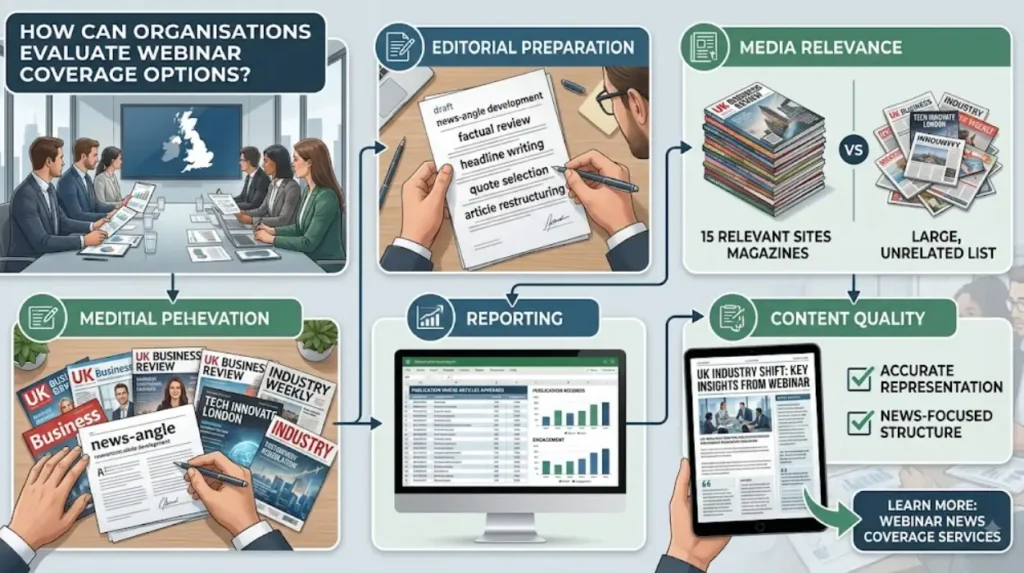
Organisations evaluating webinar coverage options can compare editorial preparation, publication reach, target media categories, article development, distribution processes, reporting, and turnaround requirements. These criteria establish whether a coverage approach matches the webinar’s content and intended UK audience.
Editorial preparation
Check whether the process includes news-angle development, factual review, headline writing, quote selection, and article restructuring.
Media relevance
Assess whether distribution targets relevant UK publications rather than relying only on publication volume.
Fifteen relevant sites can provide a more useful media footprint than a larger list containing unrelated publications.
Reporting
Coverage reporting identifies where articles appeared and provides publication records for future evaluation.
Content quality
The final article needs to represent the webinar accurately while maintaining a news-focused structure.
Organisations can therefore evaluate coverage using both publication reach and editorial quality.
For readers moving from evaluation into service selection,
Webinar news coverage services provides a relevant next step.
How does webinar coverage fit into a broader UK media strategy?
Webinar coverage fits into a broader UK media strategy by connecting event content with news distribution, search visibility, thought leadership, and ongoing communications. It turns scheduled discussions into structured editorial assets while supporting consistent coverage around defined business and industry topics.
The process begins with the webinar itself.
Its speakers provide expertise. Its discussion provides context. Its statistics provide evidence. Its announcements provide news angles.
Editorial processing then converts these elements into a focused article.
Distribution places that article before relevant UK audiences.
This creates a clear content pathway:
Webinar → News Angle → Editorial Article → UK Media Distribution → Searchable Coverage
The value of this process depends on the quality of the source material, the clarity of the news angle, the accuracy of the article, and the relevance of the selected publications.
Explore More Expert Insights:
What News Coverage Looks Like for Hybrid UK Events
How Virtual Events Get Real UK News Coverage
Webinar coverage therefore functions as a structured method for extending event content into the UK news environment. It separates presentation content from editorial content while preserving the facts, expertise, and developments that make the original session relevant.



