
Real estate sponsored content reaches UK buyers by placing useful property information within relevant digital publications, search environments, and audience channels. Effective campaigns combine editorial relevance, defined buyer segments, credible messaging, distribution, and measurable engagement signals.
Real estate brands use sponsored content to communicate developments, investment opportunities, market insights, regeneration projects, and property services to defined UK audiences. The format sits between advertising and editorial publishing. It provides controlled brand messaging while using the structure and context of established media environments.
For readers starting with the wider role of sponsored publishing:
Why Real Estate Brands Publish Sponsored Content in 2026 provides useful context on why property brands use this format in 2026. The next consideration is distribution: reaching the right buyer requires more than publishing an article on one website.
The UK property market contains multiple buyer groups. Residential buyers, landlords, commercial investors, developers, tenants, agents, and institutional investors use different information sources. Sponsored content performs best when its subject, publication environment, and distribution strategy match the intended audience.
What is real estate sponsored content?
Real estate sponsored content is paid media content created for a property brand and published through a media platform with clear commercial disclosure. It combines controlled messaging with informative content designed for a defined property audience.
Sponsored content differs from conventional display advertising. A banner delivers a short promotional message. Sponsored content uses an article, market analysis, interview, case study, or property feature to communicate more detailed information.
The content remains commercially controlled by the sponsoring organisation. The publishing environment provides the distribution channel. Disclosure identifies the commercial relationship between the advertiser and publisher.
What does sponsored content include?
Common real estate sponsored content formats include:
- Property market analysis
- New development features
- Investment guides
- Developer interviews
- Regeneration project coverage
- Commercial property reports
- Build-to-rent explainers
- Case studies
- Property investment commentary
For example, a UK residential developer can publish an article explaining the location, transport connections, amenities, sustainability features, and buyer profile of a new housing development.
Why does format matter?
Format determines how much information a buyer receives before taking action. A property feature supports detailed explanation. An investment guide answers research questions. An interview introduces leadership expertise. A case study demonstrates an existing project.
Each format supports a different stage of the buyer journey.
How does sponsored content reach the right UK property buyers?
Sponsored content reaches targeted UK property buyers through audience selection, publication placement, topical relevance, geographic targeting, search visibility, and distribution. Each component connects the content with a defined buyer segment and information need.
Audience selection begins with the buyer profile. A campaign targeting first-time buyers uses different subject matter from one targeting commercial property investors.
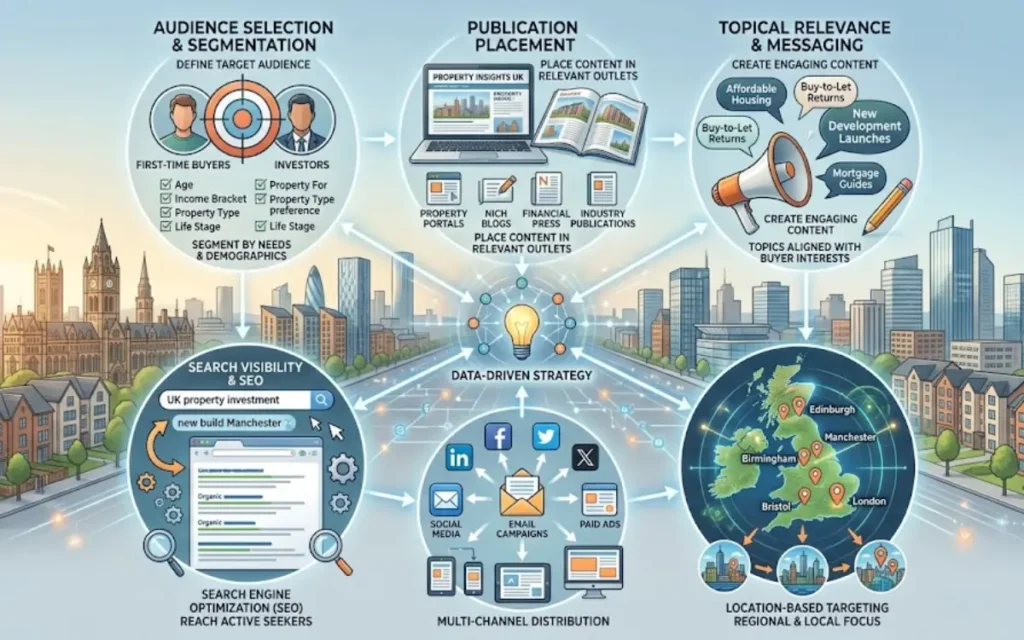
Geographic relevance also matters. UK property demand differs between London, Manchester, Birmingham, Leeds, Edinburgh, Glasgow, Bristol, and other markets. A local development requires stronger regional relevance than a national property investment report.
How does publication selection affect reach?
Publication selection determines the audience encountering the content. Property-focused publications reach readers with established sector interest. Business publications reach broader commercial audiences. Regional publications connect content with geographically relevant readers.
For example, a Manchester development campaign can prioritise publications with strong North West business or property readership. A national investment report can use broader UK business and finance environments.
How does audience intent affect distribution?
Buyer intent describes the information need behind a search or media interaction.
High-intent property audiences actively research:
- Property prices
- Rental yields
- New developments
- Commercial space
- Investment locations
- Mortgage considerations
- Market conditions
Sponsored content aligned with these subjects provides information at a relevant research point.
How does the UK buyer journey influence sponsored content?
The UK property buyer journey moves through awareness, research, comparison, evaluation, and action. Sponsored content supports these stages by answering specific questions, explaining property propositions, establishing expertise, and directing interested audiences toward deeper information.
A buyer rarely makes a property decision after one exposure. Property transactions involve financial, geographic, legal, practical, and lifestyle considerations.
Sponsored content therefore works as an information asset within a wider journey.
What content works during awareness?
Awareness content introduces a market, development, location, or property trend.
Examples include:
- “How Manchester’s Build-to-Rent Market Is Changing”
- “What Regeneration Means for Birmingham Property”
- “Key Factors Driving UK Commercial Property Demand”
These topics introduce relevant concepts without requiring an immediate transaction.
What content works during research?
Research-stage content provides specific information. Buyers compare locations, property types, developers, yields, amenities, transport links, and market conditions.
A property brand can publish a location guide covering average property characteristics, infrastructure, employment centres, and development activity.
What content works during evaluation?
Evaluation content provides evidence. Case studies, project data, expert interviews, development specifications, and detailed comparisons support this stage.
For example, a commercial property company can explain how a completed office development achieved occupancy targets and supported tenant requirements.
Which components make UK real estate sponsored content effective?
Effective real estate sponsored content combines a defined audience, relevant subject, credible information, strong publication placement, transparent sponsorship, search-friendly structure, and measurable distribution. These components work together to improve qualified visibility rather than simply increasing publication volume.
How important is the topic?
Topic relevance determines whether the content addresses a genuine information requirement.
A generic article about “the property market” lacks a precise audience. A guide about “commercial property investment in Manchester” defines the subject, location, and likely reader.
Specificity strengthens semantic relevance.
What role does evidence play?
Evidence increases informational value. Useful evidence includes market statistics, development specifications, project information, expert commentary, planning information, location details, and clearly attributed research.
Real estate content requires factual accuracy because property decisions involve significant financial commitments.
Why does structure matter?
Structured content helps readers locate information quickly. Clear headings, concise paragraphs, defined terminology, statistics, examples, and descriptive subheadings improve comprehension.
Search engines also use structured language to identify entities and topics. A well-organised article clearly identifies locations, property types, developers, investment concepts, and market conditions.
How does SEO support real estate sponsored content?
SEO supports sponsored content by connecting property articles with relevant search queries, entities, locations, and buyer questions. Search-focused structure increases discoverability when content directly addresses specific information needs and uses clear property terminology.
SEO for sponsored content starts with search intent rather than keyword repetition.
A property article targeting UK investors can incorporate related concepts such as rental yield, capital growth, commercial property, residential investment, property development, location analysis, and market trends.
Which semantic entities matter?
Relevant entities depend on the subject. A London property article can reference London boroughs, transport networks, property types, developers, investment concepts, and relevant market terminology.
A commercial property article can include office space, industrial property, retail units, leasing, occupancy, rental income, tenant demand, and investment returns.
These entities create contextual depth.
How does search intent affect article structure?
A question-based structure matches how buyers research property.
For example:
- What is the average property price in the area?
- Why are buyers choosing this location?
- What transport links serve the development?
- Which property types are available?
- What factors affect rental demand?
Answering these questions directly improves informational usefulness.
How do publication authority and audience relevance compare?
Publication authority and audience relevance serve different functions. Authority supports credibility and visibility, while audience relevance determines whether the content reaches people interested in the property subject. Strong campaigns evaluate both factors before selecting media placements.
A high-traffic publication is not automatically the best environment for every property campaign.
A specialist property publication can deliver stronger topical relevance for an investment-focused article. A regional business publication can provide stronger geographic relevance for a local development.
What should brands evaluate?
Key evaluation criteria include:
- Audience relevance
- Geographic relevance
- Topic alignment
- Publication credibility
- Content quality
- Search visibility
- Distribution reach
- Reporting availability
These criteria provide a practical framework for comparing sponsored content opportunities.
How can real estate brands measure sponsored content performance?
Real estate sponsored content performance is measured through publication reach, page views, engagement, referral traffic, branded searches, enquiries, assisted conversions, and audience quality. Measurement connects media exposure with identifiable buyer behaviour.
Reach measures how many people encounter the content. Engagement measures interaction with the published article.
Referral traffic identifies visitors arriving through links. Enquiries indicate stronger commercial intent. Assisted conversions show where sponsored content contributed to a wider customer journey.
Where does real estate sponsored content work best?
Real estate sponsored content works across residential property, commercial property, investment, development, regeneration, build-to-rent, property technology, and professional services. Each application requires content aligned with its buyer, market, location, and decision criteria.
How does it work for property developers?
Developers use sponsored content to explain projects, locations, construction progress, sustainability features, amenities, and buyer propositions.
A development article can introduce a project before readers visit the developer’s website or sales environment.
How does it work for property investors?
Investment-focused content provides market analysis, location research, rental information, development trends, and investment considerations.
The objective is to support research rather than reduce a complex investment decision to a promotional statement.
How does it work for commercial property?
Commercial property content addresses business requirements such as location, accessibility, floor space, tenant facilities, logistics, occupancy, and leasing conditions.
A regional office development, for example, can use sponsored content to explain its relevance to businesses considering relocation.
How can brands choose between sponsored content options?

Brands can compare sponsored content options by evaluating audience fit, publication relevance, geographic coverage, content format, distribution scope, search visibility, reporting, and campaign objectives. A structured comparison prevents media selection based only on audience size or headline traffic.
The first decision is audience. Define whether the campaign targets residential buyers, investors, landlords, developers, occupiers, or another property segment.
The second decision is geography. Define national, regional, or city-level reach.
The third decision is content purpose. Define whether the campaign supports awareness, research, authority building, consideration, or lead generation.
For brands evaluating a specific managed publishing solution:
Real Estate Sponsored Content by Time Intelligence Media Group provides a route into the service-level consideration stage without changing the informational purpose of the campaign.
What is the main route from sponsored content to UK buyer action?
The route from sponsored content to buyer action follows a measurable sequence: audience exposure, content engagement, information gathering, website visitation, enquiry, and commercial evaluation. Strong content supports each stage with relevant information and clear next-step pathways.
Sponsored content creates the initial media touchpoint. The article answers a defined question and establishes context. Interested readers continue to a website, property listing, report, contact page, or other relevant information source.
For example, a buyer reading a regional development feature can visit the development website, review available properties, examine location information, and submit an enquiry.
Explore More Expert Insights:
How SaaS Brands Publish Sponsored Content Across 15 Sites
How Healthcare Sponsored Articles Get Published on UK News
The same principle applies to commercial property and investment audiences. Content begins the information journey. Subsequent digital and sales assets support evaluation.
Real estate sponsored content therefore works as a structured media component rather than an isolated advertisement. Its value depends on the relationship between audience, topic, publication, distribution, search visibility, and measurable buyer behaviour.