
Event organisers in the United Kingdom often compare editorial event coverage with traditional newswire distribution before selecting a media solution. The two models serve different objectives. Times Intelligence Media Group operates a portfolio of regional news brands, while a newswire distributes releases across a broader syndication network.
The decision becomes clearer when the objective is defined as 15-site event coverage. A 15-publication media group provides a controlled set of regional editorial destinations. A newswire prioritises distribution scale, journalist access, syndication and network reach. These differences affect relevance, reporting, visibility and the value of each published placement.
What is Times Intelligence 15-site event coverage?
Times Intelligence 15-site event coverage is a regional media distribution model that places event-related stories across fifteen connected UK news brands, creating structured publication coverage across London, Birmingham, Manchester, Leeds, Liverpool, Bristol, Cardiff, Edinburgh, Glasgow, Oxford and Cambridge.
Times Intelligence Media Group identifies itself as a news-focused media and public relations organisation. Its published news-brand portfolio includes East London Times, North London News, South London News, West London News, Edinburgh Daily News, Birmingham Express, Cardiff Daily, Glasgow Express, Oxford Daily, Cambridge Tribune, Liverpool Standard, Bristol Express News, Manchester Mirror, The Leeds Times and The Wales Times.
This structure gives event organisers a defined publication footprint. The campaign is not simply measured by the number of journalists receiving a release. It is measured by the number and relevance of publishing destinations.
For a UK event, location relevance is particularly important. A Birmingham conference has a stronger geographic relationship with Birmingham-focused media than with an unrelated international website. A Manchester healthcare event has a clear regional context when presented through Manchester-focused media.
What does the 15-site structure include?
The network covers multiple UK locations and regional audiences. The fifteen named brands create a geographic distribution framework rather than a single publication destination.
This approach suits events where regional discoverability forms part of the communication objective. Examples include:
- Business conferences
- Corporate events
- Healthcare conferences
- Fintech events
- Property exhibitions
- Education events
- Industry forums
- Networking events
- Awards ceremonies
- Public-sector events
The event story can focus on speakers, attendance, announcements, partnerships, awards, outcomes or industry developments.
How does Newswire distribution work for UK events?
Newswire distribution sends an event press release through a media distribution network to journalists, newsrooms, websites and syndication channels, prioritising broad dissemination rather than a fixed fifteen-publication editorial footprint for one defined regional campaign.
Newswire services vary considerably by provider and package. For example, PR Newswire describes a network reaching newsrooms, journalists, influencers and thousands of digital media outlets, while Nexis Newswire promotes distribution across 1,000+ premium websites and targeted UK media categories.
Other providers use smaller or differently structured networks. Newswire Now, for example, states that its distribution service reaches more than 80 media outlets.
Therefore, “Newswire” does not represent one universal media list. The exact publications, syndication destinations, journalist contacts, geography and reporting depend on the provider and selected package.
What does a newswire prioritise?
A newswire primarily prioritises distribution. The release enters a system designed to move information efficiently across media contacts and publishing networks.
The process commonly includes:
- Preparing the event announcement.
- Selecting geographic or industry targeting.
- Uploading the press release.
- Distributing the content to selected media contacts or network destinations.
- Syndicating the release to online outlets.
- Producing performance or distribution reports.
PA Media, for example, describes its UK press-release service as distribution through its newswire and press release hub, with access to more than 5,000 journalists.
This model works when the primary objective is broad news distribution. A fixed 15-site publication package works differently because the media destinations themselves form the central campaign asset.
Which option gives an event organiser more controlled 15-site coverage?
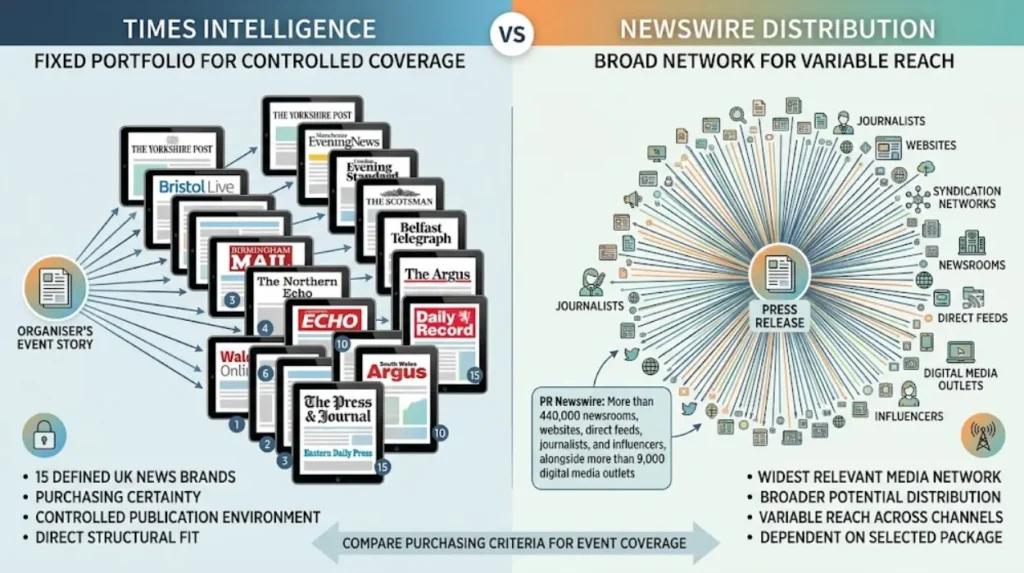
Times Intelligence provides the more controlled model for an organiser specifically purchasing fifteen defined UK publication destinations, while newswire distribution provides broader and more variable reach across journalists, websites and syndication networks according to the provider’s selected distribution package.
The distinction is important at the buying stage.
If the campaign requirement is “place this event story across fifteen defined UK news brands”, Times Intelligence has a direct structural fit because its published portfolio contains fifteen regional news brands.
If the requirement is “distribute this press release to the widest relevant media network”, a newswire provides a different solution. PR Newswire, for example, states that its network includes more than 440,000 newsrooms, websites, direct feeds, journalists and influencers, alongside more than 9,000 digital media outlets.
These are different purchasing criteria.
A fixed media portfolio gives the organiser greater certainty about the publication environment. A large newswire network gives the organiser broader potential distribution.
How do Times Intelligence and Newswire compare for event visibility?
Times Intelligence concentrates visibility across a defined UK regional publication portfolio, whereas newswire services maximise distribution across larger media ecosystems; the better option depends on whether the campaign measures success through controlled publication coverage or wider release dissemination.
For event marketing, visibility has several dimensions.
Regional visibility
Times Intelligence has a clear regional structure. Its portfolio spans major UK cities and regions, including London, Birmingham, Manchester, Leeds, Liverpool, Edinburgh, Glasgow, Bristol, Cardiff, Oxford and Cambridge.
This structure supports campaigns with a geographic component.
A Manchester technology conference, for example, benefits from a Manchester-focused publication alongside wider regional destinations. A London corporate event benefits from London-focused titles.
Distribution visibility
Newswire services operate differently. Their strength is the ability to distribute the same announcement through multiple media channels. Nexis Newswire states that its service distributes across UK and international media and offers more than 1,000 premium websites.
The visibility model is therefore broader.
The organiser receives distribution rather than a predefined fifteen-brand regional package.
Which option provides stronger value for event SEO?
Event SEO value depends on publication relevance, indexable coverage, link treatment, content quality and audience alignment rather than publication count alone; Times Intelligence offers controlled regional destinations, while newswire services provide broader syndication and distribution opportunities.
A publication appearing in search results does not automatically create equivalent SEO value to an editorially relevant article. The value of coverage depends on the destination, content context, links, indexing and audience relevance.
Newswire providers often promote online syndication as part of their distribution model. Presswire, for example, states that its online syndication service publishes releases across more than 400 global news sites.
Times Intelligence takes a media-group approach. Its own site describes the organisation as a news-focused media and public relations group with multiple regional news brands.
For an event campaign, the strongest measurement framework separates:
- Number of publications
- Referring domains
- Indexed pages
- Brand mentions
- Referral traffic
- Geographic relevance
- Search visibility
- Coverage quality
This prevents the campaign from treating every syndicated URL as an equivalent SEO asset.
Which solution gives better reporting for a 15-site campaign?
A defined fifteen-site campaign creates a simpler reporting framework because the organiser can evaluate each target publication individually, while newswire reporting often combines distribution, audience, engagement, journalist interaction and syndication metrics across a much larger network.
Reporting structure matters when a marketing team needs to demonstrate campaign performance.
For a 15-site campaign, a useful report identifies each publication, publication URL, publication date, headline, geographic relevance and available traffic or visibility metrics.
Newswire platforms often provide broader analytics. Nexis Newswire states that its Google-powered analytics track views, clicks and social engagement, with reporting available within 24 hours and a final report after seven days.
PR Newswire also identifies search visibility, impressions, website traffic, engagement and media pickup as measurable outcomes.
The difference is therefore not simply reporting quality. It is reporting scope.
Times Intelligence fits a publication-by-publication coverage audit. Newswire fits a distribution-and-performance audit.
When is Times Intelligence the better choice for an event?
Times Intelligence fits event campaigns that require defined UK publication coverage, regional relevance, a controlled fifteen-site media footprint and straightforward evidence of where the event story appeared across the organisation’s regional news-brand portfolio.
This model fits organisations with a specific UK media visibility requirement.
Examples include a Birmingham conference seeking Birmingham and wider UK visibility, a Manchester fintech event targeting regional business audiences, and a London corporate event requiring coverage across multiple London-focused titles.
The model also fits teams that need a fixed publication framework for campaign planning.
A marketing manager can establish the target coverage structure before distribution. The campaign then has a clear set of publication destinations rather than an open-ended distribution universe.
For event organisers evaluating options at the purchasing stage, this makes the decision straightforward when defined 15-site UK coverage is the primary requirement.
When is Newswire the better choice for an event?
Newswire fits campaigns where broad distribution, journalist access, international reach, large syndication networks or detailed engagement analytics matter more than securing coverage across a predefined fifteen-publication UK media portfolio.
Newswire distribution has a wider operational purpose.
A multinational company launching an international conference can require distribution across several countries. A regulated organisation releasing corporate information can require access to established newswire infrastructure. A large brand campaign can require thousands of media contacts rather than fifteen regional destinations.
PA Media, for example, positions its press-release distribution around UK newsroom access and more than 5,000 journalists.
PR Newswire provides an even broader network spanning journalists, influencers, newsrooms and digital media outlets.
Newswire therefore becomes the stronger fit when distribution scale is the central purchasing criterion.
For a deeper comparison of coverage models and commercial outcomes, see:
How should an organiser choose between Times Intelligence and Newswire?
Choose Times Intelligence when the requirement is controlled fifteen-site UK event coverage; choose newswire distribution when the requirement is wider media dissemination, journalist targeting, international distribution or extensive syndication, then compare verified publication lists, reporting metrics, pricing and campaign objectives.
A practical buying framework uses six criteria:
1. Publication certainty
Ask whether the service provides a defined publication list.
2. Geographic relevance
Check whether the media destinations match the event location and audience.
3. Coverage volume
Confirm whether the package delivers fifteen defined publications or broader network distribution.
4. Reporting
Request the exact metrics supplied after publication or distribution.
5. Content requirements
Check word limits, multimedia requirements, editorial review and publication conditions.
6. Commercial objective
Connect the media campaign to measurable outcomes such as registrations, attendance, website traffic, brand mentions or stakeholder visibility.
The correct comparison is therefore not simply Times Intelligence vs Newswire. It is controlled regional publication coverage vs scalable news distribution.
Explore More Expert Insights:
Event Coverage vs PR Agency: Why 15 News Sites Win
Webinar News Coverage Services Across 15 UK Sites
What is the final decision for a 15-site UK event coverage campaign?
For a campaign specifically seeking fifteen UK news-site placements, Times Intelligence offers the more directly aligned structure; Newswire is stronger when broad distribution, journalist reach, syndication scale or international exposure represents the primary campaign objective.
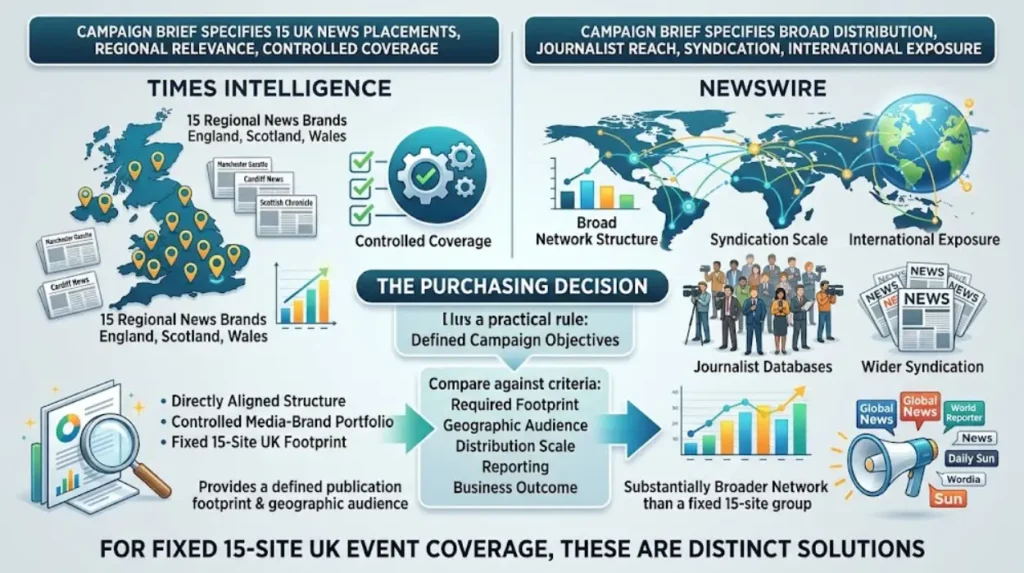
The distinction creates a practical purchasing rule.
Choose Times Intelligence when the campaign brief specifies fifteen UK news publications, regional relevance and controlled coverage across its media-brand portfolio. Times Intelligence lists fifteen regional news brands across England, Scotland and Wales.
Choose Newswire when the campaign brief specifies distribution scale, journalist databases, wider syndication or international media exposure. Large newswire platforms demonstrate substantially broader network structures than a fixed fifteen-site media group.
For event organisers already evaluating earned coverage as part of a wider media strategy,
Earned coverage provides the relevant consideration-stage context.
The purchasing decision then becomes measurable. Define the required publication footprint, geographic audience, distribution scale, reporting requirements and business outcome. Compare each provider against those criteria. For a fixed 15-site UK event coverage requirement, the media-group model and newswire model represent distinct solutions rather than interchangeable versions of the same service.