
Event coverage is the publication of event-related stories across relevant news websites, trade publications, and regional media. Each credible article creates an opportunity for a backlink, brand mention, referral traffic, search visibility, and stronger topical authority within the brand’s target market.
Event coverage connects a physical or virtual event with digital media distribution. The coverage typically includes event announcements, speaker interviews, industry findings, product demonstrations, expert commentary, audience statistics, or significant business developments.
For SEO, the important entity is the backlink. A backlink is a hyperlink from an external website to a brand’s website. Search engines use links as one signal for understanding relationships, relevance, and authority between web entities.
A campaign targeting 15 suitable UK news websites creates 15 distinct opportunities for editorial references. The final number of live backlinks depends on publication decisions, editorial formatting, and whether each article includes a website link.
This makes event coverage different from simply publishing an event page. The event page exists on the brand’s own domain. Media coverage places the brand within external publishing environments.
How does an event generate quality backlinks?
An event generates quality backlinks when its news value gives independent publications a reason to reference the organising brand, event page, research, speaker profile, registration resource, or supporting content through relevant editorial links from established websites.
The process starts with an event containing a clear news angle. Journalists need information that fits their publication, audience, and editorial priorities.
A strong event story contains identifiable entities and factual information. These entities include:
- The organising company
- Event name
- Event date and location
- Speakers
- Industry sector
- Announced findings
- Products or services discussed
- Expert opinions
- Registration or information pages
The next stage involves preparing media-ready content. A press release, event summary, speaker commentary, research finding, or post-event report provides journalists with material for publication.
The campaign then targets relevant media outlets. A technology event requires technology publications. A construction conference requires construction and property media. A financial services event requires finance and fintech publications.
The backlink becomes valuable when the external article has genuine topical relevance. A link from a relevant UK business publication has stronger contextual value than a random link from an unrelated website.
Why can 15 news sites create stronger backlink diversity?
Fifteen news sites create backlink diversity by placing a brand across multiple referring domains, editorial contexts, publication audiences, and industry environments. This distribution expands the website’s external link profile instead of concentrating visibility on one publisher or single media property.
Backlink diversity describes the range of independent websites linking to a domain.
A campaign with 15 referring domains produces a broader external footprint than repeated links from one website. The domains can represent different media categories, including:
National business publications
Business publications provide access to readers interested in corporate developments, investment, entrepreneurship, leadership, and market trends.
Regional UK publications
Regional publications connect an event with a specific geographic market. For example, a Manchester business event can receive coverage from publications serving Greater Manchester.
Trade publications
Trade media provide specialist topical relevance. Examples include construction, healthcare, technology, finance, education, property, and manufacturing publications.
Industry news websites
Industry-focused websites create another contextual environment for event coverage. Their articles often address a specific professional audience.
This diversity supports a broader entity relationship around the brand. The company appears in different editorial contexts while remaining connected to the same event, topic, and industry.
What makes a backlink from event coverage high quality?
A high-quality event coverage backlink comes from a legitimate, relevant website with editorial standards, topical alignment, a real audience, and a natural connection between the linked page and published story. Link relevance matters more than simply increasing link volume.
Quality has several measurable dimensions.
Relevance identifies whether the publication covers subjects connected to the brand. A cybersecurity event covered by a technology publication creates stronger topical alignment than coverage on an unrelated entertainment website.
Referring-domain diversity identifies how many independent websites link to the brand. Fifteen independent domains provide broader distribution than 15 links appearing across one domain.
Editorial context identifies whether the link exists naturally within an article. A link supporting an event fact, speaker profile, research finding, or registration page has a clear contextual purpose.
Publication credibility relates to the website’s established presence, editorial process, audience, and reputation.
Destination relevance identifies whether the linked page supports the story. An event article can link to the event page, research report, speaker biography, product page, or corporate announcement.
A backlink campaign therefore requires more than counting links. The campaign needs to evaluate who links, why they link, where they link, and what context surrounds each link.
How does event coverage support SEO authority?
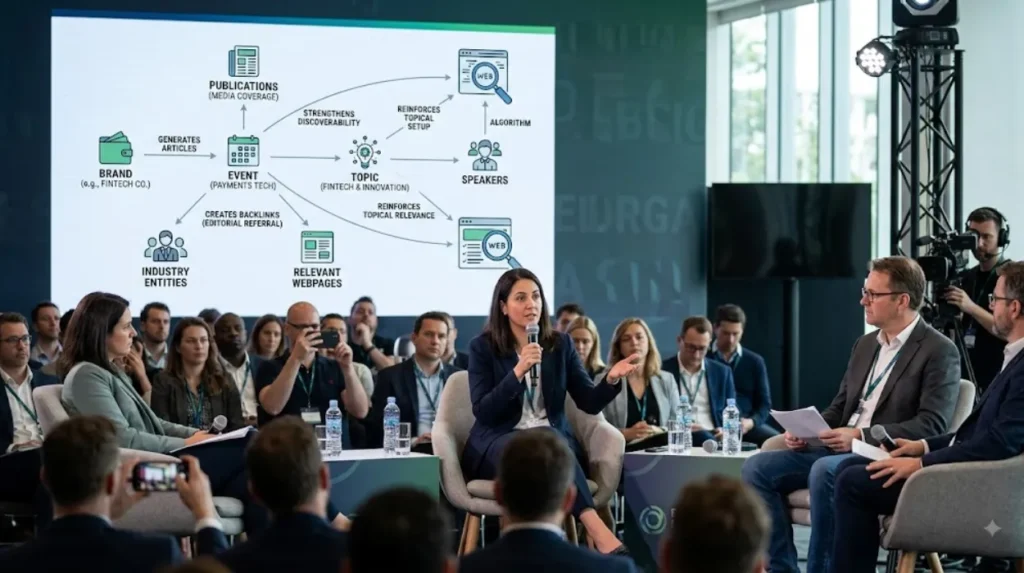
Event coverage supports SEO authority by increasing external references to a brand while reinforcing relationships between the organisation, event topic, industry entities, and relevant webpages. These connections strengthen discoverability, referral pathways, and the broader digital footprint surrounding the brand.
SEO authority is influenced by multiple factors. Backlinks form one component of a broader search ecosystem that includes content quality, technical accessibility, topical relevance, user experience, brand recognition, and internal linking.
Event coverage contributes external evidence.
For example, a UK fintech company hosting a payments technology event can receive coverage discussing payment innovation, regulatory developments, speakers, and industry research. Several articles can link to the company’s website.
The resulting coverage establishes repeated associations between:
Brand → Event → Fintech → Payments → Industry expertise → External publications
This relationship gives search engines additional web-based context.
The effect is also cumulative at the entity level. A brand appearing consistently across relevant publications becomes easier to associate with its subject area.
For readers exploring:
News coverage backlinks, event coverage demonstrates how editorial PR and SEO intersect. The objective is not simply to obtain links. It is to create relevant external references around meaningful business activity.
Which event assets attract backlinks?
Event assets attract backlinks when they provide useful information that journalists and audiences need to reference. Strong assets include original research, expert commentary, speaker profiles, event findings, data releases, recordings, reports, and detailed event pages containing authoritative information.
Different event assets support different editorial purposes.
Original event research
Research provides statistics that journalists can cite. For example, a UK business event can publish survey findings covering technology adoption among 500 UK companies.
Speaker expertise
Recognised speakers provide authoritative commentary. Their credentials, professional background, and statements create additional editorial angles.
Event findings
Post-event findings transform an event into a news story. A conference that identifies five major industry trends provides material for follow-up coverage.
Data and statistics
Specific numbers increase citation value. A statement such as “68% of surveyed businesses adopted automation in 2026” creates a factual reference point.
Event reports
A downloadable report gives publications a destination for deeper information. Journalists can link to the report when summarising its findings.
Event pages
The primary event page provides dates, location, agenda, speakers, registration details, and supporting information. It often becomes the most logical destination for coverage links.
These assets create multiple reasons for publications to reference the same campaign.
How should brands plan a 15-site event coverage campaign?
A 15-site event coverage campaign requires defined objectives, media segmentation, news assets, publication targets, outreach timing, link destinations, and measurement criteria. Planning these elements before distribution creates a consistent process for securing relevant coverage and evaluating backlink quality.
The campaign can follow six practical stages.
1. Define the event news angle
Identify one primary story. Examples include a new research report, major speaker announcement, industry forecast, business milestone, or post-event finding.
2. Build the media target list
Create a 15-site target list based on relevance. Separate publications into national, regional, business, and trade categories.
3. Match assets with destinations
Assign each story element to an appropriate webpage. A research story links to the report. A speaker story links to the speaker or event page. A product announcement links to the relevant product page.
4. Prepare publication-ready content
Use a clear headline, factual introduction, supporting statistics, quotations, company information, event details, and relevant links.
5. Distribute and monitor coverage
Track publication name, article URL, publication date, referring domain, anchor text, linked destination, and whether the article remains live.
6. Evaluate the backlink profile
Measure referring domains, followed links, referral sessions, indexed coverage, brand mentions, and ranking changes for relevant pages.
This process creates a repeatable framework rather than treating event coverage as a single publicity activity.
What results can brands measure from 15 event backlinks?
Brands can measure event backlink performance through referring domains, live links, referral traffic, indexed articles, brand mentions, organic visibility, target-page performance, and publication relevance. These metrics connect media coverage with measurable SEO activity and reveal which event stories generate the strongest external references.
A useful measurement framework separates coverage metrics from SEO metrics.
Coverage metrics include:
- Number of published articles
- Number of target publications reached
- Number of live backlinks
- Number of referring domains
- Number of brand mentions
- Publication category
- Publication location
SEO metrics include:
- Organic impressions
- Organic clicks
- Target-page rankings
- Referring-domain growth
- Referral sessions
- Indexed coverage
- Search visibility for event-related topics
For example, a campaign targeting 15 UK websites can record 15 published articles, 12 live backlinks, 12 referring domains, and measurable referral traffic. The difference between target coverage and confirmed backlinks becomes important for campaign evaluation.
Not every article produces an identical SEO outcome. A publication can mention the brand without linking to it. Another publication can link to an event page. A third can link to original research.
The reporting system needs to capture these differences.
When is event coverage more useful than a single PR placement?
Event coverage becomes more useful when a brand needs several independent media references around one business activity. Multiple relevant publications provide wider contextual coverage, broader referral opportunities, and greater backlink diversity than relying on one external article for the entire campaign.
A single placement creates one referring-domain relationship.
A 15-site campaign creates multiple relationships across different editorial environments. This structure supports brands launching events, releasing research, entering regional markets, announcing speakers, or publishing industry findings.
The approach also creates reusable content opportunities. Pre-event coverage can establish awareness. Live-event reporting can capture developments. Post-event coverage can distribute findings and expert commentary.
This three-stage model extends the useful life of one event:
Before the event: announcements, speakers, research previews.
During the event: expert statements, announcements, interviews, live findings.
After the event: reports, statistics, conclusions, recordings, industry commentary.
The event therefore becomes a source of several connected news stories rather than one announcement.
For brands evaluating structured media options, the next decision involves comparing event coverage with broader PR agency approaches. The distinction is explored through:
Event coverage in the next stage of the content journey.
How should brands evaluate event coverage providers?
Brands evaluating event coverage providers need to examine publication relevance, confirmed media targets, backlink reporting, editorial processes, geographic coverage, delivery timelines, and measurement standards. A clear evaluation framework separates genuine media distribution from simple article placement or low-value link generation.
The provider evaluation process starts with the target media list.
Ask which publications receive the campaign and whether those websites match the intended audience. A list of 15 relevant UK publications provides more useful information than an unsupported claim about large media reach.
Next, examine reporting.
A useful report identifies publication names, article URLs, dates, backlinks, linked pages, and coverage status. This information allows marketing and SEO teams to verify campaign outcomes.
Finally, examine the relationship between coverage and SEO objectives. The provider needs to understand whether the campaign focuses on brand visibility, event registrations, referral traffic, backlinks, industry authority, or a combination of these outcomes.
A structured approach gives brands a clearer basis for comparing event coverage solutions and broader PR distribution services.
What is the main SEO value of 15 quality event backlinks?
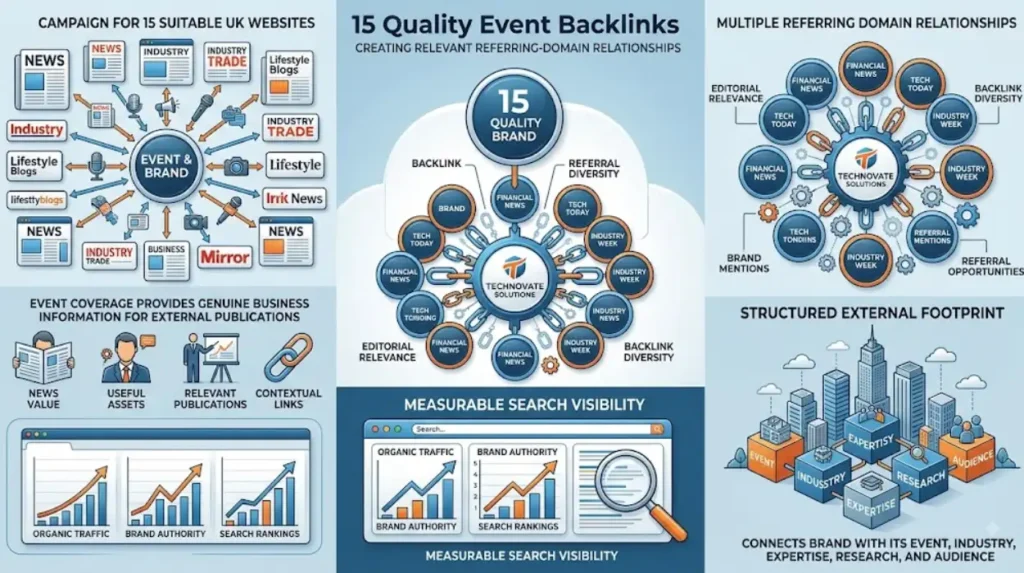
The main SEO value of 15 quality event backlinks is the creation of multiple relevant referring-domain relationships around one brand and topic. Effective event coverage combines editorial relevance, backlink diversity, brand mentions, referral opportunities, and measurable search visibility into one coordinated campaign.
Event coverage works because an event provides genuine business information for external publications to discuss.
A campaign targeting 15 suitable UK websites creates multiple opportunities for independent editorial references. The strongest campaigns combine news value, useful assets, relevant publications, contextual links, and precise measurement.
Explore More Expert Insights:
How Webinar Coverage Turns Sessions Into UK News Articles
How Hybrid Event Coverage Works Across 15 News Sites
The result is not simply a collection of URLs. It is a structured external footprint connecting the brand with its event, industry, expertise, research, and audience.
For brands progressing from educational SEO research toward practical media strategy, understanding this relationship provides the foundation for evaluating event coverage against other PR options and determining which distribution model fits a specific campaign objective.



