SaaS sponsored content is paid editorial-style content that presents software products, expertise, or business insights through publisher websites. It combines brand messaging with informative content to reach relevant UK business audiences.
Software as a Service (SaaS) describes software delivered through the internet, usually through a subscription model. SaaS companies include customer relationship management platforms, accounting software providers, cybersecurity platforms, project management systems, and business intelligence providers.
Sponsored content gives these companies a structured publishing route. The brand supplies an approved topic, article, or campaign brief. A publisher then places the content within its website under its applicable commercial content rules.
For UK SaaS companies, placement quality matters. A campaign needs relevant publishers, clear commercial labelling, consistent brand information, and accurate reporting.
This makes SaaS sponsored content by Time Intelligence Media Group a service-focused option for companies seeking coordinated publication across media properties.
Companies researching publication models can also review:
Sponsored content publishing to understand how multi-site campaigns work before selecting a distribution service.
How does Time Intelligence Media Group deliver SaaS sponsored content?
Time Intelligence Media Group delivers SaaS sponsored content through a coordinated publishing process covering campaign requirements, content preparation, publisher selection, placement, verification, and reporting for UK-focused SaaS marketing campaigns.
The process begins with campaign requirements. These requirements define the SaaS product, target audience, geographic market, campaign objective, preferred topics, and publishing requirements.
The next stage focuses on content. A SaaS company provides an existing article or campaign brief, depending on the agreed service. Content must meet the requirements of the selected publication.
Publisher selection then determines where the content appears. Relevant publications are selected according to campaign requirements rather than treating every website as an identical distribution channel.
After publication, the campaign moves into verification and reporting. Published URLs provide evidence of completed placements and create a record for internal marketing teams.
What does the publication workflow include?
A typical workflow contains six stages:
- Campaign briefing — Define the SaaS product, audience, topic, and campaign requirements.
- Content preparation — Prepare approved sponsored content for publication.
- Publisher selection — Match the campaign with relevant media websites.
- Submission — Send content through the applicable publishing process.
- Publication verification — Confirm live placements and published URLs.
- Reporting — Record placements and campaign outcomes.
This structure gives marketing teams a defined process from initial brief to published coverage.
Which components matter in a SaaS sponsored content campaign?
A SaaS sponsored content campaign requires relevant publishers, accurate content, consistent brand information, clear commercial disclosure, appropriate links, publication verification, and reporting that records where each piece of content appears.
Publisher relevance is central to campaign quality. A cybersecurity SaaS company has different audience requirements from an HR software platform. Examples include cybersecurity publications, technology media, business websites, and HR-focused publications.
Content accuracy is equally important. Product names, features, statistics, customer claims, and company descriptions need to remain consistent throughout the article.
Link placement also requires attention. Links need to point to relevant destination pages and support the reader’s understanding of the topic. Common destinations include product pages, research reports, solution pages, and company resources.
Commercial disclosure establishes the nature of the placement. Sponsored content needs to follow the commercial and editorial requirements applied by the publishing website.
What should SaaS brands prepare before publication?
A SaaS company can prepare:
- Approved company description
- Product or service information
- Target audience definition
- Campaign topic
- Article or content brief
- Preferred landing page
- Approved brand terminology
- Supporting statistics and evidence
- Contact information for campaign coordination
- Reporting requirements
Preparation reduces unnecessary revisions and keeps publication information consistent.
How does sponsored content support SaaS marketing goals?
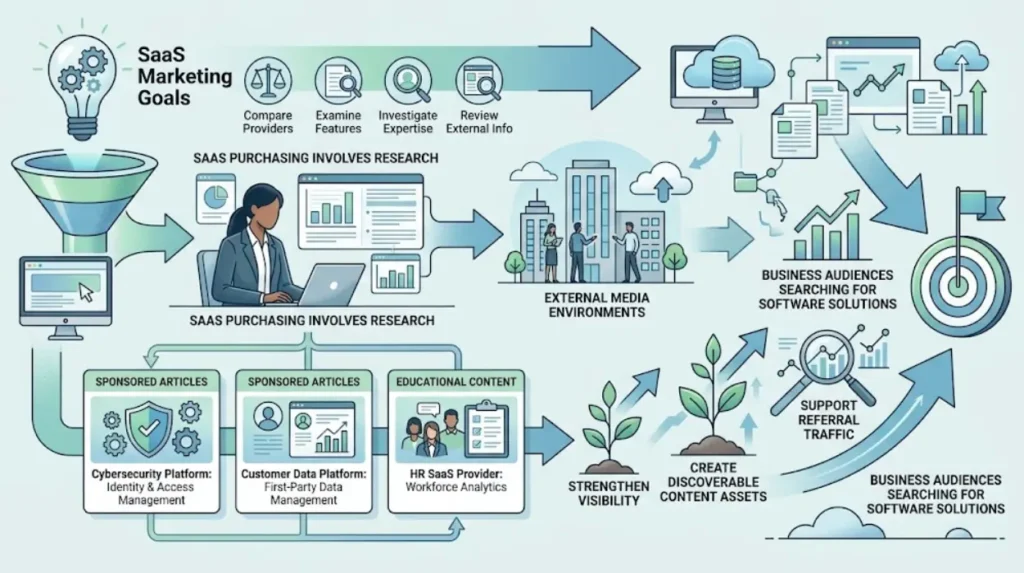
Sponsored content supports SaaS marketing by placing relevant brand information in external media environments, creating discoverable content assets, supporting referral traffic, and strengthening visibility among business audiences searching for software solutions.
SaaS purchasing involves research. Buyers compare providers, examine features, investigate industry expertise, and review external information before contacting vendors.
Sponsored articles add another source of brand visibility during this research process. A SaaS company can publish educational content around topics connected to its product category.
For example, a customer data platform can publish content about first-party data management. An HR SaaS provider can publish content about workforce analytics. A cybersecurity platform can publish content about identity and access management.
The value comes from connecting the content topic with the audience and publication.
Can sponsored content support SEO?
Sponsored content creates externally published URLs that search engines can discover. The SEO value of links depends on the publisher, link attributes, relevance, and search engine policies.
A campaign also creates additional branded content assets. These assets can support entity recognition by providing consistent information about a company, product, category, or executive.
Search visibility is not determined by publication volume alone. Content relevance, quality, technical accessibility, brand consistency, and overall website authority remain important.
Why use multiple UK publisher placements for SaaS campaigns?
Multiple UK publisher placements give SaaS brands broader media exposure across relevant audiences and create a coordinated set of published content assets instead of relying on one external publication for campaign visibility.
A multi-site campaign distributes attention across different publisher audiences. This structure suits SaaS brands targeting several business segments.
For example, an enterprise software provider can target technology, business, finance, and management audiences with different editorial topics. A small-business SaaS platform can focus on entrepreneurship, SME, accounting, and business technology publications.
The approach also creates a larger publication footprint. Each verified placement becomes a separate media asset that marketing teams can track.
Companies evaluating a 15-site publishing model can review:
Multi-site SaaS content distribution for decision-stage information about campaign execution and service selection.
How do you evaluate Time Intelligence Media Group for SaaS sponsored content?
Evaluate Time Intelligence Media Group by comparing publisher relevance, campaign scope, content requirements, publication process, reporting standards, turnaround expectations, and pricing against the specific requirements of your SaaS marketing campaign.
A practical evaluation begins with publisher fit. Review whether available placements match your SaaS category and target UK audience.
Next, examine the campaign process. A defined workflow provides clarity around briefing, content submission, publisher coordination, publication, and reporting.
Reporting is another decision factor. Marketing teams need published URLs and sufficient campaign information to verify completed placements.
Pricing needs to be assessed against the number and type of placements included. A 15-site campaign has different requirements from a single sponsored article.
What questions should a SaaS company ask before ordering?
Ask these questions before approving a campaign:
- Which UK publishers are included?
- How many placements are included?
- Which SaaS categories are supported?
- Who prepares the sponsored content?
- What content specifications apply?
- How are publisher placements selected?
- Are sponsored placements clearly disclosed?
- What links can be included?
- What reporting is provided?
- How are live URLs verified?
- What turnaround applies to the campaign?
- What happens when a proposed placement does not meet the campaign requirements?
These questions establish measurable expectations before payment and publication.
Which SaaS companies benefit from sponsored content distribution?
SaaS companies benefit from sponsored content when they need external media visibility for products, expertise, launches, research, or category education and require a structured process for coordinating publication across relevant UK media websites.
Different SaaS businesses use sponsored content for different campaign purposes.
SaaS startups
Startups use sponsored content to introduce a new software category, explain product capabilities, and establish brand visibility among potential customers.
Scale-ups
Scale-ups use external publications to support expansion into new UK market segments. Content can focus on industry problems, software trends, customer challenges, and business outcomes.
Established SaaS providers
Established providers use sponsored content to support product launches, research campaigns, executive positioning, and category-specific communications.
B2B SaaS platforms
B2B SaaS companies can target professional audiences through business, technology, finance, HR, cybersecurity, and industry publications.
The campaign objective determines the appropriate content theme and publisher selection.
What results can SaaS brands measure from sponsored content?

SaaS brands can measure sponsored content through published placements, referral visits, engagement, branded search activity, campaign URLs, content visibility, and other marketing indicators connected to the campaign’s defined objectives.
Publication count provides the basic delivery measurement. A campaign report can record each live placement and its URL.
Referral traffic measures visitors arriving from publisher pages. UTM parameters provide additional tracking when supported by the publisher and campaign setup.
Branded search activity provides another visibility indicator. SaaS companies can monitor changes in searches for their company, product, or branded terms alongside other marketing activities.
Conversions require separate measurement. A publisher article does not automatically demonstrate revenue attribution. SaaS marketing teams need analytics, attribution rules, and tracked landing pages to connect media activity with downstream actions.
How can a SaaS brand start a sponsored content campaign with Time Intelligence Media Group?
A SaaS brand can start by defining its campaign objective, target UK audience, SaaS category, content requirements, preferred number of placements, landing pages, and reporting needs, then requesting campaign details from Time Intelligence Media Group.
The first step is campaign definition. Identify the software product and the audience that needs to see the content.
The second step is content preparation. Establish the topic, key messages, supporting evidence, links, and brand terminology.
The third step is placement planning. Define the required number of UK media placements and the relevant publication categories.
Explore More Expert Insights:
Healthcare Sponsored Content by Time Intelligence Media Group
Fintech Sponsored Content by Time Intelligence Media Group
The fourth step is measurement. Decide which indicators matter, such as publication completion, referral traffic, engagement, or branded visibility.
Time Intelligence Media Group can then be assessed against those requirements. The decision process remains straightforward when deliverables, publisher relevance, content specifications, reporting, and pricing are documented before campaign approval.
For SaaS companies seeking a coordinated UK sponsored content campaign, the service provides a decision-stage route from campaign planning to verified media publication.