

Earned news coverage is editorial attention given to an event because journalists identify it as relevant, timely, or newsworthy. It appears in independent publications through editorial decisions rather than direct advertising payments, creating a distinct form of public event visibility.
Earned news coverage refers to articles, event reports, interviews, announcements, previews, and editorial mentions published by news organisations without purchasing the editorial space itself. The publication controls the story, headline, placement, and editorial treatment.
For events, earned coverage can focus on several newsworthy elements. Examples include a major conference announcement, a business summit, a charity event, a technology exhibition, or a public-sector gathering.
Paid advertising follows a different model. An organiser pays for defined promotional space, such as a display advertisement, sponsored placement, social advertisement, or search advertisement.
The distinction is important because earned media and paid media serve different communication functions. Paid advertising provides controlled promotion. Earned coverage provides editorial visibility.
Why is earned news coverage different from paid advertising?
Earned coverage depends on editorial selection, while paid advertising depends on purchased placement. The difference affects credibility, message control, audience interpretation, publication format, distribution, and how audiences encounter information about an event before, during, and after attendance.
Paid advertising gives an event organiser control over the promotional message. The organiser normally determines the creative asset, advertising copy, target audience, campaign duration, and budget.
Earned coverage places greater emphasis on news value. Journalists and editors determine whether an event provides sufficient public or industry relevance for publication.
How does editorial independence affect event coverage?
Editorial independence separates news reporting from advertising. A journalist writing about a business conference, healthcare exhibition, university event, or industry summit presents the information within an editorial context.
This distinction changes how the audience interprets the content. Advertising is explicitly promotional. Editorial coverage exists within a publication’s news or features environment.
For example, an advertisement for a London technology conference can promote ticket sales directly. An editorial article about the same conference can explain its speakers, industry relevance, economic significance, or major announcement.
How does earned coverage build visibility for events?
Earned coverage builds visibility by placing event information within established editorial environments where audiences already consume news, industry updates, business reporting, and local stories. It extends event awareness beyond direct promotional channels and existing organiser audiences.
Event visibility depends on reach and relevance. An organiser’s website, email list, and social channels primarily reach people already connected to the organisation.
News coverage introduces the event to audiences outside those existing channels. A regional publication can reach readers in a specific city. A business publication can reach professionals within an industry. A national publication can expose an event to a broader UK audience.
The publication itself also provides context. Instead of presenting only a ticketing message, an article can explain why an event matters.
Which types of events benefit from news visibility?
Different event categories generate different forms of news interest. Examples include:
- Business conferences announcing major industry speakers
- Technology exhibitions presenting new products
- Charity events supporting public campaigns
- Healthcare conferences addressing professional developments
- Financial events discussing market trends
- University events featuring research or public lectures
- Property exhibitions involving major developments
- Cultural festivals attracting regional audiences
The news value comes from the event’s specific facts rather than from the event format alone.
Why does audience trust matter when comparing earned coverage with paid ads?
Audience trust matters because editorial content and advertising carry different communication signals. Readers recognise paid advertisements as promotional messages, while independent editorial coverage provides information through a publication’s established reporting and content environment.
Trust does not mean that every editorial article receives universal acceptance. It means the communication context differs.
A reader encountering a paid advertisement understands that the organiser purchased the placement. The advertisement exists to promote the event.
An editorial article operates under the publication’s editorial standards. The journalist or editor determines the information presented and the structure used.
This distinction becomes important for events targeting professional audiences. Business decision-makers often encounter event information alongside other industry news. Editorial placement situates the event within that information environment.
Does earned coverage remove promotional intent?
No. An event organiser still benefits commercially from awareness generated by coverage. The difference lies in the mechanism used to obtain visibility.
Paid advertising purchases attention. Earned coverage obtains editorial attention through newsworthiness, relevance, relationships, announcements, or events that provide legitimate reporting material.
For example, a conference announcing a significant industry partnership provides a factual development that journalists can report. The resulting article remains editorial content rather than an advertisement.
How does earned coverage support event discovery?

Earned coverage supports discovery by connecting event information with audiences searching for news, following publications, reading industry updates, and monitoring regional developments. This creates additional discovery pathways beyond an organiser’s direct marketing channels and existing audience database.
Search behaviour plays an important role in event discovery. People search for conferences, exhibitions, business events, speakers, venues, industry developments, and local activities.
A published article can provide another indexed source containing the event name, location, date, organisers, speakers, topic, and relevant context.
For example, someone researching technology conferences in Manchester can encounter an article covering a technology event through a news or business publication.
What information makes event coverage discoverable?
Useful event coverage normally contains clear factual entities and relationships, including:
- Event name
- Event date
- Event location
- Event organiser
- Event category
- Main speakers
- Industry or subject
- Key announcement
- Target audience
- Registration or attendance information
Clear factual information improves understanding for both human readers and search systems.
How does the lifespan of earned coverage differ from event advertising?
Earned coverage can remain accessible after an event ends, while many paid advertisements disappear when their campaign period or purchased placement ends. Published articles therefore create an additional historical record of the event and its associated information.
Advertising campaigns commonly operate within defined periods. A social advertisement can run for seven days. A display campaign can operate for one month. A search campaign can stop when its budget or scheduled period ends.
Editorial articles remain part of a publication’s archive. Their accessibility depends on the publication, indexing, archiving practices, and content management system.
This creates a chronological record around an event.
Pre-event coverage can announce the event. During-event reporting can document developments. Post-event coverage can report outcomes, speakers, announcements, or attendance.
Why is post-event coverage important?
Post-event coverage extends the communication lifecycle. The event does not disappear from public information immediately after attendees leave.
A conference article can document a keynote announcement. A charity event report can record fundraising activity. A business summit report can document a partnership announced during the programme.
This creates useful reference material for future audiences, stakeholders, journalists, partners, and attendees.
What role does credibility play in event marketing?
Credibility in event marketing comes from clear information, relevant evidence, transparent sourcing, and the context in which an event is presented. Earned coverage contributes an independent editorial layer that differs from organiser-controlled promotional advertising.
Credibility is not created by publication alone. The quality of the information remains important.
Accurate event dates, named speakers, verified locations, specific announcements, and clear organisational details strengthen factual communication.
Earned coverage adds another layer because the event appears within a publication’s editorial environment.
This is particularly relevant for professional events. A senior executive evaluating a conference can assess information presented through business journalism alongside the event’s own website and promotional materials.
How does third-party coverage affect event perception?
Third-party coverage gives audiences information from outside the organiser’s owned channels.
Owned media includes the event website, organiser blog, newsletter, and official social profiles. Paid media includes purchased advertising. Earned media includes editorial articles and independent mentions.
Each channel has a distinct role.
Owned media provides detailed official information. Paid media provides controlled promotional distribution. Earned media provides editorial exposure and external context.
Can earned coverage replace paid advertising for every event?
Earned coverage and paid advertising are different communication channels, so one does not universally replace the other. Their suitability depends on event objectives, audience, timing, message control, news value, campaign duration, and the type of visibility required.
Paid advertising remains useful when an organiser requires precise control over audience targeting, creative assets, budget, timing, or calls to action.
Earned coverage becomes relevant when an event has a strong news angle and requires editorial visibility.
A major UK business conference, for example, can use advertising to promote registration while using earned coverage to report a significant speaker announcement.
The two approaches therefore operate within different parts of an event communication strategy.
When is paid advertising more controllable?
Paid advertising provides direct control over:
- Campaign budget
- Audience targeting
- Creative format
- Advertising copy
- Campaign duration
- Landing page destination
- Frequency
- Geographic targeting
This control makes paid media measurable as a direct promotional channel.
Earned coverage provides less control over editorial presentation. The publication determines the final editorial treatment.
What factors determine whether an event is newsworthy?
Event newsworthiness depends on factors such as timeliness, relevance, scale, public interest, novelty, location, notable participants, measurable outcomes, and significant announcements. Strong factual angles give journalists clearer reasons to cover an event.
An event title alone rarely provides sufficient news value.
A stronger story contains a specific development. Examples include a major executive joining a conference, a new industry report being released, a significant partnership being announced, or a public campaign reaching a measurable milestone.
What makes an event announcement stronger?
Specificity improves news relevance. Compare two announcements:
“Business conference announced in London.”
“London business conference announces 20 senior speakers for a programme focused on UK manufacturing investment.”
The second statement contains identifiable entities, a location, a participant group, a topic, and a specific development.
These details provide stronger editorial context.
How should organisations evaluate earned and paid event coverage?
Organisations can evaluate earned and paid event coverage by comparing their objectives, audience reach, message control, editorial context, duration, discovery potential, measurement methods, and costs. Each channel produces a different type of communication value.
A useful evaluation framework separates the two channels rather than treating them as identical forms of promotion.
| Factor | Earned News Coverage | Paid Advertising |
|---|---|---|
| Placement | Editorial | Purchased |
| Message control | Limited | High |
| Editorial context | High | Promotional |
| Audience targeting | Publication-led | Advertiser-led |
| Campaign duration | Publication-dependent | Campaign-defined |
| News value | Important | Not required |
| Creative control | Limited | High |
| Discovery | Search and publication audiences | Advertising platforms |
| Primary function | Editorial visibility | Promotion |
The comparison becomes more useful when event objectives are defined first.
An organiser seeking editorial recognition evaluates newsworthiness and publication relevance. An organiser seeking immediate targeted promotion evaluates advertising reach, audience targeting, creative control, and campaign duration.
For a deeper comparison of performance factors, readers can explore:
Earned vs paid event coverage.
What are the main benefits of earned news coverage for events?
Earned news coverage provides editorial visibility, external context, additional discovery pathways, longer-lasting publication records, and access to audiences beyond an event organiser’s existing channels. These benefits make earned media a distinct component of event communication.
The main benefits include:
- Editorial visibility: The event appears within a news or industry publication.
- External validation: Information comes through an independent editorial environment.
- Audience expansion: Coverage reaches people outside owned communication channels.
- Search discovery: Published content creates another indexed information source.
- Longer accessibility: Articles can remain available after campaigns end.
- Event documentation: Coverage records announcements, speakers, activities, and outcomes.
- Industry relevance: Trade publications can place events within specific professional contexts.
These benefits depend on newsworthiness, publication relevance, factual accuracy, and the quality of the resulting coverage.
How does earned event coverage fit into the wider media landscape?
Earned event coverage forms one part of a wider media ecosystem that includes owned, paid, and shared channels. Understanding these channel differences helps organisations select communication methods based on event objectives rather than treating every visibility channel as interchangeable.
Owned media communicates directly through channels controlled by the organiser. Paid media purchases promotional exposure. Earned media relies on editorial interest. Shared media involves audiences distributing or discussing event content through social and community channels.
An event can therefore exist across several communication environments.
For example, an organiser can publish official event information on its website, promote registration through paid advertising, receive editorial coverage from business publications, and gain social discussion from attendees.
Each channel communicates the event differently.
For readers evaluating the next stage of event media strategy,
15-site event coverage provides a more specific framework for understanding multi-publication distribution.
What should organisations remember about earned news coverage for events?
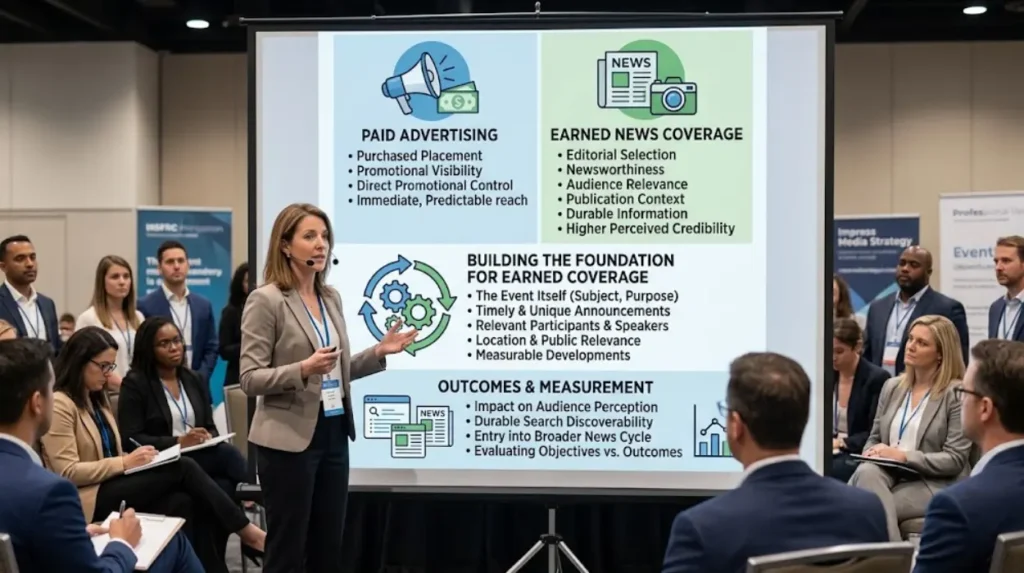
Earned news coverage differs from paid advertising because it operates through editorial selection rather than purchased placement. Its value comes from newsworthiness, publication context, audience relevance, discoverability, and durable event information rather than direct promotional control.
The central distinction is simple: paid advertising buys promotional visibility, while earned news coverage earns editorial attention.
For events, the difference affects how audiences encounter information, how publications frame the story, how long information remains accessible, and how the event enters broader news and search environments.
Explore More Expert Insights:
How News Coverage Builds Backlinks and SEO Authority
How Webinars Earn Coverage Across 15 UK News Sites
A strong event communication strategy begins with the event itself. Its announcements, participants, location, subject, public relevance, and measurable developments determine the available media opportunities.
Understanding these foundations provides the basis for evaluating earned and paid event coverage through measurable objectives, audience requirements, and communication outcomes.



