

Webinars are digital events delivered through online platforms for a defined audience. They include expert presentations, panel discussions, product education, interviews, training sessions, and industry briefings. When a webinar contains newsworthy information, its content can become a source for coverage across UK news sites.
Webinar coverage refers to the process of turning information from an online event into publishable news content. Journalists assess speakers, announcements, statistics, research findings, business developments, and audience relevance before deciding whether a story fits their publication.
A webinar does not automatically become a news story. Its content needs a clear news angle, identifiable sources, factual information, and relevance to a publication’s audience. Understanding this process explains how one digital event can generate coverage across multiple UK media outlets.
What makes a webinar newsworthy?
A newsworthy webinar contains information that matters beyond the event itself, including new research, expert commentary, business developments, industry data, regulatory information, or significant announcements that provide journalists with clear editorial value for publication.
The strongest webinar stories contain information that can be independently understood outside the original session. A journalist needs a clear subject, source, fact, and reason for publication.
For example, a webinar discussing UK employment trends becomes more newsworthy when speakers present new survey results showing a specific change in recruitment patterns. The data creates a defined editorial angle.
Which webinar elements attract editorial attention?
Several webinar components create usable news material:
- New research findings
- Original statistics
- Expert commentary
- Industry forecasts
- Regulatory developments
- Business announcements
- Consumer trends
- Market analysis
- Policy discussions
- Significant organisational developments
A webinar featuring an economist explaining newly released UK economic data provides a different editorial opportunity from a general educational presentation. The subject matter determines the potential news value.
How does webinar content become a news story?
Webinar content becomes a news story when journalists identify a specific fact, statement, development, or trend that satisfies editorial requirements and can be presented as an independent article rather than simply as a recording or event summary.
The transformation begins with identifying the most important information inside the session. A 60-minute webinar can contain several statements, but only a small number usually form strong news angles.
A journalist separates general discussion from publishable information. A speaker’s opinion becomes more useful when supported by data, professional expertise, or a clear development.
For example, a technology webinar featuring three cybersecurity specialists can produce a story about a newly identified threat, provided the discussion contains specific evidence and relevant UK context.
What information gets extracted?
Journalists typically identify:
- The main development — what happened or changed.
- The source — who provided the information.
- The evidence — statistics, research, documents, or verified facts.
- The relevance — why the subject matters to the publication’s audience.
- The context — information that explains the development.
This structure gives the article a clear factual foundation.
Readers interested in how this transformation works in greater detail can explore:
Webinar coverage.
Why can one webinar generate coverage across multiple UK news sites?
One webinar can generate coverage across multiple UK news sites because different publications serve different audiences, regions, industries, and editorial priorities, allowing the same factual event to produce distinct stories when relevant information matches each publication’s coverage focus.
The UK media landscape contains national, regional, specialist, business, technology, finance, healthcare, education, and consumer publications. Each category evaluates stories according to its audience.
A finance publication can focus on investment implications from a webinar. A technology publication can focus on technical developments. A regional publication can focus on local businesses or employment.
The underlying event remains the same, but the editorial angle changes according to audience relevance.
What types of UK publications can cover webinar content?
Examples include:
- National news publications covering major developments
- Regional publications covering local implications
- Business publications covering companies and markets
- Trade publications covering specific industries
- Technology publications covering digital developments
- Finance publications covering economic and financial subjects
- Healthcare publications covering medical and health-sector developments
For example, a webinar about UK construction costs can generate a business story about market conditions, a construction trade article about material prices, and a regional story about development activity.
What role do speakers play in webinar news coverage?

Webinar speakers provide identifiable sources for news articles, giving journalists expert commentary, factual statements, professional analysis, and attributable quotations that strengthen the credibility and editorial usefulness of stories developed from online events.
Speakers are central to the news value of many webinars. Their professional identity establishes the context behind statements made during the event.
A company executive can provide information about business activity. An academic can discuss research findings. A policy specialist can explain regulatory developments. An industry analyst can interpret market data.
The speaker’s expertise needs to relate directly to the subject covered.
Why do identifiable sources matter?
Attribution allows journalists to establish who made a particular statement. This creates accountability and provides readers with context.
A story stating that UK retailers face changing consumer demand becomes stronger when the claim is attributed to a named retail analyst and supported by specific data.
Webinar recordings also provide a source for verifying quotations and statements. Accurate attribution is essential when converting spoken content into written journalism.
How do statistics strengthen webinar coverage?
Statistics strengthen webinar coverage by giving journalists measurable evidence that supports a story, establishes the scale of a development, identifies a trend, and provides specific information that readers can understand without watching the original webinar.
Numbers create defined information for news reporting. A statement such as “businesses are increasing cybersecurity spending” lacks measurable context.
A statistic such as “62% of surveyed UK SMEs increased cybersecurity spending during the previous 12 months” provides a specific fact that journalists can evaluate and report.
Which webinar statistics are most useful?
Useful data includes:
- Percentage changes
- Survey results
- Market values
- Growth rates
- Employment figures
- Consumer behaviour data
- Investment figures
- Research findings
- Year-on-year comparisons
The source, methodology, sample size, date, and geographic scope also matter. Clear supporting information allows journalists to assess the reliability and relevance of the data.
How does UK relevance affect webinar coverage?
UK relevance increases the editorial value of webinar content when the subject connects directly with British businesses, consumers, institutions, regulations, markets, regions, or public issues covered by UK publications and their specific readerships.
A global webinar does not automatically provide a UK news angle. Content becomes more relevant when it contains information about the UK.
For example, a webinar examining international fintech trends can contain a UK-specific segment covering British payment regulations, financial institutions, investment activity, or consumer behaviour.
Regional relevance also creates separate editorial opportunities. A webinar discussing property development can become more relevant to publications covering Manchester, Birmingham, Glasgow, Leeds, or other specific areas when it includes local data.
What creates a strong UK news angle?
UK-specific information includes:
- British market statistics
- UK regulatory changes
- Local employment figures
- British consumer research
- UK business announcements
- Regional economic data
- Statements about UK policy
- Developments affecting British industries
This information connects webinar content with established UK editorial categories.
How do different news sites use the same webinar differently?
Different news sites use the same webinar differently by selecting information that matches their audience, editorial category, geographic focus, and publishing priorities, creating separate articles from distinct angles while maintaining the same underlying factual source.
A single webinar can contain several independent editorial angles.
Consider a webinar examining artificial intelligence in British workplaces. A business publication can focus on productivity. A technology publication can focus on AI adoption. A human resources publication can focus on workforce skills.
Each article uses relevant information from the same session, explore:
Why does editorial angle matter?
Editorial angle determines which part of the webinar becomes the central subject of an article.
The same statistic can support different stories when its implications differ by audience. A finding about remote working can interest business readers, HR professionals, property specialists, and regional audiences for different reasons.
This creates broader opportunities for legitimate coverage without requiring every publication to reproduce identical content.
What types of webinars can generate UK news coverage?
Webinars covering business, finance, technology, healthcare, education, employment, property, sustainability, regulation, and consumer trends contain established editorial subjects that provide clear opportunities for journalists to identify relevant information and develop news stories.
The subject of the webinar influences its potential media relevance.
Examples include a fintech webinar discussing payment fraud, a healthcare webinar presenting new research, a property webinar examining housing demand, and an education webinar presenting employment-skills data.
Which webinar formats provide useful news material?
Common formats include:
- Expert panels
- Research presentations
- Industry briefings
- Executive interviews
- Policy discussions
- Market outlook sessions
- Data-led presentations
- Specialist Q&A sessions
Each format creates different source material. Panels provide multiple expert perspectives. Research presentations provide data. Interviews provide attributable statements.
How does webinar coverage support wider search visibility?
Webinar coverage creates additional searchable content when news articles publish relevant names, subjects, statistics, entities, and factual statements, expanding the number of indexed references connected with the original event and its core topics.
Search visibility depends on how information is represented across published content. Articles containing clear entities and factual statements provide structured information for search systems.
A webinar about UK renewable energy, for example, can contain entities such as renewable energy companies, government policies, investment figures, technologies, and regional projects.
When these entities appear accurately in relevant news coverage, the event becomes connected with a wider information ecosystem.
What entities matter in webinar coverage?
Important entities include:
- Speaker names
- Organisations
- Locations
- Industries
- Products
- Research studies
- Government bodies
- Regulations
- Market categories
- Technologies
Clear entity relationships help readers and search systems understand who, what, where, and why the story concerns.
What determines whether webinar content becomes publishable?
Publishable webinar content combines a clear news event, reliable sources, specific evidence, timely information, UK relevance, and an identifiable audience interest, giving journalists the factual components required to develop an article from the original online session.
The quality of the webinar itself does not determine coverage. Editorial relevance remains central.
A professionally produced webinar with no new information provides limited news material. A simple online discussion containing new research, important statistics, and expert analysis provides stronger editorial substance.
Timing also matters. Information connected with a current development has greater relevance while that development remains active.
What makes webinar information easier to report?
Journalists benefit from information that is:
- Specific
- Attributable
- Current
- Verifiable
- Relevant
- Clearly explained
- Supported by evidence
These characteristics reduce ambiguity and make the underlying information easier to understand and report accurately.
How does webinar coverage differ from simply publishing a webinar recording?
Webinar coverage differs from publishing a recording because a news article extracts and structures editorially relevant information, while a recording preserves the complete event without converting its discussion into a concise, independently readable news report.
A recording requires viewers to watch the session to identify important information. A news article presents the relevant development directly.
This distinction explains why webinars and news coverage serve different information needs.
A 45-minute webinar can contain a two-minute announcement that forms the basis of a news article. The article provides the key facts without requiring readers to review the entire event.
Explore More Expert Insights:
What News Coverage Looks Like for Hybrid UK Events
How Virtual Events Get Real UK News Coverage
What is the overall process for earning coverage across UK news sites?
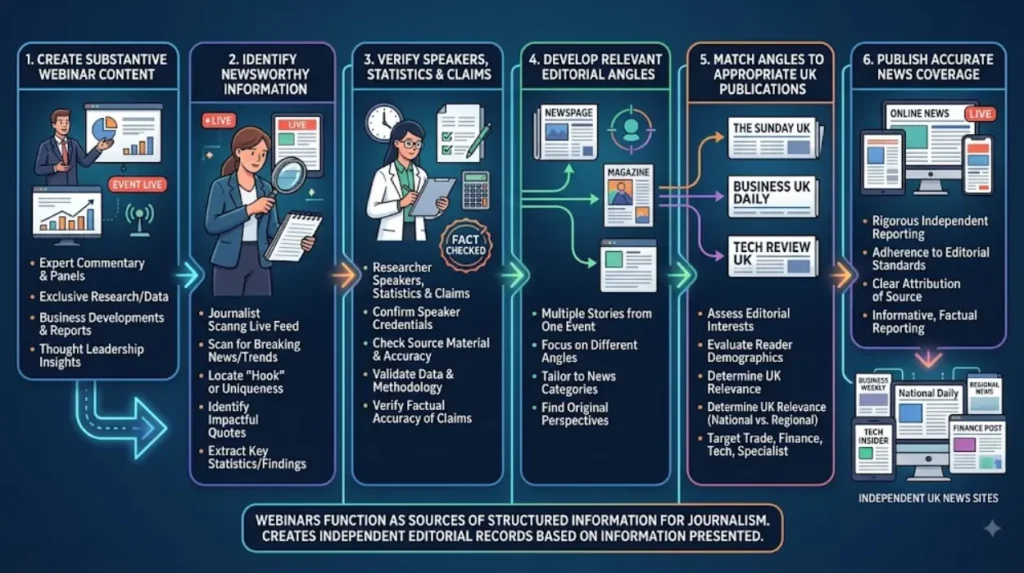
The process begins with a newsworthy webinar, continues through identification of relevant facts and sources, and progresses into publication through editorial selection, audience-specific angles, accurate reporting, and distribution across appropriate UK news categories and publications.
The process can be understood through six stages:
- Create substantive webinar content.
- Identify newsworthy information.
- Verify speakers, statistics, and factual claims.
- Develop relevant editorial angles.
- Match angles with appropriate UK publications.
- Publish accurate news coverage.
The result is not simply wider exposure for an online event. It is the creation of independent editorial records based on information presented during the webinar.
For readers exploring the next stage,
Webinar news coverage explains how these editorial opportunities connect with broader publication strategies.
Webinars therefore function as sources of structured information for journalism when their content contains genuine news value. Research, expert commentary, business developments, statistics, and UK-specific information provide the strongest foundations.
Coverage across 15 UK news sites depends on relevance to each publication rather than repetition of one identical story. National, regional, business, trade, finance, technology, and specialist publications assess the same event through different editorial priorities.
Understanding this process helps explain how an online session moves from a live digital event to a collection of independent UK news articles.



