

Event coverage converts a live event into published editorial content across relevant news sites. A PR agency provides communications strategy. For brands seeking measurable search visibility, 15 targeted news placements create multiple referral, citation, and brand-discovery opportunities from one campaign.
Event coverage and PR agency services serve different operational purposes.
Event coverage is a focused media distribution service that turns an event into published news content. The event becomes the source asset. The service creates articles, distributes them to selected publications, monitors publication results, and reports the resulting coverage.
A PR agency provides a wider communications function. Its activities can include media relations, campaign strategy, reputation management, press office support, executive communications, stakeholder engagement, and long-term brand positioning.
For a brand with a specific event and a defined media objective, the distinction matters. A 15-site event coverage campaign provides a measurable publication target. It creates multiple URLs, media mentions, referral opportunities, and search-visible brand references from one event.
This makes event coverage particularly relevant for businesses that need defined outputs rather than a broad communications retainer.
Why do 15 news sites outperform a single PR agency channel?
Fifteen news sites win when the objective is measurable event visibility across independent publications. Each placement creates a separate indexed URL, referral path, brand mention, and editorial context, strengthening the media coverage footprint around the event and its business message.
The advantage of 15 news sites comes from coverage distribution and publication diversity.
One publication provides one editorial environment. Fifteen publications provide 15 separate environments. Each article has its own URL, publication context, audience, crawlable content, and potential referral path.
The results also create a broader digital footprint around the event.
For example, a UK technology company launching a new platform can use event coverage to generate articles across business, technology, startup, regional, and specialist news publications. Each article can communicate the launch from a different editorial context.
The objective is not simply to count 15 URLs. The objective is to secure relevant and usable coverage.
Key outputs include:
- Published news articles
- Brand mentions
- Event references
- Editorial backlinks where provided
- Indexable publication URLs
- Referral traffic opportunities
- Search-visible content
- Publication reporting
- Coverage records for future campaigns
This is where the:
Event coverage backlinks internal resource fits into the wider decision process. It explains how event-led publication activity contributes to a brand’s backlink profile.
How does a 15-site event coverage service work?
Event coverage converts event assets into news-ready stories, while PR agencies manage wider communication programmes. A 15-site model combines editorial production, targeted distribution, publication tracking, and link monitoring, creating a defined process from announcement through reporting and measurable campaign outcomes.
The process starts with the event itself.
1. Event information is collected
The campaign requires factual event information. Typical inputs include:
- Event name
- Date and location
- Organiser
- Speakers
- Participants
- Business purpose
- Announcements
- Quotes
- Images
- Website URLs
- Supporting statistics
These details provide the factual foundation for the article.
2. The news angle is defined
A news angle identifies why the event matters.
A product launch has a launch angle. A conference has an industry discussion angle. An executive appearance has a leadership or business angle. An award ceremony has a recognition angle.
The angle determines the editorial framing.
3. News content is produced
The event information becomes a publication-ready article.
The article needs a clear headline, factual introduction, relevant details, quotations, supporting information, and appropriate brand references.
The content remains focused on the event rather than becoming a generic promotional page.
4. Distribution targets are selected
The content is distributed across the agreed publication network.
A 15-site campaign creates a defined media footprint. Publication selection depends on campaign requirements, geographic relevance, sector relevance, audience alignment, and availability.
5. Publications are monitored
After distribution, the campaign tracks published URLs.
Monitoring identifies which publications have carried the story, where the brand appears, whether the event details are accurate, and whether links are present.
6. Coverage is reported
The final report records the publication results.
A useful report includes publication names, article URLs, publication dates, headline information, link details where applicable, and campaign-level coverage metrics.
What components make event coverage more valuable than simple PR distribution?
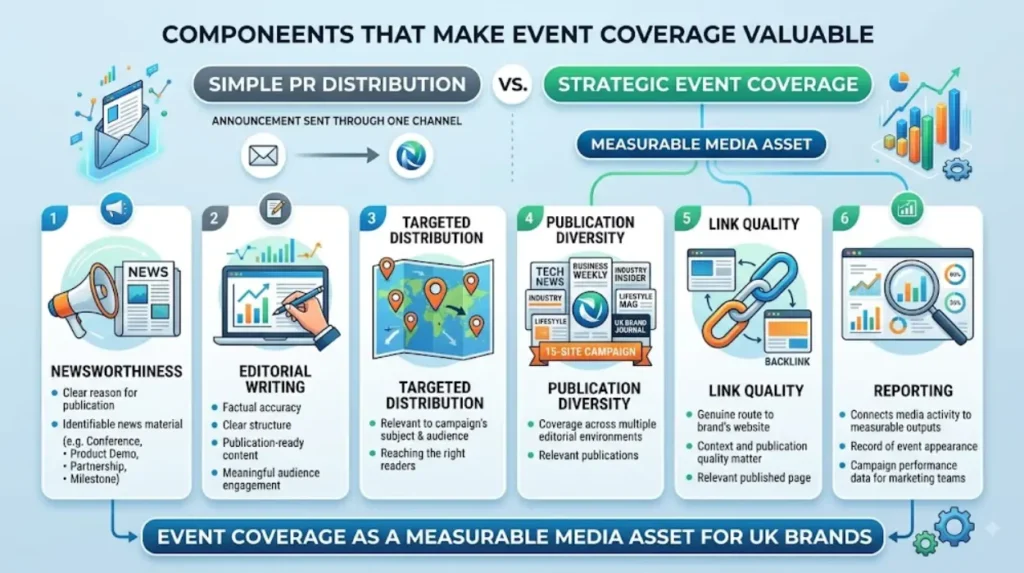
The strongest event coverage service combines newsworthiness, editorial writing, targeted distribution, publication diversity, link quality, and reporting. These components turn an event into a measurable media asset rather than an announcement sent through one communications channel for UK brands today.
The service quality depends on the complete delivery process.
Newsworthiness
The event needs a clear reason for publication. A conference announcement, product demonstration, executive appointment, partnership, award, or corporate milestone provides identifiable news material.
Editorial quality
Publication-ready content needs factual accuracy and a clear structure. Poorly written material reduces the usefulness of distribution because publication alone does not guarantee meaningful audience engagement.
Publication diversity
A 15-site campaign creates coverage across multiple editorial environments. The value increases when the publications are relevant to the campaign’s subject and audience.
Link quality
A backlink is useful when it comes from a relevant published page and provides a genuine route to the brand’s website. Link presence alone is not sufficient. Context and publication quality matter.
Reporting
Reporting connects media activity to measurable outputs. It gives marketing teams a record of where the event appeared and how the campaign performed.
How do 15 news placements support SEO and backlink objectives?
Fifteen quality news placements increase the number of independent pages discussing an event and the routes users take to reach a brand. Value comes from relevant editorial context, publication diversity, indexable coverage, and measurable referral activity across the campaign online.
Event coverage supports SEO through several connected mechanisms.
First, published articles create additional web documents associated with the brand and event. These documents can contain the company name, executives, products, services, event details, and relevant website references.
Second, editorial links create potential referral pathways.
Third, multiple publications create broader entity associations. Search systems can encounter consistent references to the same organisation across different publishers and pages.
Fourth, news coverage creates content that supports brand discovery. Someone searching for the event, speaker, company, product, or announcement can encounter coverage beyond the company’s own website.
This is different from relying exclusively on an owned newsroom or corporate blog.
A company website controls its own publishing environment. External news coverage creates third-party editorial references that exist outside that controlled environment.
The SEO objective therefore involves more than backlink quantity. It includes publication relevance, contextual references, crawlable URLs, brand consistency, and discoverability.
Which events are suitable for 15-site news coverage?
Event coverage fits launches, conferences, webinars, awards, executive appearances, product demonstrations, partnerships, and corporate milestones. The service works when each event contains a clear news angle, verifiable information, named participants, and assets suitable for editorial publication across relevant UK publications.
Different event types create different editorial opportunities.
Product launches
A product launch provides a clear announcement structure. The article can explain what has launched, who it serves, the organisation behind it, and the market context.
Conferences and exhibitions
Conference coverage can focus on speakers, themes, announcements, industry developments, and business participation.
Webinars
Webinars provide publishable information through speaker commentary, research findings, industry insights, and key discussion points.
Awards
Awards create recognition-based news. Coverage can identify the recipient, award category, organisation, judging context, and achievement.
Executive appearances
An executive speaking at a recognised event creates a leadership-focused story. The article can connect the appearance with the executive’s role and the event’s subject.
Partnerships
Corporate partnerships create announcement-driven content. Coverage can explain the organisations involved, the purpose of the partnership, and its intended business outcome.
When is a PR agency a better choice than event coverage?
A PR agency remains relevant when a brand needs integrated strategy, media relations, reputation management, campaigns, stakeholder communications, and ongoing counsel. Event coverage provides a narrower deliverable: turning one event into structured news coverage across selected publications for event campaigns.
The two services are not identical.
A PR agency provides an ongoing communications infrastructure. It can manage journalist relationships, media pitching, crisis communications, campaign planning, interviews, executive positioning, and reputation programmes.
Event coverage focuses on a defined publication outcome.
A business launching a major annual communications programme needs broader PR infrastructure. A business organising one conference and requiring 15 published news articles has a more specific requirement.
The decision depends on scope.
A PR agency is appropriate for:
- Long-term media relations
- Reputation management
- Crisis communications
- Executive positioning
- Integrated PR campaigns
- Journalist outreach
- Strategic communications
Event coverage is appropriate for:
- One defined event
- Multiple news publications
- Structured media distribution
- Backlink opportunities
- Event-related search visibility
- Publication reporting
- Defined campaign outputs
The distinction prevents brands from buying a broad service when a focused media deliverable meets the immediate requirement.
How should brands compare event coverage with a PR agency?
Brands can evaluate event coverage against a PR agency by comparing outputs, publication count, relevance, links, turnaround, reporting, and scope. A decision based on these measures identifies whether a focused 15-site service matches the campaign’s immediate media objective before selection.
A practical comparison uses measurable criteria.
| Evaluation factor | Event coverage | PR agency |
|---|---|---|
| Primary purpose | Event publication | Wider communications |
| Publication target | Defined, such as 15 sites | Campaign-dependent |
| Editorial content | Event-focused | Multiple content types |
| Media relations | Limited or distribution-focused | Core service |
| Backlink opportunities | Direct campaign objective | Secondary or campaign-dependent |
| Reporting | Publication-focused | Wider PR reporting |
| Duration | Defined campaign | Often ongoing |
| Strategic scope | Narrow | Broad |
The most important question is not which service is universally better.
The question is which delivery model matches the required outcome.
A company with one event and a requirement for 15 news placements has a clearly defined campaign scope. A company managing continuous media relations needs a broader communications model.
When should a brand choose event coverage instead of a PR agency?
Choose event coverage when the primary objective is securing multiple published news stories from a defined event. Choose a PR agency when the objective includes ongoing media relations, reputation management, strategic communications, and broader campaign activity beyond event publication directly.
The decision becomes clearer when the campaign has measurable requirements.
Choose event coverage when the brief specifies:
- One event or event campaign.
- A defined publication target.
- News article production.
- External media visibility.
- Backlink opportunities.
- Publication URLs.
- Coverage reporting.
- A defined delivery period.
Choose a PR agency when the brief requires continuing strategic activity across multiple communication channels.
This distinction also improves budget control. A focused event campaign has a defined scope, while a retained PR function covers a wider set of activities.
For brands evaluating suppliers, the service agreement needs to specify publication expectations, content responsibilities, reporting requirements, turnaround, link conditions, and campaign scope.
How can brands measure the value of 15 news sites?
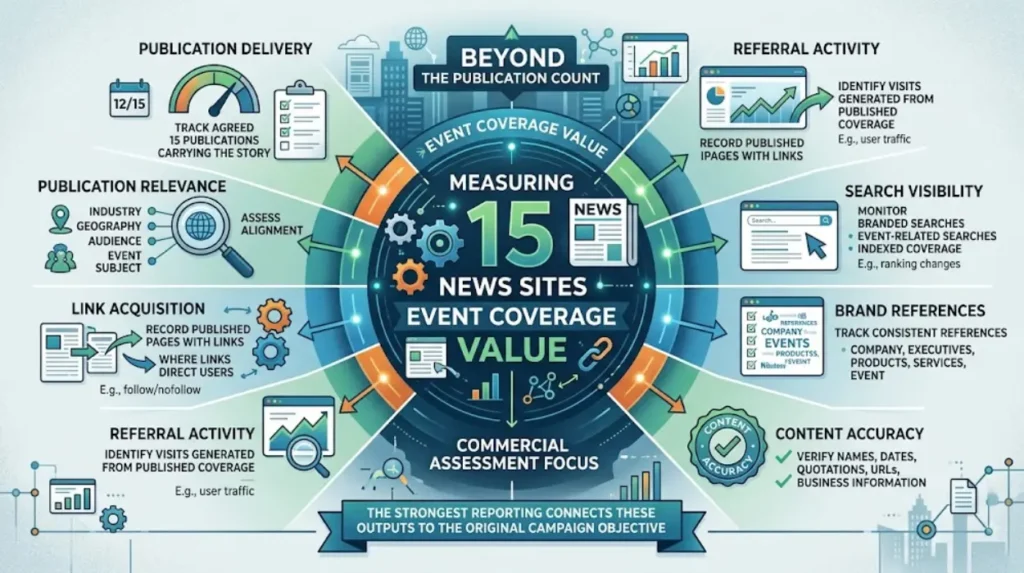
Event coverage delivers value when the service produces relevant publications, indexable pages, accurate brand references, useful links, and transparent reporting. The commercial assessment focuses on measurable outputs and business relevance rather than the headline number of publications alone for decision-makers.
A 15-site campaign needs more than a publication count.
Brands can measure:
Publication delivery
Track how many of the agreed 15 publications carried the event story.
Publication relevance
Assess whether the sites align with the brand’s industry, geography, audience, or event subject.
Link acquisition
Record which published pages contain links and where those links direct users.
Referral activity
Use analytics to identify visits generated from published coverage.
Search visibility
Monitor branded searches, event-related searches, and indexed coverage over the campaign period.
Brand references
Track consistent references to the company, executives, products, services, and event.
Content accuracy
Verify names, dates, quotations, URLs, and business information across published articles.
The strongest reporting connects these outputs to the original campaign objective.
Is 15-site event coverage the right choice for a UK brand?
Fifteen-site event coverage is the right choice when a UK brand needs a defined number of external news placements from one event and wants measurable publication, backlink, and visibility outputs. A PR agency fits broader, ongoing communications requirements beyond event coverage.
For a UK brand, the choice depends on the event, audience, sector, publication requirements, and desired outcome.
Event coverage provides a focused route from event → editorial content → multiple publications → indexed coverage → referral and visibility opportunities.
A PR agency provides a broader route from communications strategy → media relations → campaigns → ongoing coverage → reputation management.
Brands comparing the two models need to define the desired outcome before selecting a provider.
Explore More Expert Insights:
Webinar News Coverage Services Across 15 UK Sites
Hybrid Event Coverage: Get Published on 15 News Sites
For businesses primarily focused on event-led publication and measurable media outputs, a 15-site campaign provides a clear and assessable scope. For organisations requiring continuous media relations and strategic communications, a PR agency provides the broader operational framework.
The key decision is therefore based on scope, outputs, publication relevance, backlink requirements, reporting, and business objectives rather than service labels alone.



