

Diversity, equity and inclusion (DEI) events have become important forums for discussing workplace practices, representation, accessibility, leadership, equality, and community participation. Conferences, seminars, panels, workshops, and public programmes create structured opportunities to examine how organisations and communities approach inclusion.
In the United Kingdom, DEI events involve businesses, charities, educational institutions, professional bodies, public-sector organisations, community groups, and specialist networks. Their subjects connect with employment, organisational culture, leadership, social policy, accessibility, and professional development.
News coverage gives these events a wider informational context. Publishing event information across 15 news sites creates multiple points where audiences can discover speakers, themes, discussions, research findings, and outcomes. This makes DEI event coverage relevant to both event communication and public information.
What are DEI events?
DEI events address diversity, equity and inclusion through conferences, workshops, panels and public programmes. Coverage across 15 news sites expands awareness of these discussions, documents participation, and places event information within broader UK media and public-interest contexts for wider audiences.
DEI stands for diversity, equity and inclusion.
Diversity concerns the presence and representation of people with different backgrounds, experiences, characteristics, and perspectives.
Equity concerns fair access to opportunities, resources, participation, and organisational processes.
Inclusion concerns creating environments where people can participate, contribute, and access opportunities effectively.
A DEI event can focus on one subject or combine several areas. For example, a workplace conference can examine inclusive recruitment, accessibility, leadership representation, employee participation, and organisational culture.
Common DEI event formats include:
- Conferences featuring multiple speakers and sessions
- Panel discussions addressing specific inclusion issues
- Workshops focused on workplace practices
- Seminars examining research and policy
- Networking events connecting professionals and organisations
- Public forums discussing community participation
- Leadership events addressing representation and organisational development
The format influences the information available for news coverage. A conference provides multiple sessions and speakers. A workshop provides a focused subject. A research-led event provides findings and expert commentary.
Why are DEI events newsworthy?
DEI events become newsworthy when their content connects to identifiable people, organisations, policies, research, workplace practices or community outcomes. Strong coverage starts with a clear event subject, factual details, relevant speakers, defined audiences, and timely information.
Newsworthiness depends on identifiable information rather than the DEI label alone.
An event becomes more informative when it contains a clear development, discussion, finding, announcement, or public-interest subject. Examples include the publication of new inclusion research, a discussion about workplace accessibility, or a panel examining representation in senior leadership.
What information creates an editorial angle?
Several event elements provide distinct information for journalists and audiences:
- Speaker participation
- New research or survey findings
- Organisational announcements
- Policy discussions
- Workplace initiatives
- Accessibility developments
- Community partnerships
- Leadership discussions
- Programme themes
- Post-event findings
For example, a UK business conference discussing accessible recruitment provides a specific employment-related topic. A university DEI forum examining student inclusion provides an education-related topic.
The event therefore becomes a source of structured information rather than simply an announcement.
Why do 15 news sites matter for DEI event coverage?
Coverage across 15 news sites creates multiple publication points for one DEI event. Each site can present the event within its editorial context, helping audiences discover discussions about inclusion, representation, accessibility, workplace culture, leadership, and social participation.
Fifteen news sites provide broader publication distribution than a single media outlet. Different publications attract audiences with different professional, geographic, and topical interests.
A DEI event can relate simultaneously to business, employment, education, leadership, community affairs, and social policy. Multiple news environments provide opportunities for these different contexts to become visible.
How does multiple-site coverage increase discoverability?
People search for DEI information using different terms. Search queries can include:
- DEI conferences UK
- diversity and inclusion events
- workplace inclusion conferences
- equality and accessibility events
- inclusive leadership events
- diversity conferences in London
- UK workplace equality discussions
Coverage across multiple news sites creates additional published references to the event, its speakers, themes, location, and subject matter.
This creates a broader information footprint around the event.
How does DEI event coverage work?
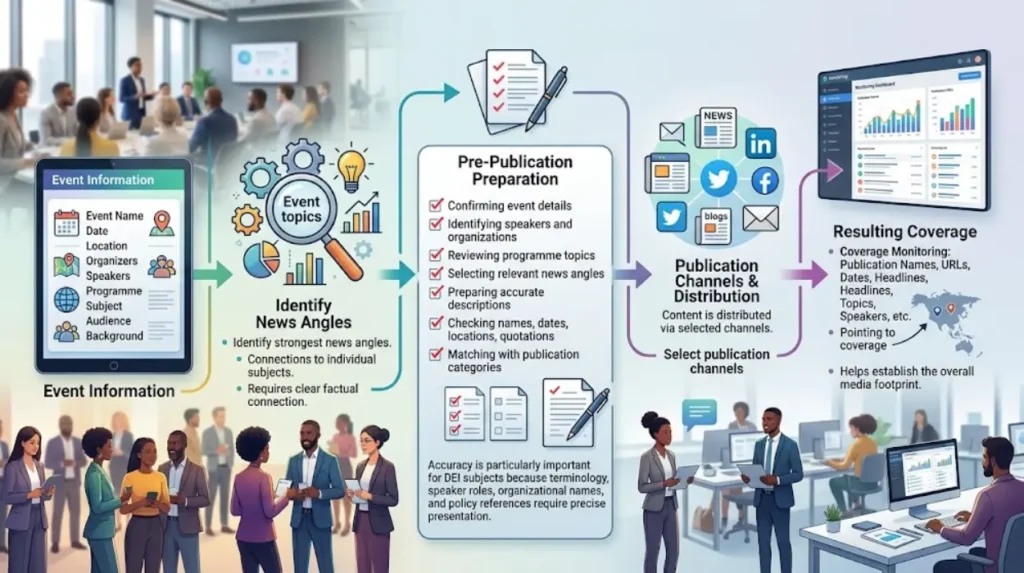
DEI event coverage usually follows a structured information flow: event details are prepared, newsworthy elements are identified, publication channels are selected, content is distributed, and resulting coverage is recorded. Each stage supports accuracy, consistency, discoverability, and contextual relevance.
The process begins with event information.
Core details include the event name, date, location, organisers, speakers, programme, subject, audience, and relevant background.
The next stage identifies the strongest news angles. A long event programme contains many individual subjects, but each requires a clear factual connection to the event.
What happens before publication?
Pre-publication preparation typically includes:
- Confirming event details.
- Identifying speakers and organisations.
- Reviewing programme topics.
- Selecting relevant news angles.
- Preparing accurate descriptions.
- Checking names, dates, locations, and quotations.
- Matching information with relevant publication categories.
Accuracy is particularly important for DEI subjects because terminology, speaker roles, organisational names, and policy references require precise presentation.
What happens after publication?
Published coverage creates a record of where the event appears. Coverage monitoring identifies publication names, URLs, dates, headlines, topics, speakers, and other relevant details.
This information helps establish the overall media footprint of the event.
What topics do DEI events commonly cover?
DEI events cover interconnected themes including workplace inclusion, accessibility, representation, equality policy, leadership, community participation, and organisational culture. Examples include disability inclusion conferences, women in leadership forums, LGBTQ+ workplace events, and ethnic diversity business summits.
DEI is a broad subject area. Individual events usually concentrate on specific issues.
Which workplace topics appear in DEI events?
Workplace-focused events frequently address recruitment, employee development, leadership, workplace accessibility, organisational culture, and representation.
For example, an inclusive recruitment event can examine job descriptions, recruitment processes, candidate accessibility, and workforce representation.
Which community topics appear?
Community-focused events can examine participation, accessibility, social inclusion, education, public services, and local engagement.
A community inclusion forum can therefore attract interest from charities, local organisations, educators, public-sector professionals, and community leaders.
Which leadership topics appear?
Leadership events often examine representation in management, inclusive decision-making, employee participation, organisational culture, and leadership development.
These subjects connect DEI with broader business and organisational management discussions.
How can coverage reach different UK audiences?
Fifteen news sites provide broader topical and geographic exposure than one publication alone. Coverage can reach audiences interested in business, employment, education, community affairs, leadership, social policy, and organisational development across different parts of the United Kingdom.
The UK media environment includes national, regional, specialist, professional, and community-oriented publications.
Different publications serve different information needs.
A business publication can focus on organisational inclusion. An employment publication can focus on recruitment and workplace culture. A regional publication can emphasise local speakers, venues, organisations, and community participation.
This distinction matters because the same DEI event can have several valid editorial contexts.
Why does geographic relevance matter?
A London-based DEI conference has a local dimension through its venue, speakers, organisations, and audience. A Manchester event can have a distinct regional context. A UK-wide conference can have broader national relevance.
Multiple publication environments allow geographical information to remain connected to the event itself.
What information can DEI event coverage preserve?
DEI event coverage helps preserve a factual public record of speakers, themes, discussions and programme activity. It also improves discoverability for people searching event names, topics, speakers, organisations, dates, locations, and specific diversity and inclusion subjects through published information.
News coverage creates an accessible record of an event beyond its original programme.
An event website provides primary information, while news coverage places selected information into editorial publications.
This record can include speaker names, discussion subjects, event dates, organisational participation, research findings, and programme developments.
Why is a public information record useful?
People often search for event information after an event has finished. They can search for a speaker, organisation, topic, event name, or discussion.
Published coverage provides additional sources containing this information.
For example, someone researching inclusive leadership can encounter an article describing a leadership panel held at a DEI conference. Someone researching workplace accessibility can find coverage focused on an accessibility session.
The resulting information remains connected to specific event activity.
What types of information can journalists use from DEI events?
DEI events generate several useful forms of information for journalists and audiences, including speaker announcements, programme details, research findings, panel discussions, attendance information, organisational initiatives, and post-event outcomes. Each element supplies a distinct editorial angle for coverage purposes.
Event information becomes more useful when individual facts have clear context.
A speaker announcement identifies expertise and participation. A research finding provides evidence. A panel discussion provides a defined topic and participating voices. An organisational initiative provides a specific development.
Which event elements create distinct stories?
Consider a conference featuring five sessions:
- Inclusive recruitment
- Disability accessibility
- Women in leadership
- LGBTQ+ workplace inclusion
- Ethnic diversity in management
Each session has a different subject and audience.
Coverage can therefore reflect the event’s broader DEI purpose while retaining specific topical relevance.
This structure also makes information easier for search engines and readers to understand because individual concepts remain clearly defined.
When do DEI events benefit from news coverage?
DEI events benefit from coverage when their subject matter has clear public relevance and identifiable information. Examples include new inclusion research, workplace policy discussions, accessibility initiatives, leadership programmes, community partnerships, and measurable participation outcomes presented during the event.
Not every event contains the same level of news information.
Events with defined subjects, named participants, new findings, organisational developments, or public-interest discussions provide stronger informational material.
The timing of coverage also matters. Pre-event information supports discovery of the programme and participants. During-event information records active discussions. Post-event coverage documents findings, participation, and outcomes.
How does timing affect information value?
Before an event, audiences need basic information such as date, location, speakers, and programme themes.
During an event, discussion topics and speaker contributions become relevant.
After an event, outcomes, findings, announcements, and key discussions provide a factual record.
Each stage answers different audience questions.
How should readers evaluate DEI event coverage?
Readers can evaluate DEI event coverage by examining publication relevance, factual accuracy, topic alignment, geographic reach, speaker identification, event details, and consistency across reports. These criteria distinguish useful informational coverage from repeated or incomplete event references when comparing reports.
Readers can assess coverage systematically rather than judging it only by the number of publications.
Which criteria matter?
Important criteria include:
- Accuracy: Names, dates, locations, roles, and event facts are correct.
- Relevance: The publication’s audience connects with the event subject.
- Topic clarity: The article explains the specific DEI issue.
- Speaker identification: Participants and their roles are clearly stated.
- Geographic context: The coverage explains relevant UK locations.
- Information depth: The article provides more than basic event details.
- Consistency: Published information remains factually aligned.
These criteria help readers understand the difference between broad publication presence and meaningful informational coverage.
For readers progressing from general understanding toward evaluating distribution approaches,
DEI event coverage provides a useful next step.
For readers examining specific delivery options,
DEI Event News Coverage Services introduces the service-level context separately from this educational overview.
What is the overall value of covering DEI events across 15 news sites?
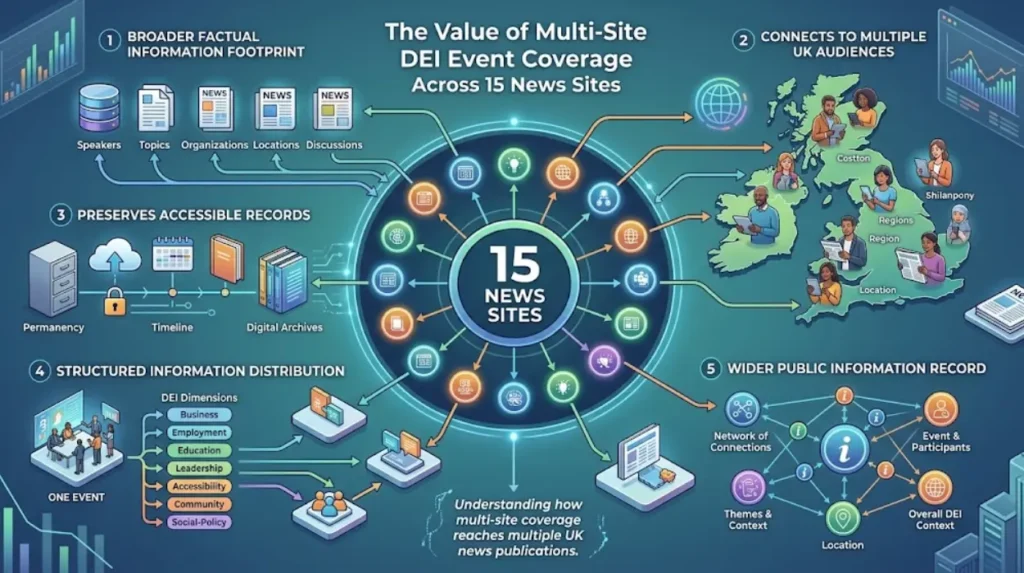
DEI event coverage across 15 news sites creates a broader factual information footprint around speakers, topics, organisations, locations, and discussions. It connects one event with multiple UK audiences while preserving accessible records of its diversity, equity, and inclusion content.
The value of multi-site coverage comes from structured information distribution.
Explore More Expert Insights:
How ESG Events Attract Purpose-Driven News Coverage
What News Coverage Means for Startup Launch Events
A DEI event can contain business, employment, education, leadership, accessibility, community, and social-policy dimensions. Fifteen news sites provide multiple environments for audiences to encounter those subjects.
The result is a wider public information record that connects the event with its participants, themes, location, and wider DEI context.
Understanding this structure helps explain why DEI events represent relevant subjects for news coverage in the United Kingdom. It also establishes the foundation for examining how such coverage reaches multiple UK news publications and how different distribution approaches operate.



