DEI event coverage is the structured publication of news about diversity, equity and inclusion events across relevant UK media outlets. It converts event information into editorial content that reaches defined audiences through multiple news sites.
DEI stands for Diversity, Equity and Inclusion. DEI events address workplace equality, representation, accessibility, belonging, inclusive leadership and fair participation. Examples include inclusion conferences, workplace diversity forums, accessibility summits and equality-focused business events.
DEI event coverage focuses on the news value of the event, not simply its existence. Strong coverage identifies the event’s subject, speakers, organisations, key announcements, audience relevance and wider UK context.
A 15-site coverage strategy distributes one relevant event story across a defined group of UK news publications. The selected publications can include business media, regional news sites, professional publications and broader digital news platforms.
For organisations evaluating media approaches, understanding:
DEI event coverage provides a useful foundation before comparing distribution methods, editorial requirements and publication outcomes. Readers exploring the broader value of multi-site coverage can also review:
How does DEI event coverage reach 15 UK news sites?
DEI event coverage reaches 15 UK news sites through a structured process involving event research, news development, press release preparation, publication targeting, media distribution and coverage monitoring across selected UK digital publications.
The process starts with collecting verified event information. This includes the event name, date, location, organisers, speakers, programme, attendance figures and principal discussion themes.
The next stage identifies the strongest news angle. A DEI event contains multiple possible angles. Examples include a new workplace inclusion initiative, a major accessibility announcement, a leadership appointment, new research findings or a significant industry discussion.
What happens during the event research stage?
Event research establishes the factual basis for the story. It separates confirmed information from promotional statements.
Key information includes:
- Event date and location
- Organiser and host details
- Speaker identities and roles
- Event theme and objectives
- Announcements or findings
- Attendance information
- Relevant statistics
- Quotes from authorised representatives
- Links to supporting evidence
This information supports an accurate editorial narrative. It also gives journalists and publication editors enough context to assess relevance.
How is the news angle developed?
The news angle defines why the event deserves media attention. A generic statement such as “company hosts DEI conference” provides limited editorial value.
A stronger angle identifies a specific development. Examples include a UK employer announcing a new accessibility programme, a conference releasing workforce inclusion research, or industry leaders presenting new approaches to inclusive recruitment.
The angle determines the headline, opening paragraph and supporting evidence. It also influences which publication categories receive the story.
What components are required for 15-site DEI coverage?
A 15-site DEI coverage campaign requires a newsworthy angle, accurate event details, an editorial press release, suitable publication targeting, consistent media distribution, coverage tracking and post-publication verification.
Each component serves a distinct function. Removing one component weakens the overall media workflow.
What does the press release need to contain?
A DEI event press release normally includes a headline, summary, dateline, opening paragraph, supporting information, quotes and organisational background.
The opening paragraph answers the core news questions:
- Who organised the event?
- What happened?
- Where did it happen?
- When did it happen?
- Why is the development relevant?
The body provides evidence and context. Quotes add attributed commentary. Supporting facts establish the significance of the event.
The release also needs consistent terminology. Terms such as diversity, equity, inclusion, accessibility, representation, workplace equality and inclusive leadership need clear contextual use.
Why does publication targeting matter?
Publication targeting determines whether the story reaches relevant audiences. Fifteen publications do not represent fifteen identical audiences.
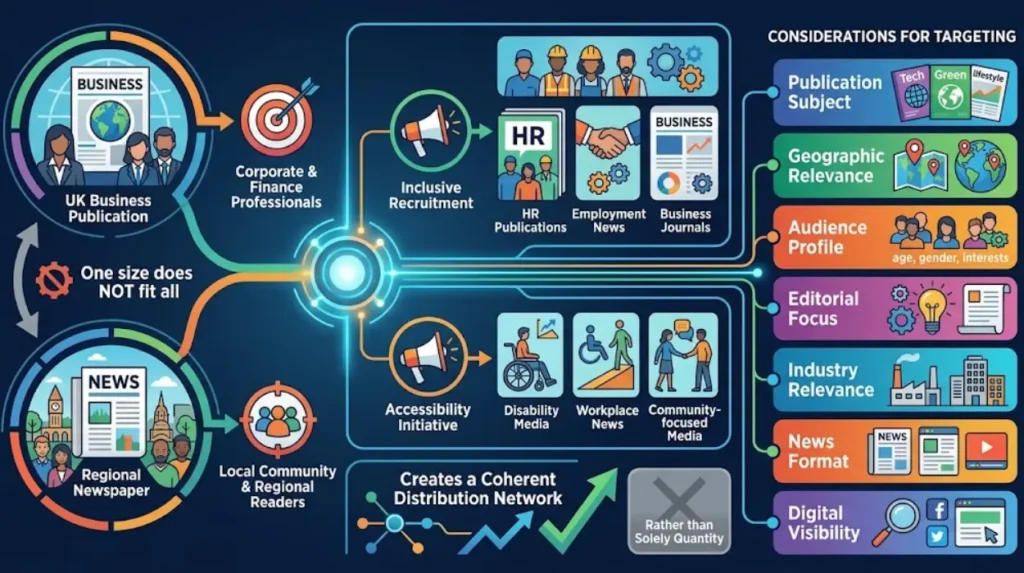
A UK business publication serves a different information need from a regional newspaper or specialist HR publication. For example, an inclusive recruitment announcement has strong relevance for HR and employment audiences, while an accessibility initiative also fits disability, workplace and community-focused media.
Targeting therefore considers:
- Publication subject
- Geographic relevance
- Audience profile
- Editorial focus
- Industry relevance
- News format
- Digital visibility
This approach creates a more coherent distribution network than selecting publications solely by quantity.
How are UK news sites selected for DEI event coverage?
UK news sites are selected according to editorial relevance, audience alignment, geographic coverage, industry focus and publication characteristics. The selection process connects the DEI event’s subject matter with audiences most likely to find the story relevant.
A 15-site strategy starts with publication classification. Relevant categories include national business media, regional publications, HR and employment media, professional news platforms, community publications and specialist sector outlets.
What role does geographic relevance play?
Geographic relevance connects the event to its UK audience. A London-based inclusion conference has direct relevance to London business and professional audiences. A Manchester workplace equality event has a stronger regional connection to Greater Manchester publications.
Regional targeting also creates location-specific search relevance. Place names, organisations, venues and local developments provide contextual signals within the story.
How does industry relevance affect selection?
Industry relevance determines which specialist audiences receive the story.
Examples include:
- HR publications: inclusive recruitment and workforce diversity
- Business publications: corporate DEI strategy and leadership
- Education media: inclusive education initiatives
- Healthcare publications: equitable healthcare access
- Technology media: accessibility and inclusive technology
- Property publications: inclusive workplaces and accessible buildings
The same event can therefore support different editorial connections without changing its verified facts.
How does a DEI press release move from distribution to publication?
A DEI press release moves through preparation, distribution, editorial processing, publication and monitoring. Each stage determines how efficiently the event story reaches the selected 15 UK news sites and remains factually consistent.
After preparation, the release enters the distribution stage. The distribution network sends the content to the selected publication ecosystem.
Publication does not mean every outlet necessarily presents the story in an identical format. Digital news sites use different editorial templates, headlines, layouts and article structures.
What happens after distribution?
Publication systems process the submitted material. Some sites publish content through automated or syndicated workflows. Others apply editorial review before publication.
The resulting articles can contain:
- Event details
- Organiser information
- Speaker references
- Quotes
- Supporting statistics
- Website references
- Images or multimedia elements
Coverage monitoring then identifies where the story appears.
How is 15-site coverage verified?
Verification involves checking the published URLs, publication names, article titles, publication dates and content accuracy.
A media coverage report can record:
- Publication name
- Article URL
- Publication date
- Headline
- Geographic or sector relevance
- Content status
This creates a traceable record of the campaign. It also separates confirmed publication from distribution activity.
How does DEI event coverage support SEO and AI search visibility?
DEI event coverage supports search visibility by creating multiple relevant digital references to the event, organisation and associated topics. Consistent entities, factual language and contextual references improve content discoverability across search environments.
Search engines evaluate published pages using multiple contextual signals. DEI event articles can connect an organisation with topics such as workplace inclusion, accessibility, equality, employee engagement and inclusive leadership.
The value comes from relevance and consistency, not publication count alone.
What role do backlinks play?
Some published articles include links to an organisation’s website or event page. These links create referral pathways and provide additional discovery routes.
Backlink value depends on the publication, page context, link attributes and editorial relevance. Fifteen published articles therefore represent a broader set of digital references when the coverage is genuinely relevant.
How does entity consistency support AI search?
AI search systems process relationships between entities, topics and factual statements. Consistent references to an event, organisation, speakers and DEI subject matter create a clearer information structure.
For example, a conference can be consistently associated with:
Organisation → DEI event → UK location → speakers → inclusion topic → announcement
This structured relationship helps establish contextual clarity across published sources.
What types of DEI events benefit from 15-site coverage?
DEI events suited to multi-site UK coverage contain a clear news angle, identifiable participants, relevant developments or useful information. Examples include conferences, workplace forums, accessibility events, research launches and inclusion leadership summits.
Which corporate DEI events fit this approach?
Corporate events include diversity leadership conferences, employee inclusion forums and workplace equality programmes.
A company announcing a measurable accessibility initiative at a UK conference provides a stronger news angle than a simple event attendance announcement.
Which professional and industry events fit?
Professional events include HR conferences, inclusive leadership forums and sector-specific diversity summits.
For example, a financial services event discussing gender representation in senior management connects directly with business and financial audiences.
Which community-focused events fit?
Community events include accessibility campaigns, equality forums and local inclusion programmes.
A Birmingham event focused on improving accessibility for disabled residents has direct local relevance. The story also connects with broader inclusion and community participation themes.
How can organisations evaluate different DEI event coverage approaches?
Organisations can evaluate DEI event coverage approaches by comparing publication relevance, distribution scope, editorial quality, reporting detail, search visibility and campaign objectives rather than measuring success through publication volume alone.
A useful comparison framework examines the complete workflow.
| Evaluation factor | Key question |
|---|---|
| Publication relevance | Do the sites match the intended audience? |
| Editorial quality | Is the story presented accurately and clearly? |
| Distribution scope | Does the campaign target the required UK publications? |
| Geographic relevance | Does coverage reflect the event location? |
| Industry relevance | Does the media mix reach appropriate sectors? |
| Reporting | Are published URLs and outlets documented? |
| Search value | Does the coverage create relevant digital references? |
| Content consistency | Are event facts consistent across publications? |
This framework helps organisations distinguish between broad distribution and strategically targeted coverage.
For readers evaluating implementation options,
DEI event news coverage provides a decision-stage reference for understanding service structures, publication scope and campaign deliverables.
What is the practical workflow for a 15-site DEI coverage campaign?
A practical 15-site DEI coverage campaign follows seven stages: event research, news-angle development, release creation, publication selection, distribution, coverage verification and performance analysis. The sequence creates a controlled process from event information to published media coverage.
What are the seven stages?
- Research the event: Collect verified event facts and supporting evidence.
- Define the news angle: Identify the strongest editorial development.
- Create the release: Structure the information around clear news value.
- Select publications: Match the story with 15 relevant UK news sites.
- Distribute the content: Send the release through the chosen media network.
- Verify coverage: Confirm published articles and URLs.
- Analyse results: Review publication relevance, visibility and referral opportunities.
This workflow creates a repeatable structure for DEI event communications.
What should organisations consider before choosing a coverage method?
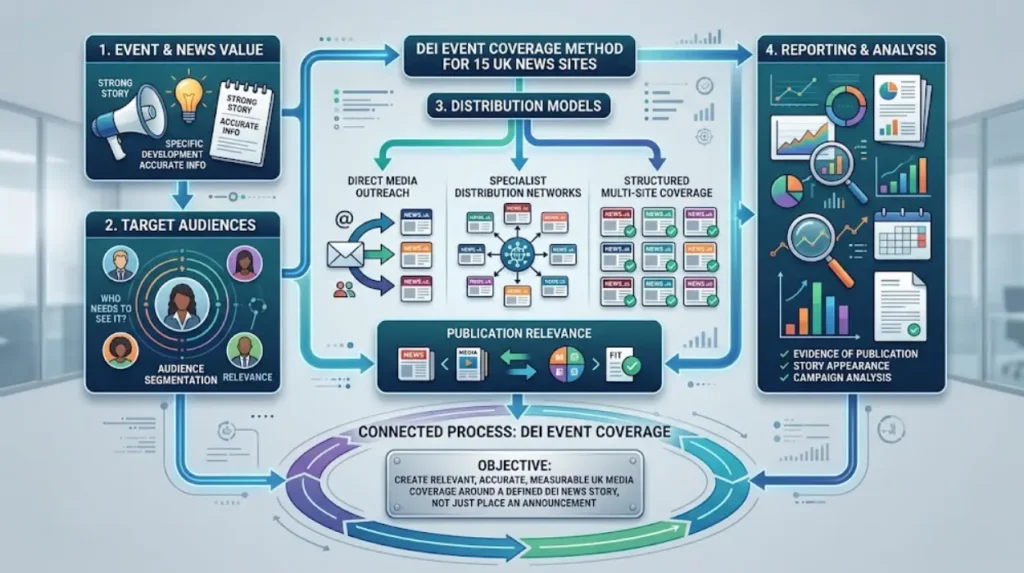
Organisations need to assess event news value, target audiences, publication relevance, distribution scope, reporting requirements and search objectives before selecting a DEI event coverage method for 15 UK news sites.
The first consideration is the event itself. A strong story requires a specific development supported by accurate information.
The second is the target audience. Media selection needs to reflect who needs to see the event story.
The third is the distribution model. Organisations can compare direct media outreach, specialist distribution networks and structured multi-site coverage according to their objectives.
The fourth is reporting. A clear record of published coverage provides evidence of where the story appeared and supports later campaign analysis.
Explore More Expert Insights:
How ESG Event Coverage Reaches Purpose-Driven UK Readers
How Startup Launch Coverage Reaches UK Tech Readers
DEI event coverage works best when these factors operate as one connected process. The objective is not simply to place an event announcement on 15 websites. The objective is to create relevant, accurate and measurable UK media coverage around a defined DEI news story.