

ESG events are organised gatherings focused on environmental, social and governance issues, bringing together businesses, policymakers, investors, experts and communities to discuss measurable sustainability, responsibility, inclusion and governance practices.
ESG stands for environmental, social and governance. The term describes three areas used to assess how an organisation manages sustainability, social responsibility and organisational conduct.
An ESG event applies these themes to a public programme. The format includes conferences, summits, panel discussions, workshops, exhibitions, roundtables and networking sessions. Examples include a net-zero conference, a social impact summit and a corporate governance forum.
In the United Kingdom, ESG events address topics connected with climate transition, responsible investment, workforce inclusion, ethical supply chains, community impact and corporate accountability.
Purpose-driven news coverage develops when an ESG event contains information that has relevance beyond the event itself. Journalists assess the subject, evidence, speakers, developments and public interest before deciding whether an event provides a reportable story.
Why do ESG events attract purpose-driven news coverage?
ESG events attract purpose-driven news coverage because they address public-interest subjects such as climate action, social impact, ethical business and governance, while providing speakers, evidence, announcements and discussions that create identifiable news angles for journalists.
Purpose-driven journalism focuses on stories connected with social, environmental, economic or public-interest outcomes. ESG events naturally contain these subjects.
News value increases when an event presents specific information. A new emissions target, sustainability investment, workforce initiative or governance policy provides a clearer reporting angle than a general discussion about ESG.
Journalists also examine relevance to their audiences. A climate policy announcement has relevance to environmental publications. A responsible investment development has relevance to financial and business media. A new social impact programme has relevance to community and social affairs publications.
Which ESG topics create strong news angles?
Common topics include:
- Net-zero targets and emissions reduction
- Renewable energy and energy efficiency
- Sustainable finance and responsible investment
- Diversity, equity and inclusion
- Employee wellbeing and workforce development
- Ethical supply chains
- Human rights and social impact
- Corporate governance and accountability
- Sustainable construction and property
- Circular economy and waste reduction
A specific announcement within one of these areas gives journalists a defined subject to investigate and report.
How do journalists evaluate ESG events for newsworthiness?
Journalists evaluate ESG events by examining relevance, originality, evidence, public interest, timing, credible sources and measurable outcomes. Events containing specific developments receive stronger editorial consideration than programmes built around broad promotional statements.
Newsworthiness is not determined by the ESG label alone. Journalists need a clear reason to report an event.
The first factor is relevance. A story must connect with the publication’s audience. UK business media focuses on commercial and corporate implications. Environmental publications focus on climate, conservation and sustainability developments. Regional publications focus on local organisations, communities and economic effects.
The second factor is originality. An event becomes more distinctive when it contains new information. Examples include a newly announced sustainability partnership, a first-year impact report or a new investment commitment.
The third factor is evidence. Journalists require factual support for important claims. Quantified emissions reductions, investment figures, participation numbers and independently verified findings provide stronger reporting material.
Timing also matters. ESG stories connected with new legislation, government announcements, major industry developments or significant environmental events have a defined news context.
What information inside an ESG event becomes news?
Information becomes news when it represents a new development, measurable result, significant statement, policy change, investment decision, research finding, partnership or community outcome that has relevance to a defined UK audience.
An event agenda contains multiple potential story elements. Not every session has equal editorial value.
A keynote speech can become news when the speaker announces a new policy or provides a significant industry forecast. A panel discussion becomes more newsworthy when participants reveal new data or respond to an important development.
Research presentations also provide strong material. A study showing changes in consumer behaviour, corporate emissions or sustainable investment patterns gives journalists factual information to report.
What examples show the difference between discussion and news?
A general statement such as “businesses need stronger sustainability strategies” provides limited news value.
A statement that a company has reduced operational emissions by 35% over a defined period provides a measurable reporting point.
A panel discussing responsible investment is a discussion.
An announcement of a defined £10 million investment programme for sustainable projects is a news development.
This distinction helps explain why some ESG events receive coverage while others remain largely event-focused.
How do speakers influence ESG event coverage?
Speakers influence ESG event coverage through their expertise, authority, relevance and ability to provide substantive information. Policymakers, researchers, executives, investors and community representatives each create distinct editorial perspectives on ESG developments.

Speaker selection affects the range of available news angles.
A government representative can provide a policy perspective. A sustainability director can explain organisational implementation. An investor can discuss capital allocation. A researcher can provide evidence. A community representative can explain social outcomes.
Credibility is important because journalists need identifiable sources. Speakers with relevant professional roles provide attribution for statements and data.
The content delivered by speakers also matters. A recognised expert discussing established concepts creates educational value. A recognised expert presenting new research, policy information or measurable findings creates stronger news potential.
Why do diverse perspectives matter?
ESG issues involve multiple stakeholders. Environmental decisions affect businesses, consumers, employees, communities and investors.
A single event containing several perspectives gives journalists more material for reporting. For example, a sustainable infrastructure conference can include a developer, local authority representative, investor, engineer and community organisation.
Each participant addresses the same broad subject from a different institutional position.
How does event content become a news story?
Event content becomes a news story when journalists identify a clear development, select relevant evidence, verify statements, attribute information to credible sources and connect the event’s subject with a wider public, industry, environmental or economic context.
The process starts with identifying the central news angle.
Journalists then assess supporting information. This includes statistics, direct statements, research findings, policy references and organisational announcements.
Verification follows. Claims involving environmental performance, financial investment or social outcomes require accurate sourcing.
The journalist then establishes context. A new sustainability commitment becomes more informative when its scale, timeframe, sector relevance and expected outcome are explained.
The final story focuses on the development rather than simply reproducing the event agenda.
What makes ESG event coverage relevant to UK audiences?
UK relevance comes from connections with British businesses, communities, regulation, investment, employment, environmental policy, regional development and public concerns. Localised facts give ESG stories clearer significance for UK readers and specialist publications.
Geography is one source of relevance. An ESG event held in London has a different regional reporting angle from an event focused on renewable energy development in Scotland or community investment in Manchester.
Industry relevance also matters. A sustainable finance event connects with financial services readers. A green construction conference connects with property and infrastructure audiences.
UK regulatory developments create additional context. ESG discussions often intersect with corporate reporting, climate targets, energy policy, responsible investment and governance requirements.
Regional details strengthen local coverage. Examples include a new sustainability project in Birmingham, a community initiative in Leeds or an offshore renewable energy development affecting coastal communities.
How does ESG event coverage reach purpose-driven readers?
ESG event coverage reaches purpose-driven readers through specialist environmental, business, finance, social impact, sustainability, governance and regional publications whose audiences actively follow responsible business and public-interest developments.
Different publications serve different reader groups.
Environmental readers seek information about climate action, biodiversity, energy and emissions. Business readers examine corporate strategy and economic consequences. Finance readers focus on investment, risk and sustainable capital.
Social impact audiences follow workforce development, inclusion, community programmes and human rights. Governance audiences examine transparency, accountability and organisational conduct.
This segmentation means one ESG event can generate several legitimate editorial angles without changing the underlying facts.
Readers interested in the next stage of audience-focused ESG coverage can explore:
What benefits does purpose-driven news coverage provide for ESG events?
Purpose-driven news coverage extends an ESG event beyond its physical audience by documenting important developments, creating searchable information, communicating measurable outcomes and connecting event discussions with wider environmental, social and governance conversations.
Coverage creates a public record of significant event developments. It allows readers who did not attend to understand key announcements and discussions.
News articles also provide context around ESG subjects. A report can explain what an announcement means for a sector, region or stakeholder group.
Search visibility is another structural benefit. Clearly written coverage creates indexable information around entities, topics, speakers, locations and developments.
The quality of the underlying information remains central. Search visibility does not replace newsworthiness, factual accuracy or editorial relevance.
Which ESG events have strong potential for news coverage?
ESG events with strong news potential contain specific developments, credible speakers, measurable outcomes, relevant research, policy discussions or announcements connected with current UK environmental, social, economic and governance issues.
Examples include:
Sustainability and climate events
These events focus on emissions reduction, renewable energy, climate adaptation, sustainable infrastructure and environmental performance.
Responsible investment events
These events examine sustainable finance, investment criteria, financial risk, corporate performance and responsible capital allocation.
Social impact events
These events address employment, inclusion, community development, education, health-related social outcomes and workplace practices.
Governance events
These events examine transparency, board responsibilities, ethical conduct, risk management, accountability and corporate reporting.
Cross-sector ESG conferences
These events combine environmental, social and governance subjects and bring together multiple stakeholder groups. Their broad structure creates several specialist reporting angles.
Readers looking for the decision-stage view can explore:
How can ESG events provide clear information for journalists?
ESG events provide clearer information for journalists when programmes identify specific subjects, speakers, evidence, announcements, data and measurable outcomes, allowing reporters to understand the central development and its relevance without relying on general promotional language.
A clear event structure helps distinguish educational discussion from reportable developments.
Useful information includes the event purpose, date, location, participating organisations, speaker roles, research findings, announced initiatives and quantified results.
Specificity improves editorial clarity. “A major sustainability initiative” provides little information. “A three-year programme targeting a 40% reduction in operational emissions” identifies the subject, timeframe and measurable objective.
Accurate terminology also matters. Environmental, social and governance terms need precise definitions because ESG covers several distinct areas.
Why does measurable impact matter in ESG news coverage?
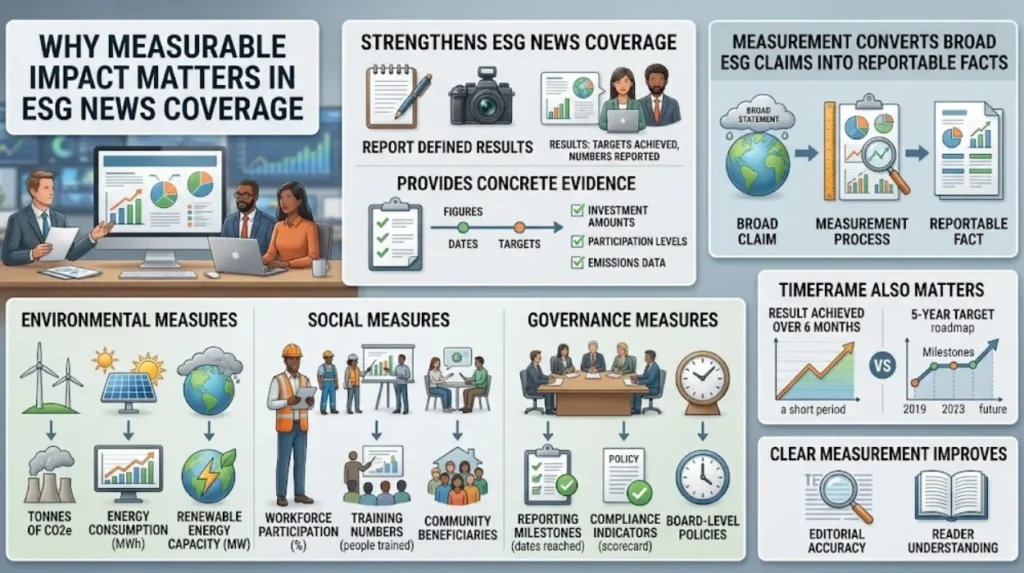
Measurable impact strengthens ESG news coverage because journalists can report defined results using figures, dates, targets, investment amounts, participation levels, emissions data and other evidence that gives readers a concrete basis for understanding an event’s significance.
Measurement converts broad ESG claims into reportable facts.
Environmental measures include tonnes of carbon dioxide equivalent, energy consumption and renewable energy capacity. Social measures include workforce participation, training numbers and community beneficiaries. Governance measures include reporting milestones, compliance indicators and board-level policies.
The timeframe also matters. A result achieved over six months has different context from a five-year target.
Clear measurement improves both editorial accuracy and reader understanding.
What is the overall relationship between ESG events and purpose-driven news coverage?
ESG events attract purpose-driven news coverage when they connect important environmental, social and governance subjects with credible speakers, new information, measurable evidence, UK relevance and clear public-interest outcomes that journalists can independently report and contextualise.
The relationship begins with the subject. ESG events address issues that affect businesses, communities, investors, employees and the environment.
The event then provides sources and information. Speakers contribute expertise, while announcements, research and data provide potential news developments.
Explore More Expert Insights:
What News Coverage Means for Startup Launch Events
How Charity Galas Earn UK News Coverage in 2026
Journalists evaluate these elements against editorial standards. Relevance, originality, evidence, timing and audience interest determine whether an event produces a reportable story.
The strongest ESG coverage therefore centres on factual developments rather than event promotion. Clear evidence, defined outcomes and credible sources give purpose-driven stories the substance required for informative UK news coverage.



