

ESG event news coverage across 15 UK sites is a coordinated media distribution approach that places one relevant event story across multiple purpose-driven publications. It combines editorial relevance, audience alignment, geographic reach, sustainability topics, and measurable coverage outcomes for event organisers.
ESG means environmental, social and governance. ESG events include sustainability conferences, climate forums, responsible investment events, social impact summits, ethical business conferences, and corporate responsibility programmes.
Purpose-driven UK news sites focus on organisations, policies, initiatives, and events connected to environmental responsibility, social impact, ethical leadership, sustainability, inclusion, and responsible business.
A 15-site campaign gives an organiser a defined media coverage target. The objective is not simply to increase the number of published articles. The objective is to place relevant event information in publications whose audiences already engage with ESG-related subjects.
For example, a UK climate innovation conference can generate coverage around renewable energy, carbon reduction, green technology, investor responsibility, and corporate sustainability. Each subject creates a different editorial entry point.
Organisers evaluating distribution providers therefore need to examine publication relevance, audience fit, editorial treatment, coverage verification, reporting, and campaign execution rather than relying only on publication volume.
How does a 15-site ESG event coverage campaign work?
A 15-site ESG event coverage campaign starts with event information, identifies relevant UK publications, prepares an editorially focused story, distributes the content, verifies publication, and reports confirmed coverage against defined campaign objectives.
The process begins with the event itself. The organiser supplies the event name, date, venue, purpose, speakers, agenda, participating organisations, and relevant ESG themes.
The campaign then defines the media audience. A sustainability conference requires different publication targeting from a social impact awards event. A responsible investment forum also requires different editorial relevance.
How is the ESG event assessed?
The event is assessed according to its news value and ESG relevance. Key factors include:
- Environmental initiatives
- Social impact programmes
- Governance developments
- Sustainability commitments
- Climate policy discussions
- Responsible investment
- Ethical business practices
- Community outcomes
- Diversity and inclusion
- Green technology
The assessment determines which aspects of the event form the strongest news angle.
How are 15 publications selected?
Publication selection focuses on topical relevance and audience alignment. A campaign can include sustainability-focused publications, business news platforms, environmental publications, social impact outlets, regional UK sites, and specialist trade media.
The selection also considers editorial scope. A publication covering UK climate policy provides a different audience from a business publication covering ESG investment.
The result is a defined 15-site target rather than an undefined media list.
How is the event story prepared?
The story uses factual information that journalists and readers can understand quickly. A strong release identifies the event, explains its significance, provides relevant data, names important participants, and states the practical outcome.
For example, an ESG investment conference can focus on sustainable finance commitments, investment trends, regulatory developments, and expert participation instead of using generic promotional language.
What components determine the quality of ESG media coverage?
Quality ESG media coverage depends on publication relevance, editorial accuracy, audience alignment, news value, distribution quality, publication verification, reporting, and measurable campaign objectives. These components determine whether 15 placements create useful visibility rather than simply increasing publication counts.

A decision-maker evaluating an ESG event coverage provider needs a clear framework for assessing these components.
Publication relevance
Publication relevance establishes whether the audience has a genuine interest in the event subject.
For example, an environmental publication is directly relevant to a climate conference. A business publication is relevant to corporate sustainability leadership. A regional publication is relevant to an event with a strong local economic or community impact.
Editorial accuracy
Coverage needs accurate event details. Dates, venues, speaker names, organisations, statistics, and ESG claims require consistency.
Accuracy protects the organiser’s reputation and gives readers reliable information.
Audience alignment
Audience alignment connects the event with people who have a defined interest in ESG subjects.
Relevant audiences include sustainability professionals, investors, business leaders, policymakers, environmental professionals, CSR teams, procurement professionals, and socially conscious business communities.
Coverage verification
Coverage verification confirms which publications actually published the story. A professional campaign report records publication names, article URLs, publication dates, and relevant coverage metrics.
This creates an auditable record of campaign delivery.
Why does coverage across 15 sites matter for ESG event organisers?
Coverage across 15 relevant UK sites expands the number of publication environments presenting an ESG event while creating multiple opportunities for discovery, brand recognition, stakeholder awareness, search visibility, and referral traffic from purpose-driven audiences.
A single publication provides one audience environment. Fifteen publications create multiple editorial contexts.
The value comes from relevance and distribution quality. A campaign appearing across environmental, sustainability, business, regional, and specialist publications creates broader topical exposure.
How does multi-site coverage support visibility?
Multi-site coverage gives an event more opportunities to appear in search results, news discovery systems, publication archives, and audience feeds.
An organiser promoting a UK sustainability summit can gain visibility among professionals searching for climate conferences, ESG leadership, sustainable finance, corporate responsibility, or environmental innovation.
How does coverage support credibility?
Publication presence provides third-party editorial exposure. The event appears in established media environments rather than existing only on the organiser’s website.
The credibility benefit depends on publication relevance, editorial standards, and factual presentation. Fifteen unrelated placements do not provide the same value as fifteen publications aligned with the event’s subject.
How does coverage support search visibility?
Search visibility depends on factors such as topical relevance, content quality, publication authority, indexing, links, and search-engine interpretation.
ESG coverage can strengthen the digital footprint surrounding an event by creating additional published references to its name, organisers, speakers, themes, and initiatives.
For organisations comparing educational approaches before selecting a distribution method, understanding how:
ESG event coverage reaches purpose-driven audiences and provides useful context for evaluating media distribution choices.
How can organisers measure the performance of 15-site ESG coverage?
Organisers can measure ESG event coverage through confirmed publication count, publication relevance, article URLs, publication dates, audience indicators, referral traffic, branded search activity, engagement, and qualified stakeholder responses generated after distribution.
Measurement starts with delivery. If the target is 15 publications, the campaign report needs to identify the 15 confirmed placements.
Which metrics matter?
Useful metrics include:
- Confirmed publication placements
- Publication relevance
- Article views where available
- Referral traffic
- Engagement
- Social sharing
- Branded search activity
- Backlink presence
- Stakeholder enquiries
- Event registrations
- Geographic audience reach
Each metric answers a different question.
Publication count measures delivery. Referral traffic measures website visits. Registrations measure conversion. Publication relevance measures audience quality.
How should coverage reports be evaluated?
A useful report separates distribution outcomes from business outcomes.
Distribution outcomes show where the story appeared. Business outcomes show what happened after publication.
For example, an organiser can record 15 confirmed placements, then compare website traffic and event registrations during the following campaign period.
This structure helps decision-makers determine whether the media campaign generated measurable value.
Which ESG events benefit from 15-site UK news coverage?
ESG conferences, sustainability summits, climate events, responsible investment forums, social impact programmes, green technology showcases, CSR events, and ethical leadership conferences all provide defined subjects for targeted multi-site UK media coverage.
Different event types require different editorial angles.
Which sustainability events fit the model?
Sustainability conferences can focus on carbon reduction, circular economy initiatives, sustainable supply chains, energy efficiency, and corporate environmental strategy.
Which social impact events fit the model?
Social impact events can focus on community investment, inclusion, employment initiatives, education, public wellbeing, and measurable social outcomes.
Which finance events fit the model?
Responsible investment conferences can focus on sustainable finance, ESG reporting, investor priorities, stewardship, climate-risk management, and responsible capital allocation.
Which technology events fit the model?
Green technology events can focus on renewable energy, clean technology, energy management, emissions reduction, environmental data, and innovation.
The editorial angle needs to match the event’s actual subject. A single generic ESG message does not provide the same relevance as a specific, evidence-based news angle.
How should organisations compare ESG event coverage providers?
Organisations comparing ESG event coverage providers need to assess publication relevance, confirmed site count, UK audience targeting, editorial standards, campaign process, reporting quality, delivery evidence, and measurable outcomes before selecting a distribution solution.
The first consideration is the definition of the promised 15 sites. Organisations need to know whether the number represents targeted publications, confirmed placements, potential outlets, or distribution destinations.
The second consideration is audience quality. A provider targeting purpose-driven UK audiences needs publications relevant to ESG, sustainability, social impact, responsible business, or related subjects.
The third consideration is reporting. A professional report needs identifiable publication evidence rather than an unverified list of media names.
The fourth consideration is campaign alignment. The provider needs to understand the event’s subject and create distribution around relevant editorial themes.
The fifth consideration is measurement. Organisations need clear metrics that connect coverage delivery with website activity, event registrations, stakeholder engagement, or other defined objectives.
Explore More Expert Insights:
Startup Launch Coverage on 15 UK News Sites Today
Charity Gala News Coverage Across 15 UK News Sites
What makes ESG event coverage a suitable media decision?
ESG event coverage becomes a practical decision when an organiser has a defined event, a specific UK audience, measurable media objectives, and a requirement for verified publication across relevant purpose-driven news environments.
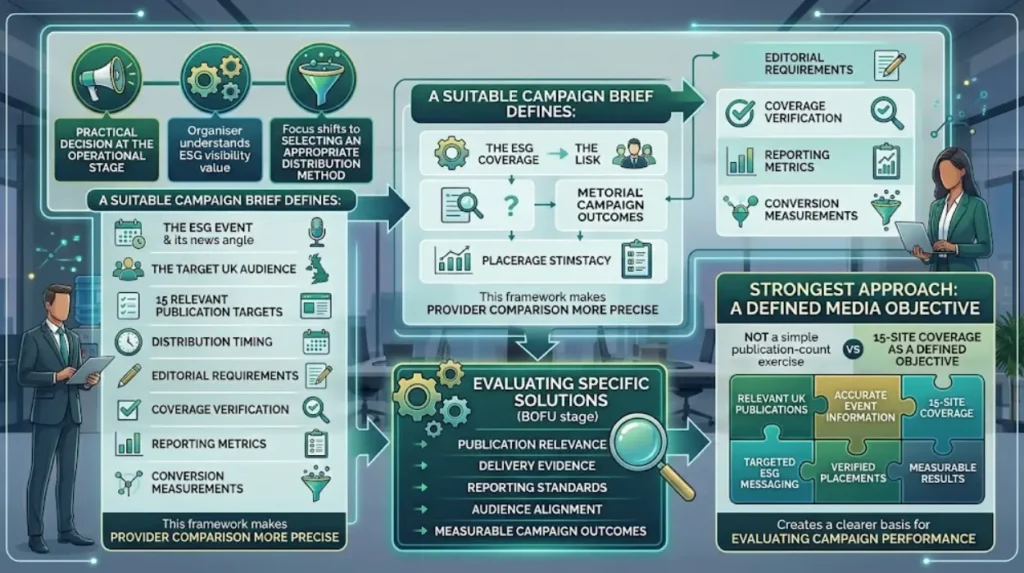
At this stage, the decision is operational. The organiser already understands the value of ESG visibility and needs to select an appropriate distribution method.
A suitable campaign brief defines:
- The ESG event and its news angle.
- The target UK audience.
- Fifteen relevant publication targets.
- Distribution timing.
- Editorial requirements.
- Coverage verification.
- Reporting metrics.
- Conversion measurements.
This framework makes provider comparison more precise.
For organisations ready to evaluate a specific media distribution solution,
ESG event coverage can be assessed against publication relevance, delivery evidence, reporting standards, audience alignment, and measurable campaign outcomes.
The strongest approach treats 15-site coverage as a defined media objective rather than a simple publication-count exercise. Relevant UK publications, accurate event information, targeted ESG messaging, verified placements, and measurable results create a clearer basis for evaluating campaign performance.
When these elements are aligned, ESG event news coverage connects sustainability-focused events with purpose-driven UK audiences through a structured, measurable media distribution process.



