

Startup launch events introduce a new business, product, platform, technology, or service to a defined audience. News coverage records and distributes information about the launch through editorial publications, business media, technology outlets, regional newspapers, and specialist news websites.
For startups in the United Kingdom, launch coverage connects an event with a wider information environment. The coverage can describe the company, explain the product, report launch announcements, and provide context about founders, investors, technology, or market activity.
Understanding startup launch news coverage starts with its purpose. It is not simply an event recap. It is an editorial representation of a launch that gives journalists and audiences structured information about what happened and why the announcement is relevant.
What does news coverage mean for a startup launch event?
News coverage for a startup launch event means editorial reporting that communicates the launch, its key announcements, participating people, product details, and business context to audiences through relevant news publications and media channels.
A startup launch event becomes news coverage when information from the event is presented as a report, announcement, interview, feature, or other editorial format. The resulting article focuses on identifiable facts rather than the event programme alone.
Coverage commonly includes:
- The startup’s name and business activity
- The purpose of the launch
- Product or service details
- Founder and executive information
- Launch date and location
- Investment or funding information
- Market sector and target audience
- Statements from relevant representatives
- Technology or innovation details
- Future business developments
The exact content depends on the news value, publication focus, and information available to journalists.
News coverage as an editorial record
Editorial coverage creates a published record of a startup launch. The article identifies the event and places the announcement within a wider business or technology context.
This distinction separates news coverage from promotional event material. An event invitation describes what attendees can expect. News coverage reports information about what the launch represents and what occurred.
Why is news coverage important for startup launch events?
News coverage gives startup launches a documented presence in the public information environment, helping audiences discover the announcement, understand its business relevance, identify the people involved, and access factual information after the event ends.
A launch event usually has a limited physical audience. News coverage extends the information beyond attendees by publishing relevant details through accessible media channels.
For example, a technology startup launching a cybersecurity platform in London can receive coverage describing the product, founders, target market, and launch announcement. A reader who did not attend the event can still understand the development through the published report.
Coverage also creates searchable information about the startup. Publication pages can contain the startup name, product name, founder names, industry terms, location, and launch details. These entities help search systems understand the relationship between the business and its announcement.
Coverage and public information
News articles provide structured information that audiences can reference after the launch. This includes journalists researching the startup, potential customers evaluating the product, investors monitoring the sector, and business professionals following market developments.
The value begins with information clarity. A report that clearly identifies the company, announcement, people, date, and market context gives readers a more complete understanding of the launch.
How does startup launch news coverage work?
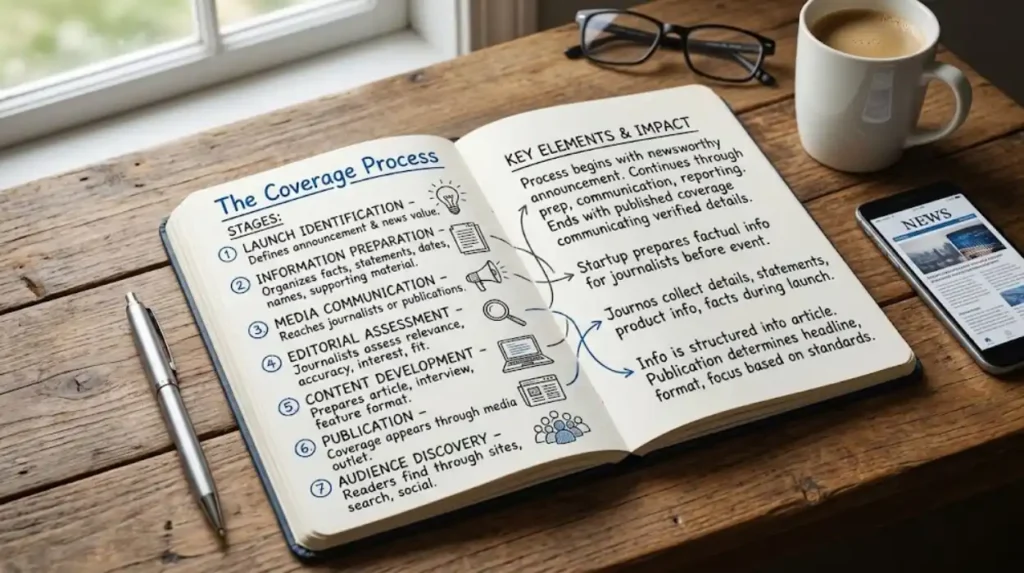
Startup launch coverage begins with a newsworthy announcement, continues through information preparation and media reporting, and ends with published coverage that communicates verified launch details to relevant audiences across appropriate editorial publications.
The process starts before the event. The startup identifies the central announcement and prepares factual information for journalists.
During the launch, journalists or editorial teams collect relevant information. They review announcements, statements, product details, event information, and supporting facts.
After the event, the information is structured into an editorial article. The publication determines the headline, article format, focus, and level of detail according to its editorial standards.
The coverage process
The process normally contains these stages:
- Launch identification — The startup defines the announcement and its news value.
- Information preparation — Facts, statements, dates, names, and supporting material are organised.
- Media communication — Relevant information reaches journalists or editorial publications.
- Editorial assessment — Journalists assess relevance, accuracy, audience interest, and publication fit.
- Content development — The publication prepares a news article, interview, feature, or related format.
- Publication — The finished coverage appears through the selected media outlet.
- Audience discovery — Readers find the coverage through publication websites, search engines, social channels, or other distribution paths.
Each stage affects the clarity and usefulness of the resulting coverage.
What information does startup launch coverage usually include?
Startup launch coverage usually includes the company identity, launch announcement, product or service information, founders, location, date, market context, relevant statements, funding details, and specific facts that explain the significance of the business development.
The information structure gives readers enough context to understand the announcement without attending the event.
A technology startup launch report, for example, can identify the company, describe its software platform, explain the problem it addresses, name the founders, state where the launch occurred, and provide information about its target market.
Core information categories
Company identity: The article identifies the startup and its business activity.
Launch announcement: The report explains what the startup introduced or announced.
Product or service: The article describes the relevant product, platform, technology, or service.
People: Founders, executives, investors, speakers, or other relevant participants receive identification where appropriate.
Business context: The coverage explains the sector, market, location, funding position, or commercial purpose.
Statements: Direct statements provide attributed perspectives from founders or other authorised representatives.
Event details: Date, venue, location, and event purpose establish the circumstances of the launch.
These components create a complete information structure for readers and search systems.
How do journalists evaluate startup launch stories?
Journalists evaluate startup launch stories through factors such as news relevance, originality, audience interest, factual accuracy, timing, market significance, credible sources, and the quality of information supplied for editorial assessment.
A startup launch does not automatically constitute a news story. Editorial publications select stories according to their audiences and publishing priorities.
A fintech launch has stronger relevance for financial technology publications when the announcement contains specific information about payments, banking technology, investment, regulation, or financial infrastructure.
A regional publication focuses more heavily on geographic relevance. A Manchester startup launching a new employment platform has a clear local dimension when the announcement relates to businesses, workers, investment, or economic activity in Greater Manchester.
Common editorial considerations
Journalists assess several information signals:
- What has actually been announced?
- Why is the announcement relevant now?
- Who is affected or interested?
- What evidence supports the claims?
- Which market or sector does the startup serve?
- What is different about the development?
- Which people or organisations are directly involved?
- What factual information can be independently understood?
Specific information strengthens the clarity of the story.
Which types of media cover startup launch events?
Startup launch events receive coverage across technology publications, business newspapers, regional news outlets, specialist trade media, financial publications, innovation platforms, and broader news organisations serving defined United Kingdom audiences.
Different publications serve different information needs. A technology publication focuses on products, software, artificial intelligence, cybersecurity, hardware, or digital platforms.
Business publications focus on entrepreneurship, investment, employment, markets, management, and company development.
Regional publications focus on local businesses, economic activity, investment, employment, and community relevance.
Trade publications concentrate on specific industries. Examples include financial services, healthcare, construction, energy, retail, logistics, and professional services.
Publication relevance
Publication relevance matters because audiences differ. A specialist cybersecurity publication provides sector-specific context for a cybersecurity startup. A regional newspaper provides geographical context for a startup connected with a particular UK city.
This creates a distinction between broad visibility and relevant visibility. The number of publications does not define the entire value of coverage. The subject matter and audience alignment also determine its informational relevance.
How does startup launch coverage support search visibility?
Startup launch coverage creates published references containing company names, product terms, founder identities, locations, industry terminology, and launch information that search systems use to interpret entities and relationships across the online information environment.
Search engines process relationships between entities and information. A published article can connect a startup with its founders, products, industry, location, and launch event.
For example, an article about a London artificial intelligence startup can contain the company name, founder name, software product, artificial intelligence category, London location, and launch date. These terms establish contextual relationships within the article.
Coverage also creates additional pages where users can encounter information about the startup. Search visibility depends on many technical and editorial factors, but clear entity information gives search systems structured textual context.
Entity consistency
Consistent naming helps information remain understandable. A startup using one official company name, one product name, and consistent descriptions creates clearer relationships between its published references.
This principle also applies to founders and locations. Accurate names, job titles, company descriptions, and geographic references reduce ambiguity within published information.
For readers exploring the next stage of UK technology audiences,
Startup launch coverage provides a related consideration-stage topic. For readers examining broader publication distribution,
15 UK news sites represents a later-stage coverage topic.
What benefits can news coverage provide after a startup launch?
News coverage provides a lasting public information record, supports audience discovery, documents business developments, increases access to launch information, and gives journalists, customers, investors, and professional audiences a published source about the startup.
The first benefit is information continuity. The launch event ends, but published articles remain accessible through publication websites.
The second benefit is audience access. People outside the original event audience can discover the announcement through media publications.
The third benefit is contextual understanding. Articles explain the launch through business, technology, geographic, or industry information.
The fourth benefit is discoverability. Published coverage gives audiences additional opportunities to encounter the startup when searching for relevant company, product, founder, or industry information.
Long-term informational value
A launch article can remain useful after the event when it contains accurate information about the startup and its development. Later readers can use the article to understand when the company launched, what it introduced, who founded it, and which market it entered.
This makes news coverage part of the startup’s broader public information record.
When is startup launch news coverage most relevant?
Startup launch news coverage is most relevant when a business introduces a new product, enters a market, announces funding, launches a technology platform, establishes a significant partnership, or presents a development with clear audience and industry relevance.
Common launch situations include:
- A software company introducing a new platform
- A fintech startup entering the UK market
- A healthcare technology business launching a digital service
- A climate technology company announcing a new solution
- A startup announcing seed or venture funding
- A technology business launching in a new UK city
- A startup announcing a significant commercial partnership
- A founder-led business introducing a new technology product
The strongest informational structure connects the launch event with a specific development.
Why the announcement matters
The central question is not simply whether an event occurred. The important issue is what the event announced.
A launch involving a new product, funding round, market entry, partnership, technology development, or business milestone provides concrete information for editorial reporting.
Explore More Expert Insights:
How Charity Galas Earn UK News Coverage in 2026
Why Earned News Coverage Beats Paid Ads for Events
What should readers understand about startup launch news coverage?
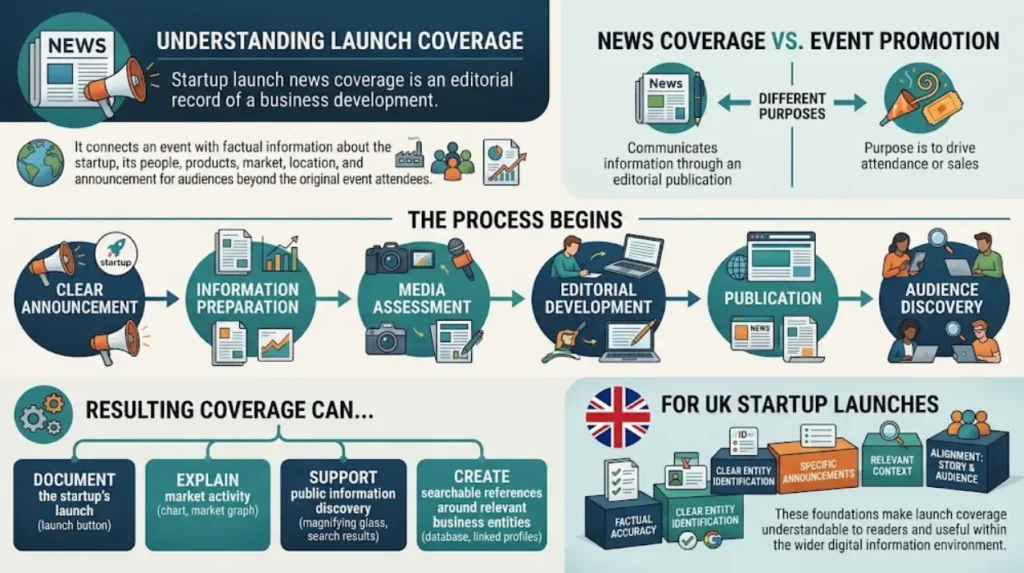
Startup launch news coverage is an editorial record of a business development that connects an event with factual information about the startup, its people, products, market, location, and announcement for audiences beyond the original event attendees.
News coverage differs from event promotion. Its purpose is to communicate information through an editorial publication.
The process begins with a clear announcement and continues through information preparation, media assessment, editorial development, publication, and audience discovery.
The resulting coverage can document the startup’s launch, explain its market activity, support public information discovery, and create searchable references around relevant business entities.
For UK startup launches, the most important foundations are factual accuracy, clear entity identification, specific announcements, relevant context, and alignment between the story and its intended publication audience. These elements make launch coverage understandable to readers and useful within the wider digital information environment.



