
Annual report outsourcing is the transfer of an organisation’s full annual reporting process to external specialists who handle writing, design, data validation, regulatory checks, and distribution.
Annual report outsourcing means hiring external teams to deliver a complete annual report package. Key entities include in-house reporting leads, external financial writers, graphic designers, compliance reviewers, and distribution partners. Outsourcing shifts tasks such as narrative drafting, financial statement formatting, audit liaison, sustainability disclosure alignment, and print or digital production to vendors. Vendors operate under contract terms that specify deliverables, timelines, data security controls, and acceptance criteria. Outsourcing applies to all report formats: printed booklets, interactive PDFs, micro-sites, and regulatory filings.
Why do 63% of UK enterprise brands outsource annual report production?
Enterprises outsource to reduce fixed internal costs, improve specialist quality, accelerate delivery, and strengthen governance around reporting processes.
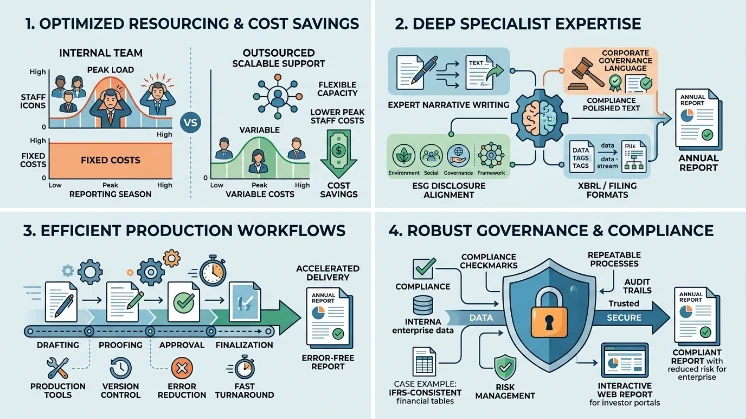
Multiple drivers explain the adoption rate. First, fixed internal headcount for peak reporting periods creates inefficiency; outsourcing enables scalable resourcing for the 6–12 weeks of peak activity. Second, specialist agencies provide dedicated expertise in narrative writing, corporate governance language, ESG disclosure alignment, and XBRL/filing formats that many internal teams do not maintain year-round. Third, vendors invest in production tools, version control, and proofing workflows that reduce errors and rework during tight timetables.
Fourth, outsourcing transfers specific compliance and formatting risks to suppliers with repeatable processes and audit-tested controls. Case examples include enterprise groups using specialist suppliers for IFRS-consistent financial tables and separate agencies producing interactive web reports for investor portals.
How is the annual report production process managed when outsourced?
Clients supply raw financials, governance notes, and editorial briefs; vendors manage drafting, design, compliance checks, and final delivery under defined milestones.
The process begins with a data handover: trial balance exports, audit-adjusted financial statements, board minutes, director statements, and sustainability metrics. Vendors map these inputs to a reporting brief and produce a content schedule with milestones for first draft, board review, audit sign-off, design proofs, and publication. Vendors perform copy-editing, numeric reconciliation, and regulatory compliance checks including Companies Act requirements and, when applicable, FTSE or AIM disclosures. Design workflows include templating, accessibility checks (colour contrast, tagging), and web optimisation for SEO and fast load times.
Final deliverables include print-ready PDFs, web-native pages, XBRL or EDGAR-compatible files where needed, and distribution packages for investor relations. Contractual elements include data protection clauses, audit trail requirements, and acceptance testing windows.
What are the main components vendors deliver in outsourced annual reports?
Deliverables include narrative copy, audited financial statements formatted to filing standards, designed layouts for print and web, sustainability disclosures, and distribution packages.
Narrative copy covers strategic reports, chair and CEO statements, business model explanations, principal risks, and operating review sections. Financial statements include balance sheet, income statement, cash flow statement, notes, and accounting policies formatted per IFRS or UK GAAP as required. Design outputs cover cover artwork, infographics, charts, tables, executive summaries, and accessible PDF tagging. Sustainability and ESG content includes GHG emissions tables, scope definitions, KPI calculation methods, and any required assurance statements. Distribution packages include print-ready files, web-optimised assets, CMS-ready code or templates, and regulatory submission documents. Vendors also provide a redline change log showing edits between draft versions and reconciliation sheets linking narrative claims to source data.
What are the measurable benefits of outsourcing annual report production?
Measured benefits include 20–40% reduction in time-to-publish, 15–30% lower project cost versus peak internal resourcing, and a measurable drop in post-publication edits and compliance queries.
Time savings arise because vendors operate parallel workflows and maintain specialised templates. Cost reductions occur as enterprises avoid hiring temporary staff, buy fewer software licences, and reduce overtime. Quality improvements show in fewer numeric discrepancies found during audit sign-off and fewer accessibility or filing rejections from regulators. Risk transfer reduces the incidence of late regulatory filings and associated fines. Vendors also improve visibility: consistent metadata and SEO optimisation for web reports increase indexed pages and improve investor discovery metrics. Quantitative outcomes vary by contract scope; enterprises that combine writing, design, and regulatory filing with a single vendor report the largest efficiency gains.
How does outsourcing affect governance and compliance?
Outsourcing centralises control through contractual SLAs, version-control logs, audit trails, and named compliance reviewers, improving traceability and accountability.
Governance is preserved by embedding approval gates into the vendor workflow. Contracts include service-level agreements (SLAs) for milestone adherence, accuracy tolerances for numeric reconciliation, and nondisclosure or data-handling clauses. Version control systems archive every draft and reviewer comment, creating an auditable chain of custody for content changes. Vendors appoint compliance reviewers to cross-check narrative statements against source documents and regulatory checklists such as the Companies Act 2006, FRC guidance, and relevant listing rules. This structure reduces the risk of contradictory statements between narrative sections and financial tables and strengthens the board’s ability to approve a fully reconciled report.
What technology and tools do vendors use in outsourced annual report production?
Vendors use collaborative content platforms, version control systems, data-reconciliation tools, design systems, and accessibility testing suites to ensure quality and speed.
Collaborative platforms allow simultaneous editing and reviewer annotations. Version control tools track changes and produce redline reports for auditors. Data-reconciliation tools ingest trial balance exports and generate formatted financial statements, reducing manual table creation. Design systems include component libraries and templates that guarantee consistent typography and layout across print and web outputs. Accessibility testing suites scan PDFs and web pages for tagging, tab order, and contrast issues. Security tools include encrypted file transfer, restricted-access document repositories, and audit logs for data handling. Vendors that provide integrated XBRL tagging or CMS export reduce manual steps and speed regulatory submission.
What are typical pricing and contracting models for outsourced annual report services?
Contracts typically use fixed-fee project pricing, retainer-based models for multi-year relationships, or modular pricing for discrete services such as writing, design, or XBRL tagging.
Fixed-fee models set a clear budget for the full report, including defined revisions and delivery milestones. Retainers cover multi-year arrangements that include annual reports plus interim reporting and investor materials; these retainers often reduce per-report cost by 10–25% versus one-off projects. Modular pricing allows organisations to outsource only design, or only financial formatting and filing, with separate fees for additional services like translation or print management. Contracts commonly include change-order clauses for scope adjustments, late-delivery penalties aligned to SLAs, and IP ownership terms defining rights to source files, templates, and final assets.
What use cases suit outsourcing versus in-house production?
Outsourcing suits organisations with episodic reporting peaks, complex multi-jurisdictional disclosures, high design or digital expectations, or limited internal specialist capacity.
Organisations with small in-house teams benefit when reporting demands spike annually. Multinational enterprises with cross-border filings benefit when vendors offer jurisdiction-specific compliance knowledge. Companies pursuing modern digital reports benefit from vendors with interactive design and SEO skills. Conversely, organisations with continuous reporting needs and large in-house communications teams may keep production internal for day-to-day control but still use vendors for specialist tasks like XBRL tagging, accessibility remediation, or print logistics.
Explore More Expert Insights:
Media-Published Research Reports: 4 UK Case Studies With Real Pipeline Numbers
Research-Backed Content vs Blog Posts: UK Lead Quality Data Compared
How should enterprise procurement evaluate annual report vendors?
Evaluate vendors on domain experience, documented compliance processes, version-control transparency, security certifications, and measurable delivery metrics.
Procurement should request case studies showing IFRS or UK GAAP formatting experience, evidence of Companies Act and listing-rule compliance, and sample reconciliation logs. Ask for documented workflows showing milestone gates and approval steps. Verify security controls such as ISO 27001 certification or equivalent and confirm data handling procedures. Request references that include audit committees or finance directors. Include acceptance criteria in the contract such as numeric tolerance thresholds, accessibility compliance level, and a timetable for post-publication corrections.
How do outsourced reports support investor relations and stakeholder transparency?
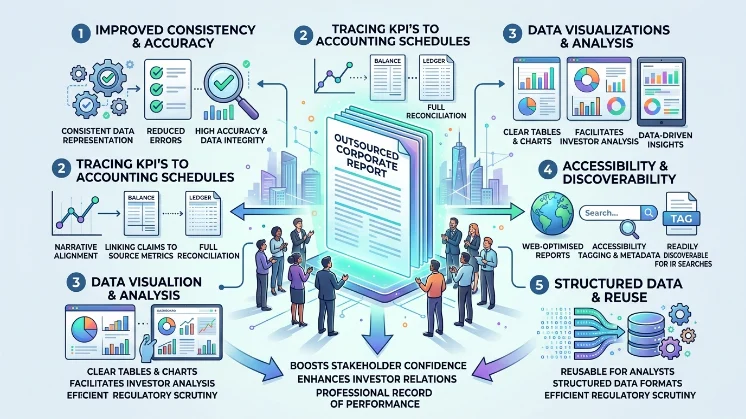
Outsourced reports improve consistency, reduce errors, and present data in accessible formats that facilitate investor analysis and regulatory scrutiny.
Specialist vendors align narrative claims to source metrics and create clear tables and charts that trace KPIs to accounting schedules. Web-optimised reports increase discoverability for investor relations searches and provide structured data that analysts can reuse. Accessibility tagging and clear metadata improve access for a broader stakeholder base. These properties increase stakeholder confidence by delivering a reconciled, traceable, and professionally produced record of performance.
Read More to Understand Better:
The £20.4bn UK Digital Economy Needs Better Industry Research: Here’s Why
Annual report outsourcing transfers production tasks to specialised vendors who deliver narrative copy, financial formatting, design, compliance checks, and final distribution under contractual SLAs. Enterprises that outsource see faster delivery, lower peak costs, improved compliance traceability, and higher-quality outputs. Procurement should evaluate vendors on documented processes, security, and demonstrable compliance experience to realise those benefits.
Get the Full Insights Here:
State of the Industry Reports: A 12-Month UK Content Visibility Study