

Research and reports services provide UK brands with a structured process that transforms a business objective into a published data asset. The service includes research design, data collection, analysis, report writing, visualisation, quality assurance, and distribution-ready publication materials.
Research and reports services are professional solutions that help organisations create evidence-based content from original or secondary data. A report is a structured document that presents findings, statistics, trends, and conclusions in a format suitable for stakeholders, media outlets, prospects, and decision-makers.
For UK brands, these services often support lead generation, thought leadership, public relations campaigns, investor communications, and market positioning. The final deliverable is not only a report. It is a complete information asset designed for publication and distribution.
What happens after a UK brand submits a research brief?

After receiving a brief, the research team defines objectives, identifies audiences, selects methodologies, establishes timelines, develops research questions, and creates a project framework that guides every stage from data collection through publication and promotion.
The brief functions as the foundation of the project. It outlines the business goal, target audience, industry focus, desired outcomes, and publication objectives.
Research specialists review the brief to identify measurable questions. For example, a UK fintech company seeking media coverage requires different research questions than a UK healthcare provider seeking procurement engagement.
The planning stage defines key performance indicators. These indicators often include citation opportunities, media coverage potential, lead generation goals, stakeholder engagement metrics, and branded search visibility.
A detailed project plan follows. This plan specifies sample sizes, respondent criteria, research methodologies, reporting formats, publication timelines, and approval stages. At this stage, brands receive clarity regarding deliverables, costs, milestones, and expected outputs before data collection begins.
How is data collected during a research and reports project?
Data collection involves gathering information through surveys, interviews, market databases, public records, industry datasets, and proprietary research methods. Each method is selected according to the project objectives and reporting requirements.
Primary research generates original information directly from participants. Common examples include surveys of 500 UK consumers, interviews with 50 procurement professionals, or questionnaires completed by 1,000 business decision-makers.
Secondary research uses existing sources. Examples include government publications, industry association reports, academic studies, financial records, and publicly available datasets.
The collection process follows strict quality controls. Researchers screen responses, remove invalid entries, verify demographic quotas, and ensure representative participation.
Data integrity is critical because every statistic included in the report requires verification and documentation.
Strong datasets often produce stronger publication outcomes. This relationship aligns with the evidence-focused principles discussed in [Insert Link to BOFU Article] using the keyword Why Fact-Dense Content Gets Cited in AI Overviews 5× More Often Than Opinion.
What deliverables do UK brands receive during the analysis stage?
During analysis, UK brands receive structured findings, statistical interpretations, trend identification, audience segmentation, executive summaries, and evidence-based insights that transform raw data into usable business intelligence and publication-ready narratives.
Raw data alone does not provide business value. Analysis converts information into meaningful findings. Researchers identify patterns within responses and datasets. They examine demographic differences, behavioural trends, purchasing preferences, awareness levels, and industry developments.
Statistical analysis helps validate findings. Percentages, growth rates, correlations, and comparisons provide measurable evidence.
Brands typically receive internal findings documents before report production begins. These documents allow stakeholders to review key discoveries and confirm strategic priorities.
Analysis also identifies the most newsworthy findings. For example, if 68% of UK consumers report a specific purchasing behaviour, that statistic becomes a potential headline for publication and media outreach. The analysis phase determines which insights deserve prominence within the final report.
What does the report creation and writing process include?
Report creation combines data interpretation, editorial development, visual storytelling, fact verification, and structured writing to produce a publication-ready document that communicates findings clearly to target audiences and stakeholders.
The document generally includes an executive summary, methodology section, key findings, supporting statistics, analysis, conclusions, and recommendations. Methodology sections explain how the research was conducted. This transparency strengthens credibility and trust.
Editorial teams organise information logically. Important findings appear first, followed by supporting evidence and contextual analysis. Every statistic undergoes verification before publication. Accuracy checks reduce the risk of reporting errors and maintain professional standards.
The writing process also ensures consistency across terminology, formatting, citations, and branding requirements. The result is a report that can be understood by journalists, prospects, executives, investors, and industry stakeholders.
How are design and visualisation incorporated into research reports?
Design and visualisation transform research findings into accessible visual formats through charts, graphs, infographics, layouts, and branded presentation elements that improve comprehension, engagement, and distribution performance.
Complex datasets become easier to understand when displayed through charts and graphics. Readers can identify patterns more quickly than through text alone.
Design teams create layouts that guide readers through findings logically. Important statistics receive visual emphasis while supporting information remains accessible.
Brand consistency remains important throughout the document. Colours, typography, visual hierarchy, and graphical standards align with organisational identity.
Many UK brands also receive standalone visual assets. These assets include social media graphics, infographic extracts, presentation slides, and media-ready statistics. Visualisation expands the usability of research beyond the report itself. A single report can generate multiple content assets for marketing, PR, sales, and stakeholder communications.
Explore More Expert Insights:
Why 63% of UK Enterprise Brands Now Outsource Annual Report Production
Media-Published Research Reports: 4 UK Case Studies With Real Pipeline Numbers
What business outcomes do UK brands achieve from research and reports services?
Research and reports services help UK brands generate authority, attract qualified leads, secure media coverage, support sales conversations, strengthen stakeholder trust, and create proprietary information assets that competitors cannot replicate.
Unlike generic content, proprietary data provides exclusive insights. This exclusivity increases visibility opportunities across search engines, AI-generated answers, media publications, and industry discussions.
Research reports also support account-based marketing initiatives. Sales teams can reference original statistics during conversations with prospects and procurement stakeholders.
Media coverage often increases when reports contain statistically significant findings supported by transparent methodologies.
Reports also strengthen organisational credibility because claims are supported by measurable evidence rather than unsupported assertions.
For many UK organisations, research becomes a long-term content asset with value extending well beyond its initial publication date.
How can UK brands choose the right research and reports service provider?
UK brands should evaluate providers based on methodology expertise, data quality controls, analytical capability, report production standards, publication support, industry experience, and proven delivery processes from briefing through final publication.
Providers must demonstrate experience designing surveys, analysing data, and producing evidence-based reports.
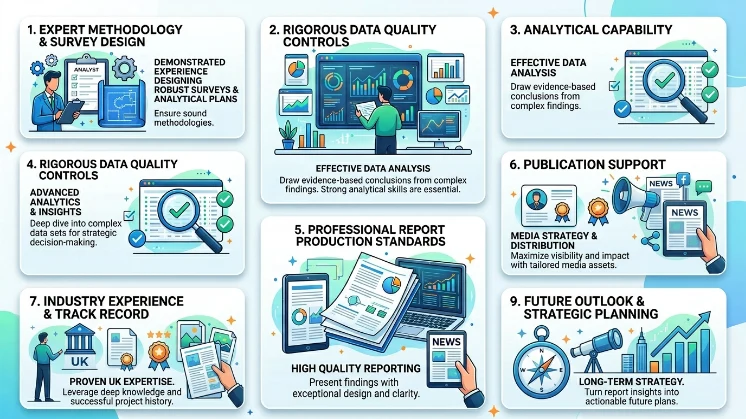
Quality assurance procedures are equally important. Brands should understand how responses are validated, findings are verified, and data integrity is maintained. Report production capabilities also require evaluation. Strong research findings lose value when documentation, design, and presentation standards are weak.
Publication support provides additional value. Providers that assist with media assets, content repurposing, and distribution preparation often generate stronger outcomes. Decision-makers should review previous reports, methodologies, sample structures, and publication examples before selecting a partner.
The strongest providers deliver a complete process that moves efficiently from initial brief through research, analysis, report production, and publication readiness.
Research and reports services provide UK brands with a complete framework for creating evidence-based publications. The process begins with a structured brief, progresses through research and analysis, and concludes with publication-ready assets designed for visibility, credibility, and commercial impact.
Learn Everything About It Here:
Why Fact-Dense Content Gets Cited in AI Overviews 5× More Often Than Opinion
From project planning and data collection to analysis, report writing, visualisation, and publication support, each stage contributes to creating a reliable information asset. For UK brands seeking measurable authority, proprietary data, and decision-stage content, research and reports services provide a structured path from initial objective to published report.
Click Here to Explore More:
How to Design a UK Industry Survey That Generates Shareable, Citable Data



