
Ownership of data and findings in a commissioned UK research report depends entirely on the written contract terms agreed between the commissioning client and the research supplier, because UK intellectual property law defaults ownership of newly created works to the creator unless explicit assignment clauses exist.
What is a commissioned research report under UK law?
A commissioned research report is a formal document containing primary data, analysis, and insights produced by an independent supplier for a paying corporate client within the jurisdiction of England, Wales, Scotland, and Northern Ireland.
Under the Copyright, Designs and Patents Act 1988, the first legal owner of copyright in a literary, dramatic, musical, or artistic work is the author who creates it. When an independent media agency, consultancy, or market research firm conducts a study, that supplier holds initial copyright over the final written document.
Statutory Ownership Defaults
- Independent Contractors: Research suppliers retain copyright and database rights unless a signed written agreement assigns those rights to the client.
- Employees: Research conducted by internal staff members falls under the Design Right and Copyright provisions for works made in the course of employment, automatically vesting ownership in the employer.
- Subcontractors: Third-party data collectors retain separate underlying rights to raw survey panels and specialized software tools used during project execution.
How does copyright law apply to raw data versus final findings?
UK copyright law protects original literary expressions and structured databases, but does not protect unorganized raw data facts, individual survey responses, or general industry ideas.
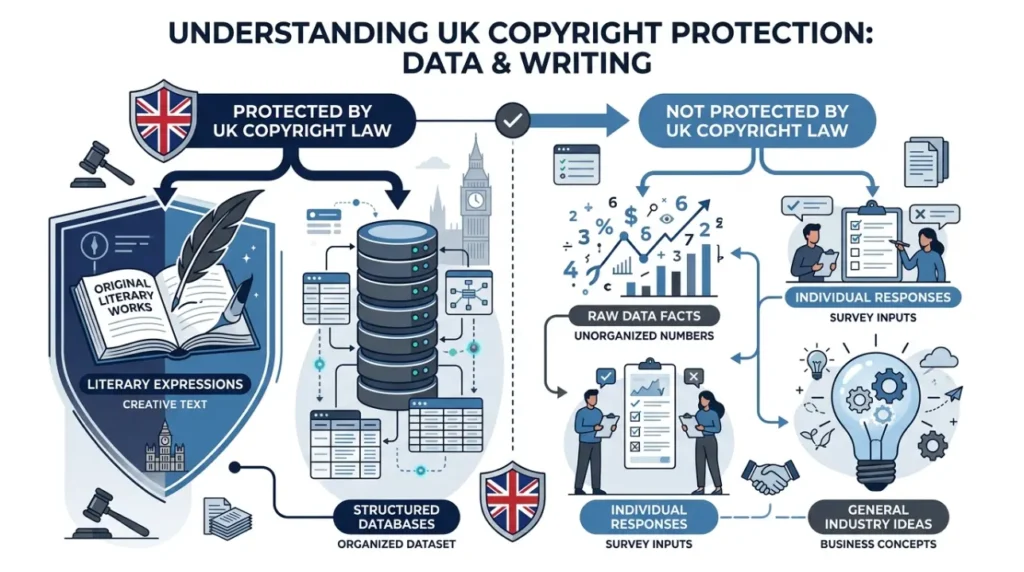
Understanding the legal distinction between raw data inputs and final analytical outputs prevents costly ownership disputes. Raw data consists of unorganized numerical figures, individual interview transcripts, and isolated statistical data points. Copyright protects the creative arrangement of a database under the Copyright and Rights in Databases Regulations 1997, provided there was a substantial investment in obtaining, verifying, or presenting the contents.
Legal Status of Report Elements
- Raw Survey Datasets: Unprocessed numerical values lack intellectual creation, meaning standalone raw data points remain outside traditional copyright protection.
- Structured Databases: Organized collections of survey responses enjoy database right protection for 15 years, preventing unauthorized extraction or reutilization of the contents.
- Analytical Findings: Narrative interpretations, executive summaries, trend forecasts, and proprietary charts receive full literary copyright protection as original written works.
Explore More Expert Insights:
How Fintech Companies Acquire Users Using Banner Ads
How Finance Brands Promote Credit Cards Using Display Campaigns
What are the standard data ownership models in UK commercial contracts?
Standard commercial research contracts in the United Kingdom utilize three primary ownership structures: full client assignment, supplier retention with exclusive licensing, or shared joint-ownership arrangements.
Negotiating these models prior to project commencement determines how commercial entities can monetize, distribute, or repurpose research assets. Each model carries distinct legal and financial implications for both commissioning organizations and research suppliers.
Contractual Ownership Structures
- Full Assignment Model: The client acquires 100 percent of the intellectual property rights, copyright, and database rights to both the raw data and the final report upon final payment.
- Licensing Model: The research supplier retains absolute ownership of the intellectual property, granting the client a perpetual, non-exclusive, worldwide license to use the findings for internal business purposes.
- Joint-Ownership Model: Both parties share rights to the underlying data while defining separate usage boundaries for commercial resale versus internal corporate deployment.
How can organizations negotiate data rights before commissioning research?
Organizations negotiate data rights prior to commissioning research by inserting explicit intellectual property assignment clauses, defining permitted reuse scopes, and establishing clear payment contingencies within the master services agreement.
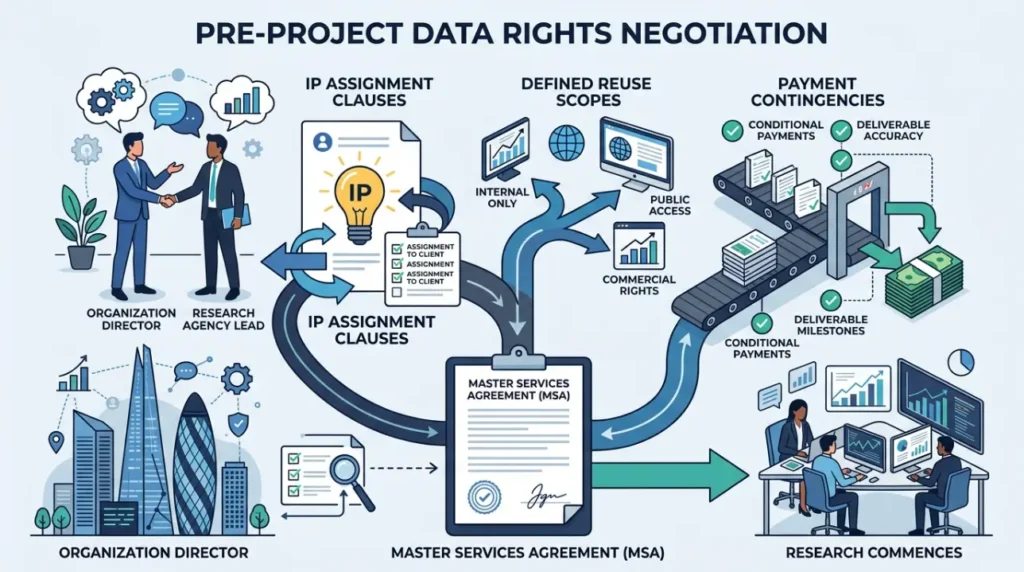
Failing to define ownership terms before fieldwork begins creates severe operational risks. Commissioning parties must outline specific deliverables, data formats, and redistribution rights within the initial statement of work.
Key Clauses to Include in Research Contracts
- IP Assignment Language: Draft explicit wording stating that all intellectual property rights in deliverables vest in the client upon creation.
- Raw Data Delivery Obligations: Specify that the supplier must deliver clean, anonymized datasets in specific machine-readable formats, such as CSV or SPSS files, at project completion.
- Third-Party Licensing Restrictions: Clarify ownership of proprietary panel data, software methodologies, and benchmark databases utilized by the supplier during the research process.
What are the commercial implications of unclear data ownership terms?
Unclear data ownership terms trigger severe commercial consequences, including copyright infringement liabilities, restricted marketing distribution rights, and costly legal disputes over secondary data monetization.
When contracts lack explicit ownership definitions, both parties often assume contradictory rights. A research supplier might resell aggregated industry benchmarks to competitors, while the client assumes exclusive ownership over the exact same dataset.