
Data ownership in a commissioned research report refers to the legal right to control raw datasets, survey metrics, and analytical findings produced during a contracted project between a corporate client and a media partner within the United Kingdom.
Data ownership establishes which legal entity holds intellectual property rights over the raw data collected from survey respondents, qualitative interviews, and secondary aggregation databases. Copyright law in the United Kingdom governs these contracted deliverables under the Copyright, Designs and Patents Act 1988, which determines authorship and initial ownership rights.
Raw Data Versus Synthesized Findings
Raw data consists of unmanipulated survey responses, anonymized respondent records, and unprocessed metric feeds harvested during the research phase. Synthesized findings represent the final charts, descriptive summaries, executive commentary, and strategic interpretations published within the deliverable document. Media partners typically retain ownership of proprietary methodology frameworks, while clients require clear title transfer for bespoke primary datasets collected specifically for their corporate objectives.
Legal Precedents in United Kingdom Contracting
Contractual agreements dictate final ownership status when statutory default rules are modified by explicit commercial terms. Commissioned works default to the creator unless an assignment clause transfers copyright and database rights to the commissioning party prior to project commencement. Commercial disputes arise when contracts omit precise definitions regarding secondary data reuse across digital marketing campaigns and syndicated publishing networks.
Why must licensing and reuse rights be defined before project commencement?
Licensing and reuse rights must be defined before project commencement to prevent copyright infringement claims, restrict unauthorized commercial redistribution, and secure legal permission for multi-channel marketing campaigns across the United Kingdom.
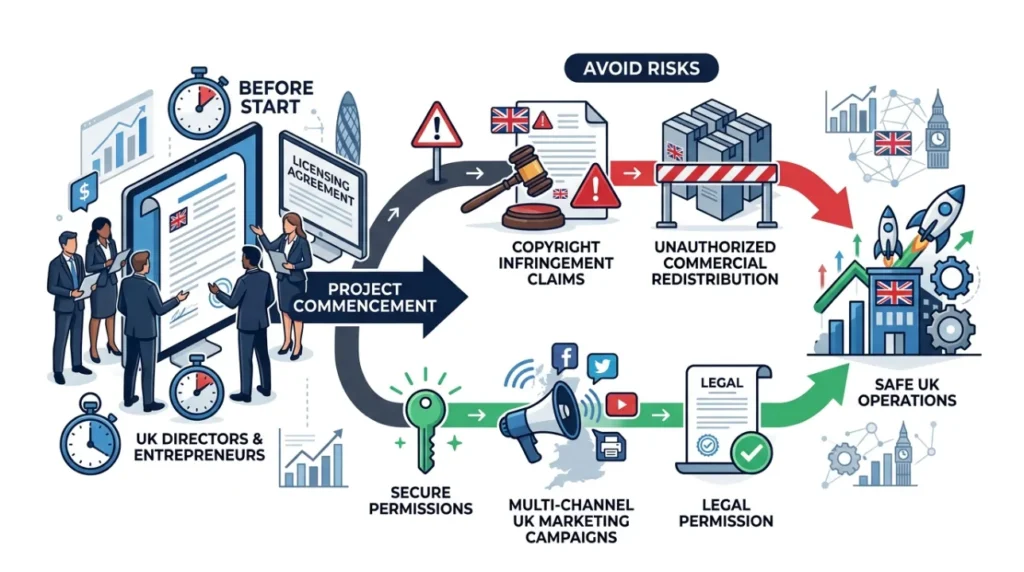
Pre-project clarity eliminates ambiguities that compromise corporate compliance policies and media partner asset valuation models. Media organizations monetize research assets through exclusive licensing tiers, syndicated distribution rights, and restricted commercial usage clauses. Clients require explicit permission to publish proprietary survey statistics in whitepapers, press releases, paid advertising campaigns, and investor relations presentations without facing licensing penalties.
Avoiding Post-Project Commercial Disputes
Disputes occur when a corporate client assumes total ownership of a final report while the media partner retains underlying database rights under United Kingdom intellectual property statutes. Defining scope boundaries upfront prevents legal friction regarding whether internal document sharing violates distribution limitations.
- Clients require distribution clearance for global subsidiaries.
- Media partners require protection against uncredited third-party data scraping.
- Legal teams require explicit indemnification clauses for third-party survey panels.
Protecting Brand Reputation and Data Compliance
Data protection legislation in the United Kingdom, including the Data Protection Act 2018 and United Kingdom General Data Protection Regulation, mandates strict compliance for consumer research data collection. Pre-project agreements establish responsibility for respondent consent protocols, anonymization standards, and regulatory adherence. Establishing these parameters safeguards corporate reputations against regulatory scrutiny regarding unethical data sourcing practices.
Explore More Expert Insights:
How to Brief a UK Publisher for Sponsored Content That Feels Like Real Journalism
Sponsored Content Across 10 Verticals: UK Engagement Benchmarks 2026
How do you structure data ownership clauses in a media research contract?
Structuring data ownership clauses in a media research contract requires precise legal definitions for raw datasets, analytical models, final report deliverables, and explicit transfer terms drafted under United Kingdom contract law.
Contract drafting requires distinct clauses that separate intellectual property ownership from functional usage rights. A robust commercial research agreement itemizes every project asset to eliminate judicial interpretation risks.
Core Elements of Ownership Clauses
- Primary Data Assignment: Explicit transfer of copyright and database rights for raw survey outputs generated exclusively for the client.
- Methodology Retention: Clauses preserving media partner ownership of proprietary research tools, algorithms, and panel databases.
- Derivative Work Rights: Terms governing the creation of infographics, webinars, and derivative media assets derived from the core report.
Step-by-Step Negotiation Process
- Asset Inventory: Catalog every anticipated output, including CSV data tables, PowerPoint decks, and PDF whitepapers.
- Rights Allocation: Designate whether the client receives exclusive ownership, non-exclusive perpetual licensing, or time-limited access.
- Territorial Scope: Define geographical boundaries for data distribution, such as United Kingdom-only dissemination versus global enterprise deployment.
- Sign-Off Protocol: Execute written addendums before fieldwork begins to bind both parties legally.
For foundational insights into baseline statutory ownership principles, review Who Owns the Data and Findings in a Commissioned UK Research Report?.
What are the commercial differences between exclusive and non-exclusive licenses?
Exclusive licenses grant single-party commercial exploitation rights for research assets, whereas non-exclusive licenses permit media partners to syndicate identical findings across multiple corporate clients within identical industry sectors.
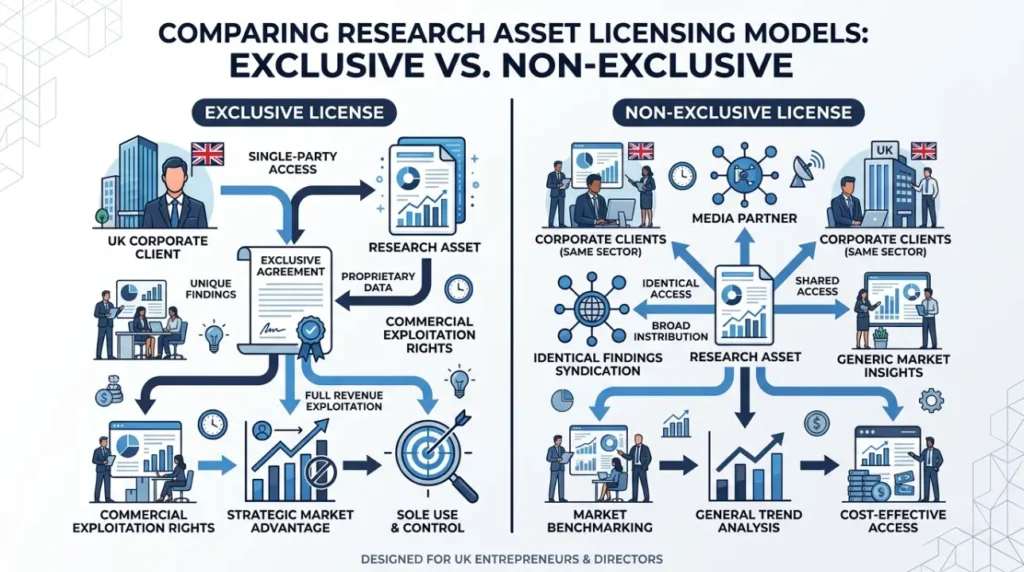
Selecting the correct licensing model impacts project budgets, competitive advantage retention, and long-term marketing value. Media partners price research commissions based on syndication potential and exclusivity premiums.
Exclusive Licensing Models
Exclusive licenses prohibit media partners from reselling raw datasets or identical findings to competing organizations within the same market sector. This model suits brands commissioning proprietary market intelligence designed to establish thought-leadership dominance.
- Higher initial commission fees reflecting lost syndication revenue for the media partner.
- Complete operational control over public release timing and embargo periods.
- Maximum protection against competitor data replication.
Non-Exclusive Licensing Models
Non-exclusive licenses allow media partners to compile broad industry studies and license identical reports to numerous subscribers simultaneously. This approach reduces costs for individual participants while generating recurring revenue streams for the media agency.
- Lower upfront research commissioning costs shared across multiple subscribers.
- Standardized industry benchmarks lacking bespoke proprietary insights tailored to single corporate goals.
- Shared distribution rights across broad publishing networks.
To evaluate comprehensive managed research services featuring flexible ownership models, explore Time Intelligence Media Group Research and Reports Services With Clear Data Ownership Terms.
How can organizations maximize the reuse value of commissioned research assets?
Organizations maximize the reuse value of commissioned research assets by securing perpetual enterprise-wide licensing, contractual rights to derivative media formats, and unrestricted permission for global multi-channel distribution.
Maximizing return on investment requires transforming a static static PDF report into an engine for ongoing content marketing and digital PR campaigns. Contracts must explicitly authorize content repurposing across diverse media channels.
Multi-Channel Content Repurposing
- Infographics: Transforming statistical tables into visual assets for social media platforms.
- Webinars: Hosting live virtual events discussing survey metrics without violating copyright terms.
- Press Releases: Distributing key findings to national news outlets for media coverage.
Long-Term Asset Management
Organizations must archive raw datasets securely to enable longitudinal tracking studies in subsequent fiscal years. Establishing clear version-control protocols ensures internal teams utilize approved data points without misrepresenting original survey findings. Securing perpetual rights guarantees that published whitepapers and archived case studies remain legally compliant indefinitely.