

A charity public relations crisis can reduce donor retention by weakening trust, increasing uncertainty, and changing perceptions of organisational credibility. Donors who question financial integrity, leadership, impact, or transparency often delay, reduce, or stop future contributions.
Donor retention measures the percentage of supporters who continue contributing after their initial donation. It reflects the strength of the relationship between a charity and its donor community.
A public relations crisis disrupts that relationship. Negative news coverage, inaccurate claims, leadership controversies, safeguarding allegations, financial concerns, or operational failures can create uncertainty around the charity’s activities.
The effect becomes stronger when donors receive conflicting information from different sources. Search results, social media posts, news reports, community discussions, and direct communications can all shape donor perceptions.
Why does trust matter to donor retention?
Trust connects a donor’s contribution with confidence in the organisation’s purpose and conduct. A donor needs credible information about how funds are raised, managed, and used.
A crisis introduces questions about that credibility. Donors seek answers about what happened, who was responsible, what the charity knows, and what actions are being taken.
When those answers remain unclear, donor confidence declines. Retention then becomes harder because future giving depends on continued organisational credibility.
Which donor groups face the greatest disruption?
Different donor groups respond differently to crisis information. Regular donors have an established relationship with the charity. New donors have less history on which to base their judgement.
Major donors, institutional funders, volunteers, campaign supporters, and recurring donors also evaluate crisis information through different criteria.
For example, a monthly donor evaluates whether continued support remains consistent with personal expectations. A major donor evaluates governance, financial controls, leadership accountability, and organisational stability.
How does misinformation affect charity donor retention?
Misinformation affects donor retention by introducing false or misleading claims into donor decision-making. Repeated inaccurate information can create doubt, increase perceived organisational risk, and cause supporters to reconsider donations before verified facts reach them.
Misinformation is false or inaccurate information presented or circulated without reliable factual support. Disinformation differs because it involves deliberate efforts to deceive.
Both forms create communication problems for charities. Donors often encounter claims before they encounter official responses.
A false statement about fundraising costs, executive salaries, programme outcomes, safeguarding, political activity, or financial management can become particularly damaging when repeated across multiple channels.
Why does repeated misinformation become difficult to correct?
Repetition increases exposure. A donor who encounters the same claim across several posts, websites, or conversations receives multiple signals about the issue.
The number of appearances does not establish factual accuracy. However, repeated exposure increases the importance of verification.
Charities therefore face two separate tasks. They need to correct the inaccurate claim and provide accessible evidence that supports the correction.
What misinformation commonly affects charities?
Common misinformation themes include:

- Incorrect claims about how donations are spent
- False allegations involving charity leaders
- Misleading statements about programme results
- Fabricated financial figures
- Incorrect claims about regulatory action
- False statements about beneficiaries
- Misrepresented photographs or videos
- Unverified allegations shared through social media
- Incorrect claims about political affiliations
- False statements about fundraising campaigns
For example, a fabricated post claiming that 90% of donations are spent on administration creates a direct challenge to donor confidence if the charity’s published accounts show a materially different allocation.
How does a charity crisis change donor behaviour?
A charity crisis changes donor behaviour through increased scrutiny, delayed giving, reduced recurring support, requests for clarification, and movement toward alternative organisations. Donor responses depend on perceived severity, credibility of information, communication speed, and confidence in organisational accountability.
Donor behaviour often changes before an organisation sees a measurable decline in annual income.
A supporter can pause a recurring payment without publicly explaining the decision. Another donor can stop opening fundraising emails. A third donor can continue supporting the charity but reduce the contribution.
These behaviours create early indicators of declining donor engagement.
Which donor behaviours indicate declining confidence?
Key indicators include:
- Lower recurring donation renewal rates
- Increased cancellation of monthly donations
- Reduced email engagement
- Lower campaign conversion rates
- Increased donor complaints
- More requests for financial information
- Higher unsubscribe rates
- Reduced event participation
- Lower volunteer engagement
- Increased donor enquiries about the crisis
Each indicator provides different information. A decline in recurring donations directly affects retention. A rise in information requests indicates increased scrutiny.
How does communication speed affect donor confidence?
Communication speed affects donor confidence because unanswered claims leave an information gap. During a crisis, donors need verified facts, clear organisational responses, and consistent updates that explain known information without creating further uncertainty.
Rapid communication does not mean releasing incomplete information. Effective crisis communication depends on accuracy, accountability, consistency, and relevance.
A charity needs to distinguish confirmed facts from information under review. It also needs to identify what actions are already underway.
For example, if a financial allegation is under investigation, a factual statement identifies the allegation, confirms the review, explains the relevant process, and provides the next confirmed update point.
This approach reduces conflicting messages.
What information do donors need during a crisis?
Donors generally need clear answers to five questions:
- What happened?
- What information has been verified?
- What does the organisation not yet know?
- What action is being taken?
- When will further information be provided?
These questions create a factual communication structure. They also prevent unrelated information from distracting from the central issue.
For organisations developing a more detailed response process, can be placed naturally on the phrase:
Why does transparency influence charity donor retention?
Transparency supports donor retention by giving supporters access to relevant facts about finances, governance, investigations, corrective actions, and organisational performance. Clear disclosure reduces information gaps and gives donors evidence for evaluating continued support.
Transparency does not require disclosure of confidential personal information or information restricted by law.
Instead, it requires clear communication about information that donors reasonably need to understand the situation.
Financial transparency includes published accounts, annual reports, fundraising information, and explanations of significant financial issues.
Governance transparency includes information about leadership responsibilities, oversight structures, policies, and accountability mechanisms.
Operational transparency focuses on the charity’s response, corrective measures, programme delivery, and safeguarding processes.
How does accountability differ from transparency?
Transparency provides information. Accountability explains responsibility and action.
A charity demonstrates accountability by identifying the relevant governance process, reviewing what happened, addressing confirmed failures, and reporting progress.
For example, if an internal review identifies weaknesses in donation processing, accountability includes explaining the corrective controls introduced to prevent recurrence.
This distinction matters because donors evaluate both what an organisation tells them and what it does in response.
How does media coverage influence donor perceptions of a charity?
Media coverage influences donor perceptions by increasing the visibility, reach, and perceived significance of a crisis. National, regional, trade, broadcast, and digital coverage can expose donors to information outside the charity’s direct communication channels.
News organisations act as important information intermediaries during public controversies.
A charity’s supporters can encounter crisis coverage through newspapers, television, radio, online publications, search results, newsletters, and social platforms.
The framing of coverage also affects the information donors receive. Headlines, quotations, reported figures, expert comments, and references to previous incidents all contribute to public understanding.
Why does consistent information matter across media channels?
Inconsistent statements create additional uncertainty.
If a charity gives different figures to journalists, donors, and stakeholders, supporters face conflicting information. Even an accidental discrepancy can create questions about organisational control.
Consistent communication uses the same verified facts across press statements, websites, donor emails, social media updates, and public reports.
The format changes between channels. The underlying facts remain consistent.
What role does donor communication play after misinformation spreads?
Donor communication provides a direct channel for correcting inaccurate claims, explaining verified facts, reinforcing organisational transparency, and maintaining relationships with existing supporters during periods of heightened public scrutiny.
Direct donor communication gives charities greater control over the information presented to existing supporters.
A donor email can provide links to published evidence, explain organisational actions, and direct supporters toward an official information source.
The communication also needs to recognise the donor’s concern without repeating unverified allegations unnecessarily.
What makes a donor update effective?
An effective update contains:
- A factual description of the issue
- Verified information
- A clear explanation of organisational action
- Relevant evidence or documentation
- A statement about accountability
- Contact information for legitimate enquiries
- The date of the next update when further review remains active
The purpose is clarity. Excessive detail can obscure the central facts, while insufficient information leaves unanswered questions.
How can charities measure the effect of a crisis on donor retention?
Charities can measure crisis-related retention effects by comparing donor renewal, recurring giving, campaign response, engagement, complaints, and cancellation data before and after the incident using consistent measurement periods.
Measurement requires a defined baseline.
For example, a charity can compare monthly donor retention across the six months before a crisis with the six months following the event.
Useful measures include:
| Metric | What it indicates |
|---|---|
| Donor retention rate | Continued donor support |
| Recurring donation cancellation | Immediate giving disruption |
| Average donation value | Changes in donor commitment |
| Email engagement | Attention and interest |
| Complaint volume | Levels of concern |
| Website traffic | Information-seeking behaviour |
| Crisis-page visits | Demand for clarification |
| Donation conversion | Willingness to continue giving |
Why is timing important when analysing retention?
A crisis does not always affect every donor at the same time.
News coverage can produce immediate reactions. Donor cancellations can occur days or weeks later. Recurring payment cycles can create longer measurement delays.
Analysis therefore needs consistent time periods and clearly defined crisis dates.
What can charities learn from donor retention after a crisis?
Post-crisis donor retention data shows how effectively an organisation maintained trust, addressed misinformation, communicated verified information, and demonstrated accountability throughout the incident and its subsequent resolution.
Retention data provides more than a financial result.
It identifies which supporter relationships remained stable and where confidence declined. When combined with communication engagement, complaint records, and donor feedback, it provides a clearer picture of stakeholder response.
A charity can then assess whether donors received sufficient information, whether communication channels worked effectively, and whether public information remained consistent.
For readers progressing from crisis awareness toward practical distribution considerations,
Secure PR Distribution, while keeping the educational context of this article focused on donor retention and crisis communication.
What is the overall relationship between misinformation, public relations crises, and donor retention?
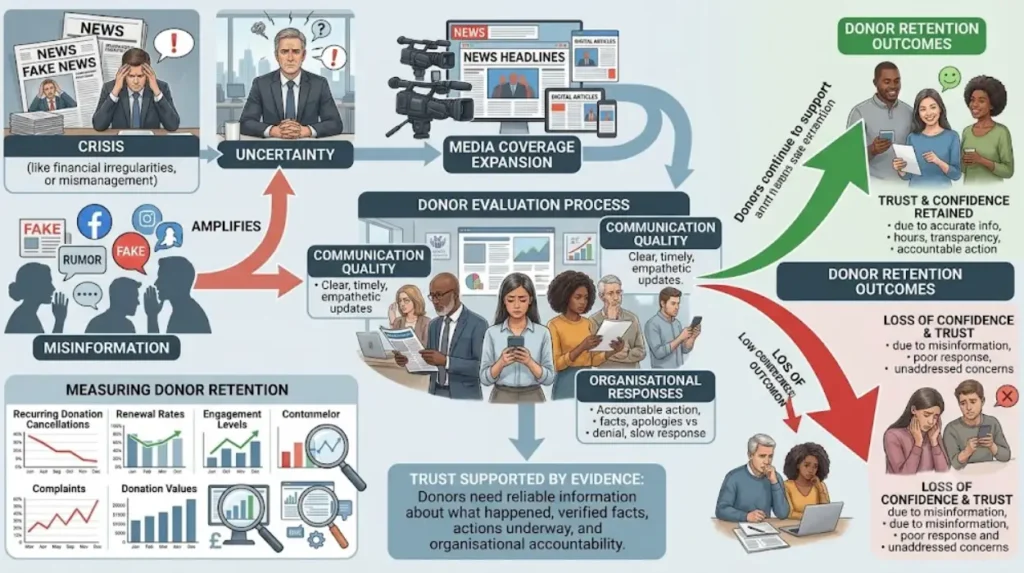
Misinformation and public relations crises threaten donor retention by weakening confidence in organisational credibility. Accurate information, transparent communication, consistent facts, and accountable action help charities protect donor relationships during periods of public scrutiny.
The relationship follows a clear sequence.
A crisis creates uncertainty. Misinformation can increase that uncertainty. Media coverage expands exposure. Donors evaluate the information available to them. Communication quality then influences how effectively the organisation addresses those concerns.
Donor retention remains measurable throughout this process.
Explore More Expert Insights:
Why continuous press presence is vital for humanitarian organizations facing donor fatigue
Charities can monitor recurring donation cancellations, renewal rates, engagement, complaints, and donation values. These measures identify changes in supporter behaviour.
The central issue is trust supported by evidence. Donors need reliable information about what happened, what has been verified, what actions are underway, and how the organisation remains accountable.
For charities operating in the United Kingdom, effective crisis communication therefore forms an important part of maintaining donor relationships when public information becomes contested, inaccurate, or rapidly changing.



