A crisis communication framework is a structured process for identifying an incident, verifying facts, assigning responsibility, preparing public statements, selecting communication channels, and providing timely updates that protect organisational credibility and maintain community trust.
A crisis communication framework gives organisations a defined response process during high-pressure situations. It prevents communication teams from making disconnected decisions when information changes quickly.
For charities, public bodies, community organisations, and social-purpose institutions, crisis communication involves more than issuing a statement. It covers fact verification, stakeholder identification, spokesperson selection, media coordination, digital monitoring, and follow-up communication.
The framework also separates confirmed information from unverified claims. This distinction is critical when misinformation spreads through social media, community groups, online publications, or messaging platforms.
Organisations that already understand the relationship between misinformation and donor retention can use crisis communication planning to address the communication problem before it becomes a long-term trust issue.
Which stages form the framework?
A practical framework contains six connected stages:
- Detect the incident and identify the source.
- Verify the available information.
- Assess the impact on stakeholders.
- Prepare a factual public statement.
- Distribute the statement through appropriate channels.
- Monitor and update communication as verified facts develop.
Each stage has a defined purpose. The process creates consistency across communications teams and senior decision-makers.
How quickly should an organisation issue a public statement?
An organisation needs an initial public response as soon as verified facts establish that stakeholders require clarification. The first statement does not require complete investigation results, but it requires accurate information, defined accountability, and clear communication about next steps.
Speed matters because information gaps attract speculation. A silent organisation leaves space for external claims to dominate public discussion.
Rapid communication does not mean publishing incomplete information. The first statement needs a narrow factual scope. It can confirm that an incident occurred, identify what has been verified, explain what remains under review, and state when the next update will appear.
For example, a UK charity facing an allegation about the use of restricted funds can issue an initial statement confirming that the allegation has been received and that its financial records are being reviewed. It can then provide a scheduled update after the review.
What belongs in the first statement?
The first public statement generally contains:
- Acknowledgement of the issue.
- Confirmed facts.
- Actions already taken.
- Information that remains unverified.
- A clear organisational position.
- A named or identified spokesperson.
- The timing of the next update.
- A contact route for affected stakeholders.
This structure reduces ambiguity. It also creates a consistent reference point for journalists, donors, employees, partners, regulators, and community members.
How does an organisation verify information before speaking publicly?
Information verification involves checking claims against reliable internal records, authoritative external sources, direct evidence, and responsible subject-matter experts before publication. Verification establishes which facts are confirmed, which claims remain disputed, and which details require further investigation.
Crisis communication teams need a documented verification process. Social media posts, screenshots, anonymous claims, and third-party commentary do not automatically constitute verified evidence.
The team first identifies the original claim. It then checks the source, publication time, supporting evidence, and relationship between the source and the incident.
Internal records provide another verification layer. These records include financial documents, operational logs, correspondence, policy documents, meeting records, and approved organisational data.
External verification depends on the nature of the incident. A public-sector organisation dealing with a service disruption requires different evidence from a charity responding to allegations about fundraising practices.
How can teams separate facts from allegations?
A simple classification system improves accuracy:
| Information type | Communication treatment |
|---|---|
| Confirmed fact | State clearly |
| Direct organisational action | State clearly |
| Unverified allegation | Identify as unverified |
| Third-party claim | Attribute accurately |
| Missing information | Explain that verification continues |
| Incorrect information | Correct with supporting evidence |
This system prevents public statements from presenting allegations as established facts.
What should a rapid public statement contain?
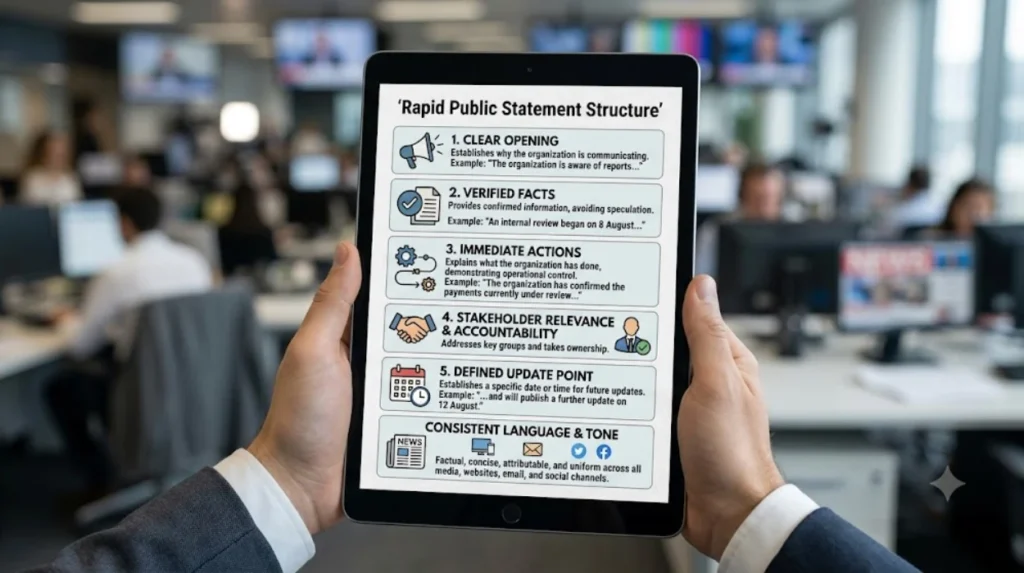
A rapid public statement needs a clear opening, verified facts, immediate actions, stakeholder relevance, accountability, and a defined update point. Its language must remain factual, concise, attributable, and consistent across media, websites, email, and social channels.
The opening sentence establishes why the organisation is communicating. The next sentences provide verified information.
The statement then explains what the organisation has done. This section demonstrates operational control without making unsupported claims.
The final section establishes the next communication point. A specific date or time creates an identifiable expectation for stakeholders.
For example:
“The organisation is aware of reports concerning its community funding programme. An internal review began on 8 August. The organisation has confirmed the payments currently under review and will publish a further update on 12 August.”
The example avoids speculation. It identifies the issue, confirms action, and establishes a future communication point.
What language creates clarity during a crisis?
Crisis statements benefit from direct language.
Use:
- “We have confirmed…”
- “An investigation began on…”
- “The review covers…”
- “The organisation has taken…”
- “This information is not yet verified…”
- “The next update will be issued on…”
Avoid vague statements that create additional questions. Terms such as “some concerns”, “recent developments”, or “unexpected circumstances” provide limited information when used without specific context.
Which communication channels support rapid crisis response?
Effective crisis communication uses coordinated channels based on stakeholder needs, message urgency, audience reach, and information control. Common channels include organisational websites, social media, email, media statements, stakeholder briefings, and direct communications with affected groups.
The organisational website often provides the central source of truth. A dedicated crisis update page gives stakeholders a stable location for verified information and subsequent updates.
Social media provides rapid reach. It also requires careful monitoring because posts can be quoted, edited, reposted, or removed from their original context.
Email works well for known stakeholder groups. Charities can use donor communications, volunteer updates, staff emails, and partner briefings to deliver information directly.
Media distribution extends the statement beyond existing audiences. It helps journalists access the organisation’s official position without relying on fragmented social media commentary.
Why does channel consistency matter?
A crisis message loses credibility when different channels publish conflicting information.
The same confirmed facts need to appear across the website, press statement, social channels, and direct stakeholder communications.
Timing also matters. Publishing the website statement before social posts gives external audiences a destination for detailed information.
How does rapid communication help retain community trust?
Rapid communication supports trust by reducing information gaps, demonstrating accountability, correcting misinformation, and giving stakeholders verified information from an identifiable source. Consistent updates also show that the organisation continues managing the incident after the first statement.
Trust depends on more than the first response. Stakeholders assess whether an organisation communicates consistently throughout the incident.
A charity that issues an initial statement and then provides documented updates creates a clearer information trail. A public body that explains service disruption, corrective action, and restoration progress gives affected communities defined information points.
This approach also reduces repeated questions. Stakeholders can refer to the same published source rather than relying on individual interpretations.
What happens when communication stops after the first statement?
A single statement rarely closes a crisis.
New information changes the communication environment. Journalists publish follow-up reports. Social media users raise additional claims. Stakeholders ask questions. Investigations produce new findings.
The communication framework therefore requires scheduled updates.
A useful update sequence includes:
- Initial acknowledgement.
- First factual update.
- Operational progress update.
- Investigation or review findings.
- Corrective action statement.
- Final resolution or closure update.
The exact sequence depends on the incident and regulatory requirements.
How should organisations correct misinformation during a crisis?
Misinformation correction requires organisations to identify the inaccurate claim, provide the verified fact, explain the evidence where appropriate, and publish the correction through channels that reach the affected audience without unnecessarily amplifying the original claim.
A correction needs precision. Repeating an inaccurate claim multiple times can increase its visibility. The organisation needs to focus attention on the verified information.
For example, if an inaccurate social post claims that a charity has stopped funding a specific community programme, the organisation can state that the programme remains active and provide the current funding position.
The correction also needs monitoring. Search results, social platforms, media coverage, and stakeholder communications reveal whether the correction has reached relevant audiences.
Which claims require immediate correction?
Priority claims include misinformation that affects:
- Public safety.
- Financial donations.
- Service availability.
- Legal or regulatory compliance.
- Personal data.
- Staff or volunteer safety.
- Community access to essential services.
- Organisational integrity.
The priority is determined by potential stakeholder impact and the speed at which the misinformation spreads.
What role does media distribution play in crisis communication?
Media distribution provides a controlled route for delivering an approved public statement to journalists, publications, stakeholders, and wider audiences. It supports message consistency by giving external audiences access to an identifiable organisational source during fast-moving incidents.
Media distribution becomes particularly relevant when a crisis has moved beyond an organisation’s existing audience.
A statement published only on a website reaches people who already know where to look. Broader distribution helps journalists and relevant publications locate the official response.
Different distribution approaches serve different requirements. Organisations can use direct media outreach, newsroom contacts, specialist distribution networks, owned channels, or combinations of these methods.
The choice depends on the incident, audience, urgency, geographical scope, and communication objectives.
For high-stakes public-sector or community announcements, organisations also need to assess how distribution providers handle sensitive information, publication timing, reporting, and message control. This creates a natural connection to:
Secure PR Distribution when evaluating solution options.
How can organisations measure whether crisis communication is working?
Crisis communication performance can be measured through response time, message reach, media accuracy, misinformation volume, stakeholder engagement, website traffic, sentiment indicators, and completion of scheduled updates. These measures reveal whether communication reached audiences and corrected information gaps.
Response time measures the period between incident identification and publication of the initial statement.
Reach measures how many relevant stakeholders encountered the official information.
Media accuracy examines whether journalists and publications reproduced the organisation’s verified position correctly.
Misinformation monitoring tracks the volume and persistence of inaccurate claims.
Website analytics provide additional evidence. Spikes in visits to a crisis information page indicate stakeholder demand for official information.
Which metrics matter after the crisis?
Post-crisis measurement focuses on longer-term outcomes.
Useful indicators include:
- Donor retention.
- Volunteer retention.
- Stakeholder enquiries.
- Media correction rates.
- Website engagement.
- Repeat misinformation incidents.
- Complaint volumes.
- Completion of promised actions.
These measurements connect communication performance with organisational trust.
How can organisations build a repeatable crisis communication process?
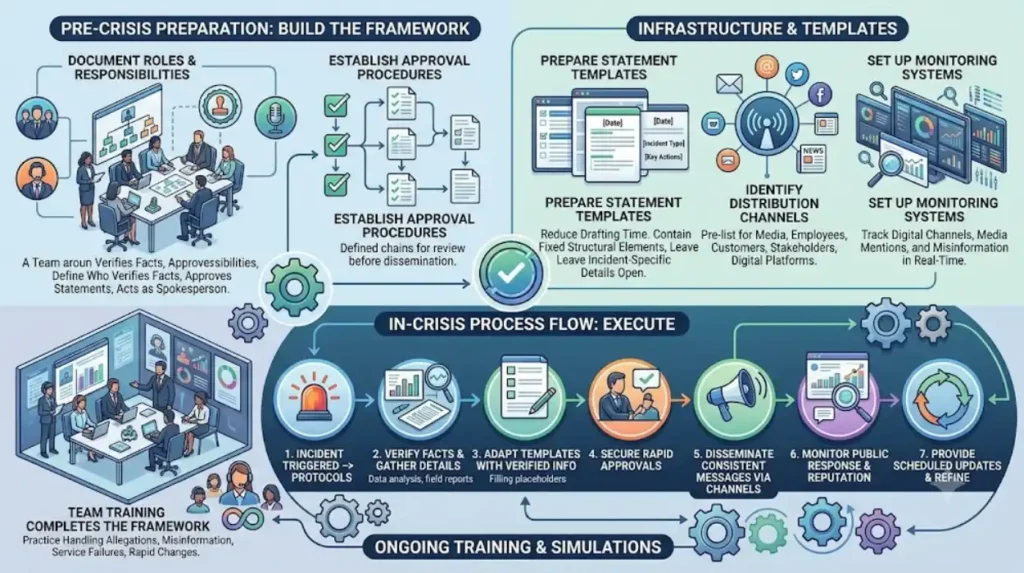
A repeatable process combines predefined roles, approval procedures, statement templates, verification protocols, distribution channels, monitoring systems, and scheduled updates. Organisations that document these components reduce decision delays and maintain consistent communication during future incidents.
Preparation starts before the crisis.
Organisations need to identify who verifies facts, who approves statements, who acts as spokesperson, who manages media enquiries, and who monitors digital channels.
Templates also reduce drafting time. A template can contain fixed structural elements while leaving incident-specific information open for verified details.
Training completes the framework. Teams need practice handling allegations, misinformation, service failures, funding concerns, and rapidly changing information.
Explore More Expert Insights:
Crafting an Authoritative Press Release Layout for Complex Policy Reform and Community Initiatives
What is the practical crisis communication sequence?
A concise operational sequence is:
Identify → Verify → Assess → Draft → Approve → Publish → Distribute → Monitor → Update → Review
This sequence provides a clear decision structure without restricting the organisation’s ability to respond to different incidents.
For UK charities and public-interest organisations, the framework also needs to account for regulatory responsibilities, stakeholder expectations, media practices, and the specific consequences of misinformation.
Rapid public statements work best when speed and accuracy operate together. The objective is not simply to publish first. The objective is to establish a credible source of verified information, maintain communication throughout the incident, and give communities clear evidence of responsible action.