

An impactful human-interest story centres on identifiable people, demonstrates a clear public-interest issue, contains verified facts, and shows measurable consequences. NGO reporters prioritise evidence, relevance, access, and human impact over organisational promotion or general advocacy claims.
NGO beat reporters cover stories involving charities, humanitarian organisations, campaign groups, community organisations, social enterprises, and public-interest initiatives. Their work requires fast assessment because editorial inboxes receive a high volume of pitches.
A human-interest story connects a wider social issue to specific people and documented experiences. It answers practical questions about who is affected, what happened, where it happened, when it happened, and why the issue matters.
For example, a charity announcing a £500,000 community programme provides an organisational fact. A story about families in a specific London borough receiving essential support through that programme provides a human-interest angle.
The distinction is editorial relevance. Reporters need a story that informs their audience rather than simply promotes an organisation.
What makes a story newsworthy?
Newsworthiness often depends on several measurable factors:
- Number of people affected
- Geographic relevance
- Timeliness
- Scale of the issue
- Evidence of change
- Public policy connection
- Community significance
- Availability of credible sources
- Access to affected individuals
- Supporting data
A pitch becomes stronger when these elements are presented clearly and accurately.
How do NGO beat reporters process hundreds of advocacy pitches?
Reporters first scan the subject line, opening sentence, relevance, timing, evidence, and proposed human angle. They then eliminate promotional, generic, unsupported, duplicated, or poorly targeted pitches before investigating stories with clear public-interest value.
The first filter is usually speed. Reporters do not read every pitch in full before deciding whether it deserves attention.
The subject line establishes the initial context. A subject such as “New research reveals rising food insecurity among families in Greater Manchester” communicates a specific development. “Important announcement from leading charity” communicates little editorial information.
The opening paragraph receives similar scrutiny. It needs to establish the news event immediately.
Reporters also assess whether the story fits their beat. An NGO reporter covering humanitarian policy, charity regulation, poverty, social justice, or community development has defined editorial priorities.
A strong story can still be rejected when it lacks relevance to the publication’s audience.
Why does the first 20 seconds matter?
The initial screening process focuses on information that helps a reporter make a rapid editorial decision. Clear facts reduce the time required to identify the story.
A useful opening identifies:
- The new development
- The people affected
- The location
- The reason the development matters
- The evidence supporting the claim
For example, “A new survey of 2,000 UK households found that 38% reduced essential spending because of rising living costs” provides a stronger starting point than “A leading charity has launched an important new campaign.”
What human-interest elements make an NGO pitch stand out?
Human-interest elements include identifiable experiences, specific consequences, credible personal testimony, relevant locations, measurable outcomes, and direct connections to wider social issues. These details give reporters evidence of how an issue affects real people beyond organisational messaging.
Personal experiences provide context for broader statistics. A person affected by homelessness, food insecurity, displacement, disability access, or community deprivation gives the reporter a human perspective.
The individual must remain relevant to the central issue. Personal information without a clear public-interest connection does not create a complete story.
Consent also matters. NGOs need appropriate permission before providing personal stories, photographs, contact information, or sensitive experiences to journalists.
Why are real people important in advocacy reporting?
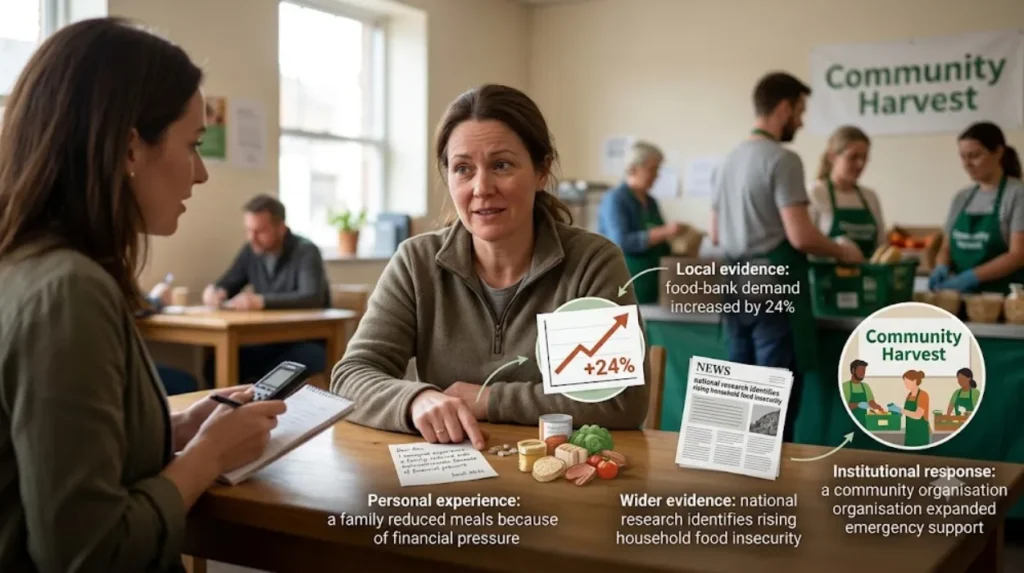
A real person provides evidence of the lived consequences behind an issue.
Consider a community food project. A general statement about food insecurity describes the problem. A documented account from a parent explaining how reduced household income affected weekly food purchases provides a specific human dimension.
The strongest pitches connect that experience to wider evidence.
For example:
- Personal experience: a family reduced meals because of financial pressure.
- Local evidence: food-bank demand increased by 24%.
- Wider evidence: national research identifies rising household food insecurity.
- Institutional response: a community organisation expanded emergency support.
This structure gives reporters several levels of information without relying on promotional language.
How do reporters evaluate evidence behind NGO claims?
Reporters evaluate evidence by checking its source, date, methodology, sample size, geographic scope, and relationship to the central claim. Specific statistics with transparent sources receive greater editorial attention than unsupported statements about impact or urgency.
Evidence allows reporters to distinguish a genuine development from advocacy messaging.
A statistic needs context. “Demand increased by 40%” does not explain the measurement period, baseline, population, or source. “Requests for emergency food support increased by 40% between January and June 2026 across 15 participating centres” provides greater editorial clarity.
Reporters also examine whether research supports the exact claim being made.
Which types of evidence are useful?
Useful evidence includes:
- Government datasets
- University research
- Independent surveys
- Official regulatory statistics
- Audited organisational data
- Local authority information
- Peer-reviewed studies
- Documented programme results
For example, a homelessness story can draw on government housing statistics, local authority records, charity service data, and interviews with affected residents.
The source needs to be identifiable. Anonymous claims without supporting documentation provide limited editorial value.
How does timeliness affect NGO story selection?
Timeliness determines whether an NGO story connects to an active public conversation, recent event, policy development, funding decision, emergency, report, or community change. Reporters prioritise developments with a clear and immediate editorial reason for coverage.
A story becomes more relevant when it connects to something happening now.
Examples include a new government consultation, severe weather event, newly published research, parliamentary development, funding announcement, humanitarian emergency, court decision, or major community programme.
Timing also affects competition. Several organisations can pitch stories around the same policy announcement. The pitch with the clearest evidence and strongest human impact receives greater editorial relevance.
How does policy context strengthen a human story?
Policy creates a wider framework for individual experiences.
For example, a change affecting social housing becomes more understandable when paired with a resident’s experience and verified local housing data.
This creates three connected layers:
- Policy: What changed?
- Evidence: How many people are affected?
- Experience: What does the change mean for an individual or community?
This structure gives reporters both public-interest context and human relevance.
Organisations working on policy reform can also improve editorial clarity by presenting complex information in an accessible format. A well-structured:
Press release layout can help separate the announcement, evidence, quotes, human-interest material, and supporting information.
What makes an advocacy pitch credible to an NGO reporter?
Credible advocacy pitches identify the organisation, disclose the purpose of the campaign, provide verifiable evidence, identify relevant spokespeople, explain the human impact, and distinguish factual information from opinion or advocacy positions.
Transparency is central to editorial assessment.
Reporters need to know who is making the claim and why. A campaign organisation presenting research needs to identify the research source. A charity describing programme outcomes needs to explain how those outcomes were measured.
Quotes also require scrutiny. A quote that repeats organisational messaging provides limited additional information. A quote explaining a specific development, consequence, or response gives the reporter usable material.
What information should an advocacy pitch contain?
A concise pitch can include:
- News development
- Relevant date
- Location
- Key statistic
- Human-interest subject
- Expert spokesperson
- Supporting research
- Contact information
- Relevant photographs or documentation
- Clear explanation of public impact
The pitch does not need to contain every available organisational detail.
A reporter needs enough information to assess the story and decide whether further contact is worthwhile.
Why do reporters reject generic NGO pitches?
Generic NGO pitches fail because they focus on organisational activity instead of public impact, use broad claims without evidence, lack a specific news event, target the wrong reporter, or provide no distinctive human-interest material that supports independent editorial coverage.
Common weak openings include phrases such as “We are delighted to announce,” “Our organisation is proud to launch,” and “We are calling for urgent action.”
These statements centre the organisation rather than the news.
A stronger approach identifies the external development first.
For example, instead of leading with a charity’s campaign launch, the pitch can lead with new findings showing that a defined population faces a measurable problem.
Which advocacy pitch mistakes reduce editorial relevance?
Frequent problems include:
- Sending mass emails without personalisation
- Using vague subject lines
- Making unsupported impact claims
- Providing outdated statistics
- Offering no human source
- Hiding the main news below several paragraphs
- Using excessive promotional language
- Sending irrelevant attachments
- Ignoring publication geography
- Pitching outside the reporter’s beat
These issues increase the time required for editorial assessment and reduce the usefulness of the pitch.
How do human-interest stories demonstrate measurable impact?
Human-interest stories demonstrate impact by connecting individual experiences with measurable changes in behaviour, access, outcomes, participation, funding, service delivery, or community conditions. The strongest evidence combines personal testimony with independently understandable facts and figures.
Impact needs definition.
A charity cannot establish impact simply by stating that a programme “transformed lives.” It needs evidence explaining what changed and how that change was measured.
For example, a youth employment programme can report the number of participants, completion rate, employment outcomes, training hours, and follow-up period.
A participant’s experience then adds context to those figures.
How can local relevance improve an NGO story?
Local relevance gives a story a defined audience.
A national statistic becomes more actionable when connected to a specific city, county, constituency, or community.
For example, an announcement about rising fuel poverty becomes more relevant to a regional reporter when it includes verified figures for households in Birmingham and an interview with an affected resident.
The same principle applies across the United Kingdom. Scotland, Wales, Northern Ireland, English regions, cities, and local communities have distinct political, economic, and social contexts.
What final checks do NGO reporters apply before pursuing a story?
Before pursuing a story, NGO reporters check factual accuracy, source credibility, public-interest relevance, human access, geographic fit, originality, timing, and editorial independence. These checks determine whether the pitch contains enough substance for further reporting.
The final assessment separates a publishable story from a promotional announcement.
Reporters need confidence that the central claim can withstand verification. They also need access to people who can provide first-hand accounts or expert context.
A story with strong statistics but no credible human source has a different editorial structure from a story with both measurable evidence and direct testimony.
What does a strong NGO pitch provide?
A strong pitch gives the reporter a clear answer to six questions:
- What happened?
- Who is affected?
- Why does it matter now?
- What evidence supports the claim?
- Who can provide first-hand information?
- Why is this relevant to the audience?
These questions define the basic editorial value of an advocacy story.
Why do human-interest stories remain important in NGO reporting?
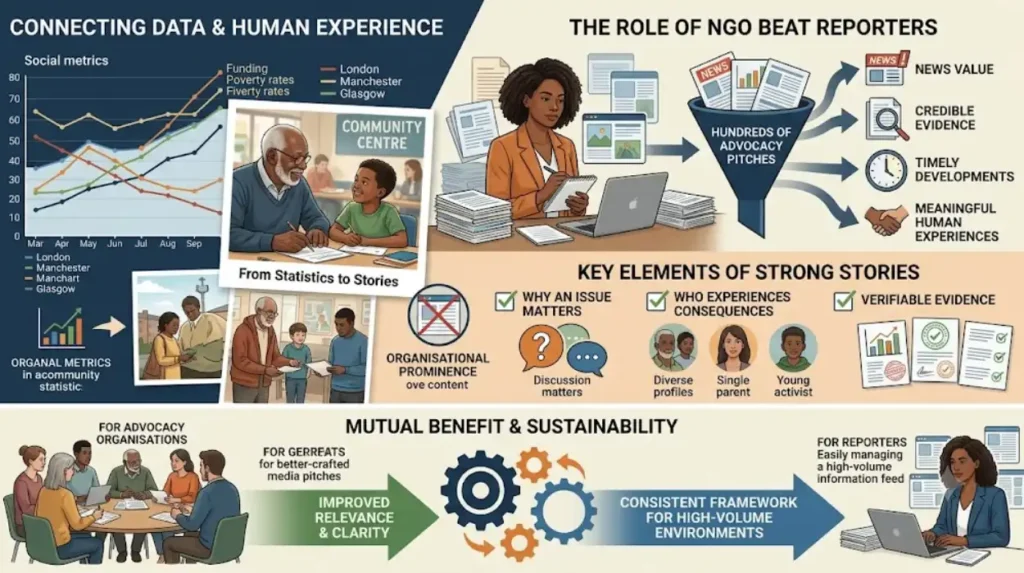
Human-interest stories remain important because they connect measurable social issues with individual experiences, giving audiences factual context about how policies, crises, campaigns, and community initiatives affect people across the United Kingdom.
NGO beat reporters filter hundreds of advocacy pitches by identifying stories with clear news value, credible evidence, timely developments, and meaningful human experiences.
The strongest stories do not rely on organisational prominence. They establish why an issue matters, who experiences its consequences, and what verifiable evidence demonstrates the wider impact.
Explore More Expert Insights:
Why continuous press presence is vital for humanitarian organizations facing donor fatigue
For advocacy organisations, understanding this editorial filtering process improves the relevance and clarity of future media pitches. For reporters, the same criteria provide a consistent framework for identifying human-interest stories within a high-volume information environment.



