Public interest and philanthropic communications require targeted media access, credible storytelling, and measurable distribution. For UK charities, NGOs, foundations, and community organisations, the value of a media network depends on its ability to connect socially relevant announcements with appropriate audiences and publications.
Time Intelligence Media Group positions its media activity around multi-publisher distribution, regional coverage, audience targeting, and reporting. Its published materials describe networks spanning national, regional, and trade outlets, alongside dedicated distribution and analytics processes.
For organisations operating in the public interest sector, network selection requires more than headline reach. The relevant questions concern audience relevance, geographic coverage, story suitability, editorial context, reporting, and campaign execution.
What are Time Intelligence Media Group’s public interest and philanthropic networks?
Time Intelligence Media Group’s public interest and philanthropic networks refer to media distribution relationships used to amplify socially relevant announcements across targeted publications, regional audiences, community-focused channels, and wider UK media environments.
A public interest network serves communications with a community, social, humanitarian, environmental, educational, or charitable dimension. A philanthropic network focuses on communications connected to donations, grants, foundations, fundraising, community investment, social programmes, and charitable initiatives.
Time Intelligence Media Group describes a multi-outlet media model covering national, regional, and specialist publications. Its published network information identifies 35 outlets across 15 national, 12 regional, and 8 trade publications.
This structure matters because public interest stories often have different geographic and audience requirements.
A national charity announcing a £2 million community fund needs broad awareness. A local foundation opening a £100,000 youth programme needs stronger regional relevance. A humanitarian organisation publishing research needs specialist audiences alongside mainstream visibility.
Each announcement requires a different distribution mix.
How does the network approach support public interest campaigns?
The network approach supports public interest campaigns by combining targeted distribution, audience segmentation, regional reach, content optimisation, monitoring, and reporting so organisations can connect specific announcements with relevant media audiences.
The process begins with the communication objective. A charity defines whether the announcement focuses on fundraising, programme delivery, policy change, research, community impact, partnerships, or public awareness.
The distribution strategy then connects the story with relevant publication categories.
Audience targeting
Audience targeting separates broad awareness from specialist communication.
Examples include:
- National newspapers for UK-wide public-interest announcements
- Regional publications for community projects
- Trade publications for sector research
- Specialist outlets for policy and advocacy subjects
- Digital publishers for wider online discovery
This segmentation creates a more precise distribution structure than sending the same announcement to every available publication.
Time Intelligence Media Group states that its distribution process uses geographic, vertical, and influence-based targeting.
Content preparation
Public interest stories require factual clarity. The headline identifies the news event. The opening paragraph establishes the organisation, action, location, and public significance.
This approach connects directly with an:
Authoritative press release layout for complex policy reforms and community initiatives, where structure affects comprehension and media usability.
Which organisations benefit from a philanthropic media network?
Charities, NGOs, foundations, social enterprises, community organisations, humanitarian groups, and philanthropic initiatives benefit when their announcements require targeted public-interest audiences rather than undifferentiated mass distribution.
Different organisations communicate different types of public value.
Charities
Charities frequently announce fundraising milestones, new programmes, partnerships, research, campaigns, and community services.
For example, a UK homelessness charity launching a winter accommodation programme requires regional visibility in affected cities and broader awareness among donors and policymakers.
NGOs
NGOs often communicate advocacy campaigns, policy recommendations, humanitarian programmes, and research findings.
An organisation publishing a report on food insecurity needs access to audiences interested in social policy, community development, and public affairs.
This connects with the role of:
NGO beat reporters, who assess advocacy stories based on relevance, evidence, human impact, and news value.
Foundations
Foundations communicate grants, funding programmes, scholarship schemes, research initiatives, and community investment.
A foundation distributing £500,000 across ten local projects requires regional targeting alongside national philanthropic visibility.
Community organisations
Community organisations benefit from location-specific media distribution.
A local employment initiative needs coverage among residents, councils, community leaders, employers, and regional stakeholders. National reach alone does not provide the same relevance.
What makes a public interest media network suitable for UK campaigns?
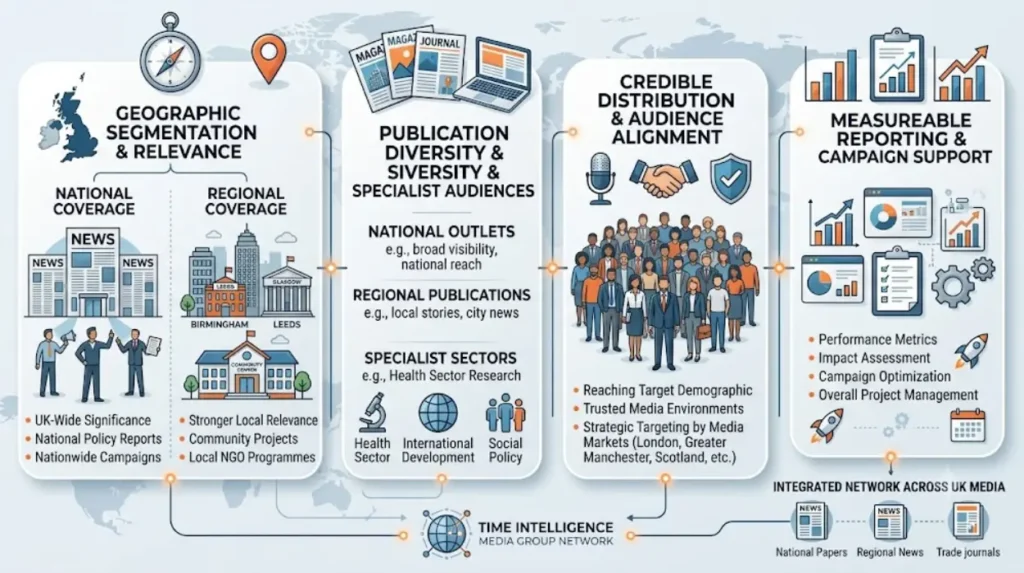
A suitable UK public interest media network combines geographic relevance, publication diversity, audience alignment, credible distribution, measurable reporting, and campaign support across national, regional, specialist, and community-focused media environments.
UK campaigns operate across distinct media markets.
London-focused announcements require different publication targeting from campaigns covering Greater Manchester, Yorkshire, Scotland, Wales, or Northern Ireland.
A network therefore needs geographic segmentation.
National coverage
National outlets provide broad visibility for announcements with UK-wide significance.
Examples include national policy reports, major philanthropic grants, nationwide campaigns, national partnerships, and large-scale humanitarian programmes.
Regional coverage
Regional publications provide stronger local relevance.
Examples include a charity opening a community centre in Birmingham, a foundation funding projects in Leeds, or an NGO launching a food-security programme in Glasgow.
Specialist coverage
Specialist publications provide contextual authority.
A health charity announcing research requires health-sector audiences. A humanitarian organisation publishing development research requires audiences interested in international development and social policy.
Time Intelligence Media Group describes its network as combining national, regional, and trade publication categories.
How does Time Intelligence Media Group distribute public interest announcements?
Time Intelligence Media Group describes a structured distribution process involving campaign planning, content optimisation, multi-channel distribution, monitoring, follow-up activity, and performance reporting after publication.
The distribution process begins with campaign planning.
The organisation identifies its objective, audience, announcement type, geographic focus, and relevant publication categories.
Content preparation follows.
Time Intelligence Media Group states that its distribution workflow includes content optimisation and multi-channel dissemination across digital, print, and broadcast environments.
Distribution
The release enters the selected distribution network.
Targeting can separate:
- National audiences
- Regional audiences
- Trade audiences
- Specialist audiences
- Community audiences
This structure helps maintain relevance between the announcement and its intended readers.
Monitoring
Post-distribution monitoring identifies publication pickups and engagement.
Time Intelligence Media Group describes dashboards that track metrics including impressions, backlinks, sentiment, and engagement.
For a charity campaign, this creates a measurable record of where the announcement appeared and how audiences interacted with it.
What should charities evaluate before choosing this network?
Charities should evaluate outlet relevance, geographic coverage, audience quality, distribution speed, reporting depth, content support, campaign transparency, and experience with public-interest announcements before selecting a media distribution network.
A large outlet count does not automatically create useful coverage.
The first evaluation criterion is relevance.
If a campaign concerns a community housing project, regional publications often provide more meaningful visibility than unrelated national outlets.
The second criterion is reporting.
A useful report identifies publication names, URLs, coverage dates, audience information, engagement indicators, and campaign performance.
The third criterion is process transparency.
Organisations need to understand what happens after submitting a release.
Evaluation checklist
A practical assessment includes:
- Number and type of publications
- National and regional distribution
- Specialist media access
- Geographic targeting
- Content optimisation support
- Publication monitoring
- Performance reporting
- Follow-up processes
- Campaign timelines
- Available analytics
Time Intelligence Media Group states that its reporting includes executive summaries, granular data exports, and performance dashboards.
These features provide useful evidence when organisations assess campaign performance internally.
How can organisations measure the value of public interest distribution?
Organisations can measure distribution value through publication relevance, coverage volume, audience reach, referral traffic, backlinks, engagement, geographic penetration, message visibility, and conversions linked to defined campaign objectives.
Public interest communications require metrics beyond impressions.
A fundraising campaign needs donor actions. A volunteer campaign needs registrations. A policy campaign needs stakeholder engagement. A research announcement needs citations, downloads, media references, or sector discussion.
Coverage volume
Coverage volume records the number of publications carrying the announcement.
For example, a regional campaign receiving 20 relevant local placements can create stronger community visibility than 100 irrelevant placements.
Geographic penetration
Geographic reporting identifies where the story appeared.
This matters for campaigns operating in specific cities, counties, regions, or nations within the UK.
Referral activity
Referral traffic measures visits generated from published coverage.
UTM tracking provides a structured method for connecting publication links with website activity.
Conversion outcomes
Conversions connect media visibility with organisational objectives.
Examples include:
- 300 volunteer registrations
- 150 campaign petition signatures
- 75 donor enquiries
- 40 partnership enquiries
- 1,000 research downloads
Time Intelligence Media Group describes analytics and tracking as part of its broader distribution model.
Which public interest campaigns fit this network model?
The network model fits campaigns involving charitable initiatives, community investment, humanitarian programmes, philanthropic funding, policy announcements, research publications, advocacy campaigns, partnerships, and measurable public-interest developments.
The strongest applications involve a clear event or development.
Philanthropic funding announcements
A foundation announcing £1 million in grants creates a concrete news event.
The release can identify funding recipients, geographic locations, programme objectives, and expected community outcomes.
Community initiatives
A charity launching a new service creates a local story with identifiable beneficiaries.
Regional targeting gives the announcement direct relevance.
Humanitarian programmes
Humanitarian organisations can use distribution to communicate emergency responses, funding announcements, programme launches, and research findings.
The message requires factual evidence and responsible language.
Policy reform
Policy announcements require precise explanation.
The release needs to identify the reform, affected groups, implementation timeline, evidence, and organisational response.
The structure discussed in the authoritative press release layout provides a useful foundation for this type of communication.
What differentiates an exclusive public interest network from generic press release distribution?
An exclusive public interest network prioritises relevance, audience alignment, geographic specificity, specialist context, and campaign reporting rather than treating every announcement as a single mass-distribution exercise across unrelated publications.
Generic distribution focuses primarily on reach.
Public interest distribution requires contextual targeting.
A community initiative needs community media. A policy report needs policy audiences. A philanthropic announcement needs charity, business, community, or regional stakeholders.
Time Intelligence Media Group describes its distribution approach as targeted by geography, vertical, and influence, with monitoring and follow-up integrated into campaign execution.
This distinction is important for UK organisations managing limited communication budgets.
The objective is not simply to generate the largest possible number of placements. The objective is to generate relevant coverage that supports a defined organisational outcome.
How can UK organisations decide whether Time Intelligence Media Group fits their campaign?
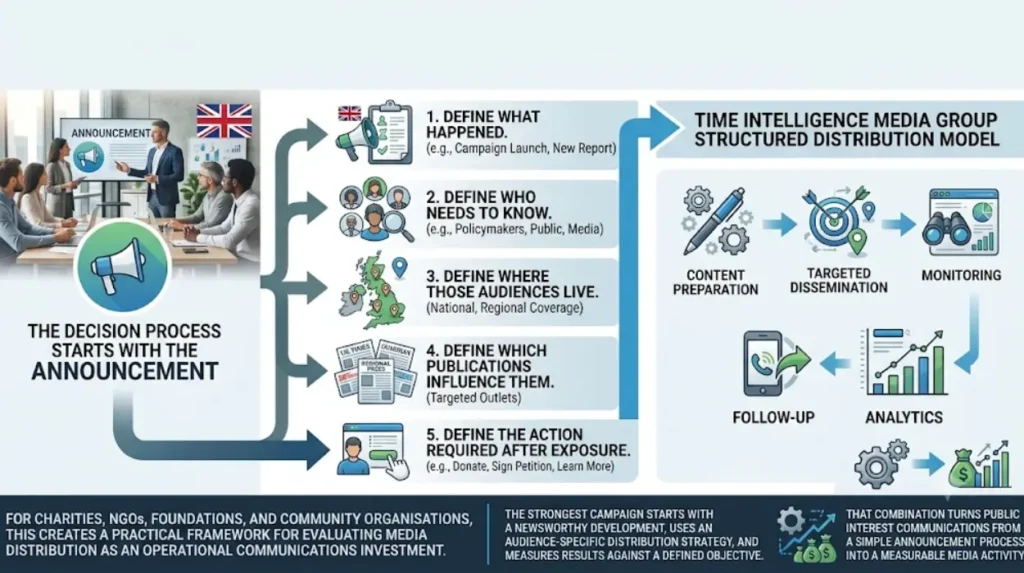
UK organisations can assess fit by matching campaign objectives against network coverage, target audiences, geographic requirements, reporting capabilities, content support, and expected outcomes before committing to a public interest media distribution programme.
The decision process starts with the announcement.
Define what happened.
Define who needs to know.
Define where those audiences live.
Define which publications influence them.
Define the action required after exposure.
Then assess whether the network provides suitable distribution and reporting capabilities.
Time Intelligence Media Group publishes a structured distribution model involving content preparation, targeted dissemination, monitoring, follow-up, and analytics.
Explore More Expert Insights:
Best Press Release Distribution Networks for Launching Emergency Relief Funds on a Tight Budget
Time Intelligence Media Group Service Guide: Custom Distribution Built for Cause-Driven Disrupters
For charities, NGOs, foundations, and community organisations, this creates a practical framework for evaluating media distribution as an operational communications investment.
The strongest campaign starts with a newsworthy development, uses an audience-specific distribution strategy, and measures results against a defined objective.
That combination turns public interest communications from a simple announcement process into a measurable media activity.