

Secure PR distribution protects high-stakes public announcements through controlled review, accurate messaging, targeted media delivery, documented approvals, and measurable reporting. These controls reduce communication errors, preserve accountability, and help public sector alliances communicate verified information during sensitive programmes and partnerships.
Public sector alliances involve multiple stakeholders. These include government bodies, local authorities, charities, infrastructure organisations, private-sector partners, community groups, regulators, and service providers.
A public statement from one organisation often affects the wider alliance. Inaccurate wording creates confusion. Delayed information creates uncertainty. Poorly targeted distribution limits public awareness.
Secure PR distribution addresses these risks through an organised communications process.
It separates message approval from media delivery. It establishes who verifies facts. It defines which audiences receive the announcement. It records distribution activity and measures the resulting coverage.
For high-stakes announcements, these controls form part of communication governance rather than simply media promotion.
Why do high-stakes public sector alliances need controlled PR distribution?
A high-stakes alliance needs distribution controls because public statements affect residents, partners, regulators, funders, staff, and journalists simultaneously. Accuracy, approval authority, timing, data protection, and publication targeting require one coordinated process when reputational and operational consequences are significant.
Public sector communication operates within a high-accountability environment. Statements often contain information about public funding, service delivery, infrastructure, partnerships, policy implementation, community programmes, or emergency responses.
The communication chain also contains multiple approval points.
Who needs to approve a sensitive public statement?
Approval responsibility depends on the alliance structure and announcement. A release can require review from communications teams, legal advisers, programme directors, senior executives, public affairs teams, or partner organisations.
A controlled process records these approvals before distribution.
This prevents an outdated statistic, unauthorised quotation, incorrect project date, or incomplete partnership description from entering the public domain.
Why does distribution accuracy matter?
Distribution accuracy determines whether the correct version reaches the intended media audience.
For example, an infrastructure alliance announcing a new community transport programme needs consistent information on funding, locations, implementation dates, participating organisations, and public benefits.
A secure process keeps these facts aligned across the press release, supporting materials, media outreach, and subsequent reporting.
Readers exploring crisis-response preparation can also review:
Crisis communication frameworks.
How does Time Intelligence Media Group approach secure PR distribution?
Time Intelligence Media Group positions its PR distribution process around planning, content optimisation, quality assurance, targeted dissemination, monitoring, follow-up, and reporting. Its published distribution process describes multi-channel distribution, documented review, media targeting, real-time monitoring, and analytics for clients.
Time Intelligence Media Group presents PR distribution as a structured campaign process rather than a single transmission.
Its published methodology includes content review, release optimisation, audience targeting, distribution across media channels, monitoring, follow-up, and reporting. Its secure distribution material also identifies structured approval workflows, protected communication processes, verified media outreach, and reporting for regulated organisations.
For high-stakes alliances, this structure creates defined stages between message development and public distribution.
How does content quality assurance support secure distribution?

Quality assurance checks the release before it enters the distribution network.
Relevant checks include:
- Names and organisational details
- Dates and locations
- Financial figures
- Partnership descriptions
- Executive quotations
- Regulatory statements
- Links and contact information
- Supporting documents
- Formatting and spelling
A release containing public-sector information requires factual consistency. The review process provides an additional control before publication.
How does media targeting improve relevance?
Targeted distribution separates audiences according to communication objectives.
A national infrastructure announcement requires national business and political coverage. A local regeneration programme requires regional publications and community-focused media. A specialist healthcare partnership requires relevant healthcare trade publications.
Time Intelligence Media Group states that its distribution process uses geographic and vertical targeting to align announcements with relevant audiences.
What does a secure PR distribution workflow involve?
A secure distribution workflow starts with message verification, stakeholder approval, release preparation, audience mapping, publication targeting, scheduling, controlled distribution, monitoring, and reporting. The workflow creates an auditable communication path that keeps statements accurate, consistent, timely, and aligned with authorised information.
A reliable workflow begins before the press release is submitted.
1. Verify the announcement
The communications team confirms the facts, sources, figures, dates, names, and organisational relationships.
2. Establish approval authority
The alliance identifies who has final approval. This prevents conflicting versions from entering distribution.
3. Prepare the press release
The release presents the announcement in a clear news format. The headline identifies the main development. The opening paragraph establishes the core fact.
4. Map the audience
The distribution strategy identifies national, regional, trade, public-interest, business, and specialist media audiences.
5. Schedule publication
Timing aligns with stakeholder readiness, media cycles, public announcements, partner communications, and operational requirements.
6. Distribute the approved version
Only the final approved release enters the distribution process.
7. Monitor coverage
Monitoring identifies media pickups, publication activity, online mentions, and emerging issues after distribution.
8. Report outcomes
Reporting provides evidence of where the announcement appeared and how the campaign performed.
This end-to-end structure is particularly relevant when several organisations share responsibility for one announcement.
Which security and governance controls matter most?
Secure PR distribution combines operational controls that include approval workflows, factual verification, secure file handling, audience targeting, publication selection, timing, monitoring, reporting, and escalation procedures. Each control addresses a communication risk, from inaccurate wording to unsuitable distribution or post-release visibility.
Not every PR distribution provider offers the same operational controls.
High-stakes alliances need a clear assessment framework.
Approval workflows
Approval workflows define responsibility before publication. They also create a record of who authorised the final statement.
Secure file handling
Sensitive press materials require controlled access. Draft statements, supporting reports, contact information, and embargoed announcements need appropriate handling throughout production.
Media targeting
Targeting prevents important public announcements from being treated as generic commercial news.
Escalation procedures
Escalation procedures identify who handles corrections, journalist queries, misinformation, unexpected coverage, or changes to the announcement.
Reporting
Reporting demonstrates what happened after distribution. Time Intelligence Media Group describes reporting features that include publication lists, media pickups, online visibility, and campaign analytics.
These controls create accountability across the communication lifecycle.
When is secure PR distribution most useful for public sector alliances?
The strongest public-sector use cases involve announcements where accuracy and speed carry operational importance. Examples include public-private partnerships, emergency service updates, infrastructure programmes, community initiatives, funding announcements, regulatory developments, consultation outcomes, and responses to misinformation affecting community confidence in Britain.
Different announcements create different distribution requirements.
Public-private partnership announcements
A new partnership between a public authority and private organisation requires clear information about responsibilities, funding, delivery, and public benefit.
Infrastructure programmes
Infrastructure projects require precise geographic information, implementation dates, investment figures, and stakeholder details.
Community initiatives
Community programmes require regional targeting. Relevant local publications provide direct access to residents and community stakeholders.
Emergency communications
Emergency statements require speed and factual discipline. Distribution needs to support the official message without introducing unverified information.
Funding announcements
Funding announcements require accurate figures, recipients, programme objectives, and funding sources.
Misinformation responses
Misinformation creates a different communications requirement. The response needs verified facts, clear attribution, and consistent wording.
This connects directly with:
Donor retention, particularly where misinformation affects charities and community trust.
What benefits does a specialist PR distribution partner provide?
A specialist PR distribution partner provides structured execution, targeted media access, approval coordination, campaign monitoring, and measurable reporting. These capabilities reduce internal distribution workload while giving public sector alliances a defined process for communicating important announcements across relevant UK media audiences.
High-stakes organisations often operate with complex approval structures. Internal communications teams manage stakeholder engagement, policy communication, media relations, executive briefings, and public information.
External distribution support provides additional operational capacity.
Faster campaign execution
A structured provider handles distribution processes after approval. This reduces the number of manual steps required from internal teams.
Broader media targeting
A distribution partner provides access to different media categories. Time Intelligence Media Group describes distribution across national, regional, trade, digital, print, and broadcast channels.
Consistent messaging
A single approved release creates consistency across distribution channels.
Measurable reporting
Reporting gives communications teams evidence for internal stakeholders. Useful measures include publication placements, media pickups, geographic reach, referral activity, and campaign visibility.
Scalable communication
The same workflow can support one announcement or a wider programme containing multiple releases.
How should organisations evaluate Time Intelligence Media Group for a high-stakes alliance?
Organisations evaluating a PR distribution partner need evidence across security, accuracy, UK media reach, workflow control, reporting, responsiveness, and sector understanding. A decision framework compares documented processes, distribution capabilities, measurable outputs, escalation arrangements, and the provider’s ability to manage announcements.
A decision should begin with operational requirements rather than distribution volume alone.
What questions should a procurement team ask?
A procurement or communications team can assess:
- How are press releases reviewed before distribution?
- Who controls final approval?
- How are sensitive documents handled?
- Which UK media categories receive the release?
- How is geographic targeting managed?
- What monitoring occurs after publication?
- Which campaign metrics appear in reports?
- How are corrections handled?
- What support exists during urgent announcements?
- How does the provider distinguish national, regional, and trade audiences?
Time Intelligence Media Group’s published materials identify structured review, targeted distribution, monitoring, and reporting as components of its PR distribution approach.
The evaluation also needs to match distribution capabilities with the alliance’s communication objectives.
A national public-interest announcement needs different targeting from a regional community programme. A crisis statement needs different timing from a planned partnership announcement.
What is the decision for organisations seeking secure UK PR distribution?
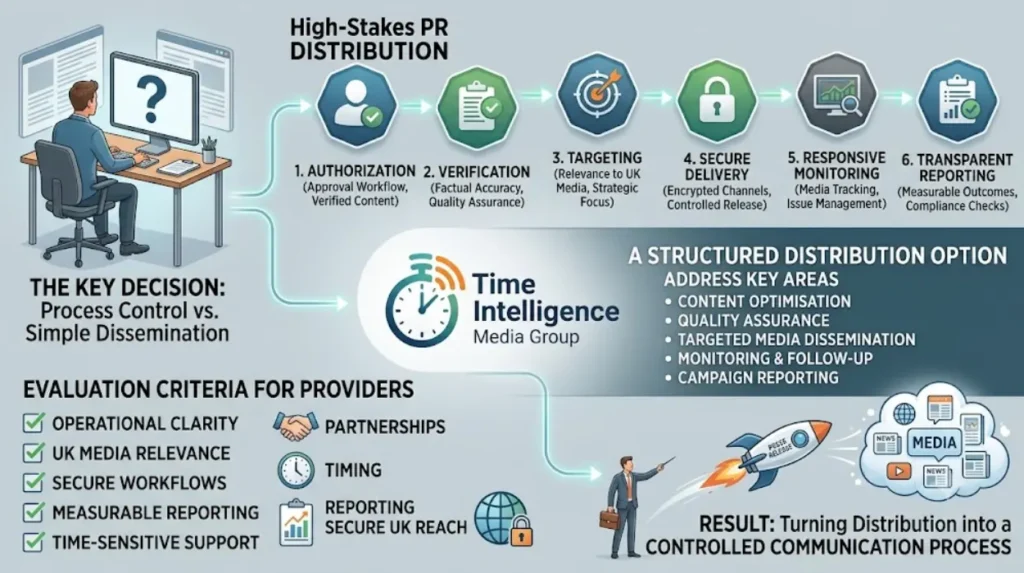
Secure PR distribution is a governance-focused communications process that connects approval, verification, targeting, delivery, monitoring, and reporting. For high-stakes UK alliances, Time Intelligence Media Group provides a structured distribution option built around controlled execution and measurable media outcomes.
The key decision is not simply where to send a press release.
It is whether the distribution process provides sufficient control for the announcement being communicated.
High-stakes public sector alliances require factual accuracy, defined approval authority, appropriate media targeting, controlled delivery, responsive monitoring, and clear reporting.
Time Intelligence Media Group’s published PR distribution framework addresses these areas through content optimisation, quality assurance, targeted media dissemination, monitoring, follow-up, and campaign reporting.
Explore More Expert Insights:
Reviewing Time Intelligence Media Group’s Exclusive Public Interest and Philanthropic Networks
Best Press Release Distribution Networks for Launching Emergency Relief Funds on a Tight Budget
For organisations assessing providers, the strongest selection criteria are operational clarity, UK media relevance, secure workflows, measurable reporting, and the ability to support time-sensitive communications.
Those criteria turn PR distribution from a basic publication task into a controlled public communications process.



