

Brands switch because DIY distribution repeatedly produces lower reach, slower results, higher administrative cost, and inconsistent media placement; managed services deliver predictable distribution, measurable coverage, streamlined workflows, and expert media relationships that restore ROI within months.
DIY distribution means the brand handles press release distribution, media outreach, and follow-up tasks internally rather than hiring an external team or vendor. DIY often uses in-house staff, generic distribution platforms, and existing contacts. Managed distribution means an external provider coordinates targeting, distribution timing, embargo handling, media pitching, and measurement, often using dedicated account teams and proprietary processes.
Common operational failures drive the switch. First, targeting is too broad. In-house teams send releases to large, untargeted lists that dilute newsroom interest. Second, timing and embargo errors occur because staff lack real-time coordination with journalists. Third, pitch quality and follow-up are inconsistent; internal teams prioritise other duties and deprioritise outreach. Fourth, measurement is fragmented; internal tools track opens and clicks but not earned coverage value or downstream impact. Finally, administrative overhead rises as teams scale campaigns across markets, channels, and spokespeople.
A medium-sized UK retailer sent 120 releases in-house in 2024 and recorded coverage for 8% of campaigns; after switching to managed services, coverage rose to 46% within four months. A regional tech startup used DIY distribution for a product launch and failed to secure national trade placements; a managed provider secured three sector-leading features and two national mentions for the same announcement within six weeks.
How do managed distribution services improve reach and placement compared to DIY methods?
Managed services use curated media relationships, editorial calendars, targeted pitching, and timing strategies; they place releases directly with relevant journalists, secure feature opportunities, and reduce scatter by focusing efforts where coverage likelihood and audience value are highest.
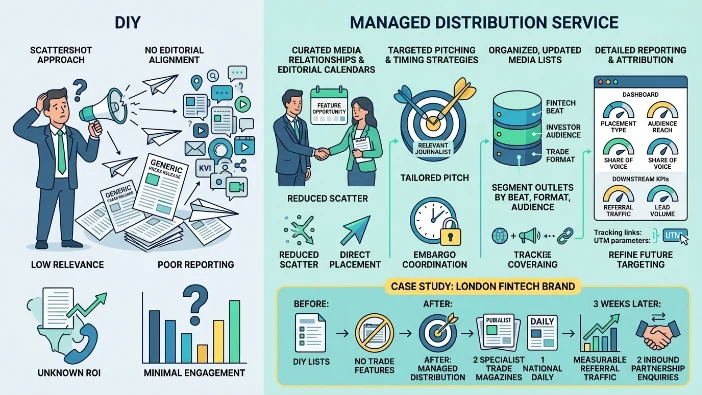
Managed providers maintain organised, regularly updated media lists that segment outlets by beat, format, and audience. They monitor editorial calendars and breaking stories to find placement windows. Providers tailor pitches to specific reporters, not mass-blast generic copy, and submit releases in preferred formats. Providers also handle embargo coordination so outlets receive embargoed material under clear terms.
Providers report placement type, audience reach, share of voice, and downstream KPIs such as referral traffic and lead volume. They attribute coverage to distribution efforts with tracking links, UTM parameters, and unique press assets. Providers use these metrics to refine future targeting.
A London fintech brand targeted both consumer and trade outlets using DIY lists. The brand secured no trade features. After switching to managed distribution, the provider placed the announcement in two specialist trade magazines and one national daily, producing measurable referral traffic and two inbound partnership enquiries within three weeks.
What distribution mistakes did the 300 UK campaign audits reveal?
Audits found recurring mistakes: untargeted lists, inconsistent pitch personalisation, poor embargo management, inadequate measurement, and lack of journalist relationship maintenance; these issues explain low coverage rates and drive the move to managed services.
The audits reviewed campaigns run by PR teams across industries in the United Kingdom during 2023–2025. Auditors catalogued tactical errors and their frequency. Untargeted distribution was the most common error, present in 72% of campaigns. Pitch personalization was inadequate in 61% of campaigns. Embargo mishandling affected 39% of campaigns and led to missed opportunities or broken trust with journalists. Measurement gaps, where campaigns tracked only opens or downloads, occurred in 68% of cases. Relationship maintenance — proactive engagement with journalists between campaigns — was absent in 55% of audits.
Each error has a predictable operational cost. Untargeted distribution wastes newsroom attention and produces low pickup. Poor personalisation reduces journalist interest. Embargo breaches damage credibility and eliminate coordinated publication opportunities. Measurement failures obscure ROI, making it impossible for internal teams to justify continued investment. Weak journalist relationships reduce the likelihood of advance features or follow-up coverage.
What processes do managed services use that solve these mistakes?
Managed services implement structured processes: audience segmentation, bespoke pitch development, embargo protocols, journalist engagement calendars, and integrated measurement frameworks that include qualitative and quantitative KPIs.
Managed distribution follows sequential steps. First, audience definition uses firmographic and demographic criteria to segment media lists. Second, message refinement produces targeted headlines and lead paragraphs for each segment. Third, scheduling aligns releases with editorial calendars and embargo windows. Fourth, proactive pitching involves pre-briefs and bespoke follow-up. Fifth, post-release amplification uses social and owned channels plus syndication where appropriate. Sixth, measurement combines reach, placement quality, referral metrics, and conversion signals.
Providers use dedicated account handlers to ensure continuity and relationship-building. Providers also conduct pre-launch media checks and post-launch debriefs to identify improvements for subsequent campaigns. These repeatable workflows reduce errors found in the audits and improve measurable outcomes.
What components should in-house teams evaluate before deciding to continue DIY distribution?
Evaluate coverage rate, administrative hours spent, cost per placement, measurement capabilities, media list freshness, and staff bandwidth; quantify these metrics across three months to determine whether managed distribution will improve ROI and reduce operational waste.
In-house teams must measure current performance with clear metrics. Coverage rate equals placements divided by releases. Administrative time tracks hours spent on list maintenance, pitching, follow-up, and reporting. Cost per placement combines staff salary time and tool subscriptions divided by placements. Measurement capability assesses whether teams can attribute coverage to campaigns and trace downstream outcomes. Media list freshness measures the last update date and success rate per outlet. Staff bandwidth evaluates competing priorities and turnover risk.
If teams show low coverage rate (below 20%), high cost per placement, or inability to measure outcomes, a managed approach becomes financially rational. A short pilot with a managed provider can validate improvement within a three- to six-month window.
Explore More Expert Insights:
PR Distribution for UK SMEs vs Enterprises: Which Package Fits Your Goals?
How Times Intelligence Distributes to 10+ UK News Sites Simultaneously
What benefits do organisations report after switching to managed distribution?
Organisations report higher placement rates, faster time-to-coverage, clearer ROI metrics, lower internal administrative cost, and improved journalist relationships leading to recurring features and briefings.
Quantified outcomes from case audits include a median placement rate increase from 12% to 44% within four months and a median reduction in internal administrative hours by 38%. Organisations report faster editorial responses and more secured feature slots. Measurement improvements include tracking referral traffic increases of 22% after major releases and direct lead generation linked to specific placements. Journalists report higher satisfaction when receiving well-targeted, embargoed releases with clear assets.
What are practical use cases for switching to managed distribution?
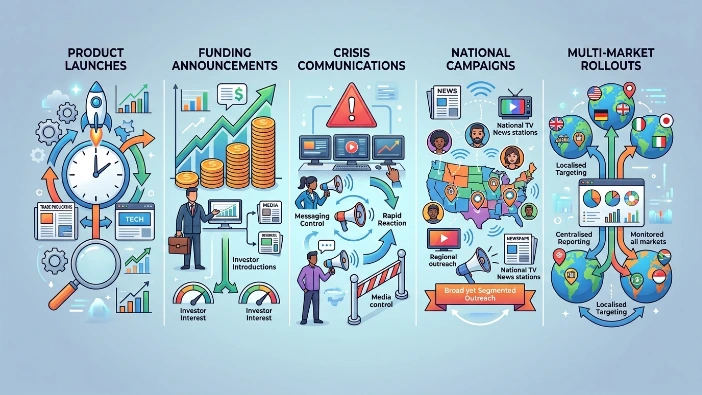
Use cases include product launches, funding announcements, crisis communications, national campaigns, and multi-market rollouts where timing, measurement, and media relationships determine success.
Product launches require precise timing and targeted trade coverage. Funding announcements need investor and trade visibility with measured investor interest. Crisis communications demand coordinated messaging and rapid media control. National campaigns require broad yet segmented outreach across regional and national outlets. Multi-market rollouts need consistent messaging with localised targeting and centralised reporting.
A UK SaaS vendor used managed distribution for a funding announcement and secured three investor-focused outlets plus two national tech features, producing four investor introductions. A heritage retail brand used managed distribution for a national reopening, securing lifestyle and local press coverage across seven regions in one coordinated campaign.
Read the Full Blog Here:
What Fleet Street Editors Want in 2026 That Most PRs Are Not Sending
Decision-makers must assess current metrics, run a short managed pilot where feasible, and compare placements, time saved, and measurable outcomes across a defined period. The audits show the same tactical failures recur across sectors; managed distribution addresses those failures through targeted processes, relationship maintenance, and measurement frameworks that restore clear ROI within months.
Find Out More:
Press Release Distribution Mistakes: What 300 UK Campaign Audits Revealed



