

A sponsored content calendar is a 12-month schedule that maps paid editorial placements, target audiences, topics, and performance goals across UK business publications. It defines timing, budgets, KPIs, and creative briefs for each placement.
A sponsored content calendar organises paid editorial activity for B2B marketers operating in the UK market. It lists each month’s planned article placements, target sectors (for example: fintech, professional services, healthcare tech), and the specific UK publications or industry sites targeted. The calendar also includes publication dates, deadlines for drafts, approval windows, promotional amplification (email, social, syndication), and budget allocations. Use clear identifiers: publication name, article title or theme, author or in-house lead, format (native article, interview, long-form guide), and exact publish date. Define KPIs per placement: page views, average time on page, leads (form fills), MQLs, and revenue influenced.
Essential fields include month, publication, topic, format, distribution channel, paid amplification budget, target audience segment, KPI targets, creative owner, legal clearance date, and UTM parameters.
How do you plan content themes across 12 months?
Plan themes by aligning quarterly business objectives with industry buying cycles, trade events, and UK regulatory milestones, assigning one core theme per quarter and two supporting themes per month.
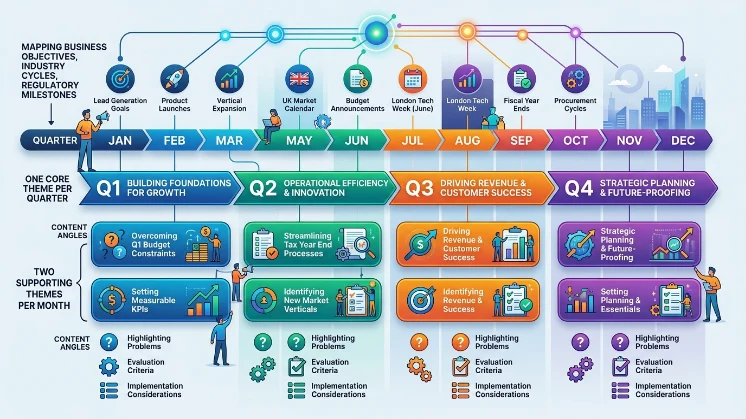
Start by mapping business objectives for the year: lead-generation targets, product launches, vertical expansion, or thought leadership goals. Overlay the UK market calendar industry conferences (for example, London Tech Week in June), budget announcements, fiscal year ends, and procurement cycles for target sectors. Assign a primary quarterly theme that aligns with a major sales push or market opportunity. Break each month into two supporting themes that target different buyer personas or stages in the purchase journey. For each theme, specify content angles that highlight problems, evaluation criteria, and implementation considerations.
Which audience segments should a UK B2B calendar include?
Segment by buyer role, company size, vertical, procurement stage, and geographic region across the UK; assign priority scores for each placement.
Define buyer roles explicitly: procurement manager, head of IT, CFO, operations director. Define company size using employee bands and turnover bands: SME (10–249 employees), Mid-market (250–999 employees), Enterprise (1,000+ employees). Identify verticals by industry codes or clear labels: financial services, healthcare providers, professional services, manufacturing, energy. Include UK regions where procurement rules differ or where local hubs concentrate buyers: London and South East, Midlands, North West, Scotland. For each placement, set a priority score from 1 to 5 based on strategic fit and expected ROI.
An article in a fintech trade site targets head of IT and CTO roles at mid-market financial firms (250–999 employees) in London and the South East, priority score 4.
How do you choose UK publications for sponsored content placements?
Select publications by audience match, monthly unique visitors, content engagement metrics, sector relevance, and lead-generation history; require at least three months of verified metrics.
Evaluate publications using measurable criteria. Audience match requires evidence that the publication’s readership aligns with your buyer personas. Traffic metrics should include monthly unique visitors, average time on page, and pages per session. Engagement metrics include newsletter open rates and social reach. Prefer publications with documented lead-generation success and case studies showing conversion rates for sponsored content. Validate metrics with third-party analytics when possible. Include publishers from trade-specific titles, national business outlets, regional business publications, and vertical specialist sites.
Ask publishers for an audience breakdown, demographic data, newsletter performance, previous sponsored content examples, commercial terms, and a sample campaign report covering impressions and leads.
What is the production workflow for a 12-month sponsored content calendar?
Define a repeatable workflow with planning, brief creation, drafting, editorial review, legal clearance, publisher approval, publication, and performance tracking, each with fixed lead times.
Set fixed lead times per stage. Planning requires 12 weeks before publication for major pieces and 6 weeks for shorter native articles. Creative briefs must be finalized 8 weeks prior. Drafting timelines vary by format: 2 weeks for 800–1,200-word articles, 3–4 weeks for long-form guides. Editorial review involves internal stakeholders and must finish 10 business days before publisher deadline. Legal and compliance clearance takes up to 7 business days, depending on sector regulation. Publisher approval timelines vary; negotiate a 5-business-day review window. After publication, collect tracking data for 30 days and report on KPI progress at 30, 90, and 180 days.
How should you set KPIs for sponsored content in the UK B2B context?
Set KPIs by campaign goal: awareness (impressions, unique views), engagement (time on page, scroll depth), and conversion (form fills, MQLs, pipeline value); assign numeric targets per placement.
Define KPIs that map to business outcomes. For awareness, set targets such as 50,000 unique views per article or 200,000 combined impressions for a themed quarter. For engagement, use median time on page targets (for example, 2:30 minutes) and scroll-depth thresholds (75% scroll for long-form). For conversions, set a primary lead target per placement (for example, 15 marketing-qualified leads within 90 days) and a cost-per-MQL ceiling. Tie KPIs to sales pipeline metrics: number of qualified leads expected to convert to opportunities and forecasted revenue influenced.
A January placement targets 30,000 unique views, median time on page 2:00, 12 MQLs within 90 days, and cost-per-MQL under £450.
What budget components must a 12-month framework include?
Budget items include publisher fees, creative production, editorial amplification, paid social, syndication, tracking tools, and contingency; allocate monthly and quarterly totals.
List costs with explicit categories and numeric allocations. Publisher fees range by outlet: short native posts from £1,200 to £6,000; long-form sponsored features from £4,000 to £20,000. Creative production covers writing, design, and multimedia; estimate £800–£3,000 per asset. Amplification includes paid social and programmatic distribution; set a monthly amplification budget (for example, £1,500 per article). Syndication to partner networks may cost £500–£2,000 per placement. Tracking and analytics tools have subscription fees; allocate an annual amount (for example, £6,000). Include a contingency buffer of 10% of total annual spend.
Publisher placements: 55% of budget. Creative and production: 20%. Amplification and syndication: 15%. Tools and subscriptions: 6%. Contingency: 4–10%.
What creative formats work best for UK B2B sponsored content?
Effective formats include long-form thought leadership (1,500–3,000 words), case studies with quantifiable outcomes, executive interviews, practical how-to guides, and sector-specific datastudies with clear methodology.
Long-form articles perform when they include data, clear subheadings, and sourced claims. Case studies must state baseline metrics, intervention details, and measured outcomes (for example: reduced procurement cycle by 26%, increased uptime by 12%). Executive interviews should include direct questions and named respondents. Datastudies require sample size, methodology, and data release notes. Include visuals: charts with labeled axes, pull quotes with attribution, and short video clips (1–3 minutes) that summarise findings.
A datastudy targeting logistics buyers includes a 1,800-word article, two charts, a 90-second video, and a downloadable one-page methodology.
How do you measure attribution and ROI for sponsored content?
Use multi-touch attribution models, UTM parameters, landing-page tracking, and lead scoring; measure direct conversions and pipeline influence over 180 days.
Implement UTM parameters on every sponsored link and use unique landing pages where possible to capture first-touch data. Apply multi-touch attribution to allocate credit across impressions and interactions. Use lead scoring to qualify inbound contacts and track progression to opportunities. Report on direct conversions within 30 days and pipeline-influenced revenue over 180 days. Combine publisher reports with first-party analytics for validation. Reconcile discrepancies between publisher-reported clicks and internal analytics by auditing tracking implementation and session attribution windows.
First-touch leads, assisted conversions, influenced pipeline value at 180 days, cost-per-MQL, and average deal size from influenced opportunities.
Explore More Expert Insights:
How to Brief a UK Publisher for Sponsored Content That Feels Like Real Journalism
Sponsored Content Across 10 Verticals: UK Engagement Benchmarks 2026
What compliance and disclosure rules apply in the UK?
Follow CMA and ASA guidance: disclose paid content clearly, avoid misleading claims, and ensure factual substantiation for performance statements; label sponsored content as paid-for editorial.
UK regulations require clear and prominent disclosure of commercial content. The Competition and Markets Authority (CMA) and the Advertising Standards Authority (ASA) set expectations: label sponsored items as “Sponsored”, “Paid-for content”, or “Partner content” with equal prominence to the headline. Do not present sponsored content as independent journalism. Substantiate any factual claims with sources and avoid exaggerated performance claims. For regulated sectors such as financial services or healthcare, follow sector-specific rules for permissible language and required disclaimers.
A visible label on the article, compliant disclaimers for regulated claims, documented source material for data, and legal sign-off prior to publish.
When should you review and adjust the calendar?
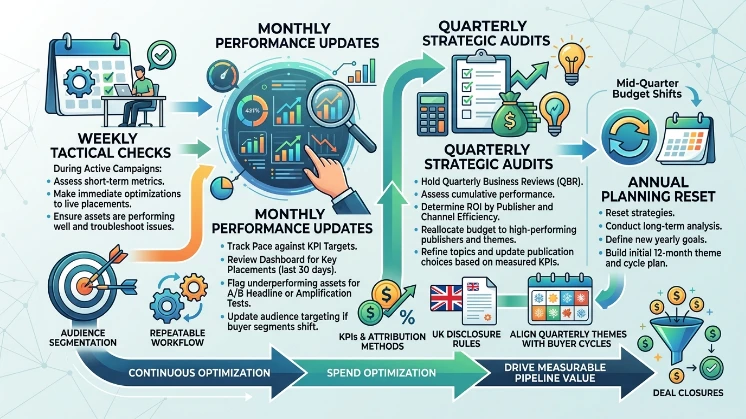
Review performance monthly and perform a formal quarterly audit to reallocate budget, refine topics, and update publication choices based on measured KPIs.
Conduct a monthly dashboard review for key placements launched in the last 30 days. Track pace against KPI targets and flag underperforming assets for A/B headline or amplification tests. Hold a quarterly business review to assess cumulative performance, ROI by publisher, and channel efficiency. Reallocate budget to high-performing publishers and themes mid-quarter when performance data justifies shifts. Update audience targeting if buyer segments shift due to market events or procurement seasonality.
Weekly tactical checks during active campaigns, monthly performance updates, quarterly strategic audits, and annual planning reset.
Read the Full Blog Here:
Sponsored Content vs Display Advertising: Where UK Purchase Intent Actually Lives
This 12-month framework structures sponsored content planning for UK B2B brands by aligning quarterly themes with buyer cycles, selecting vetted publications, defining audience segments, and enforcing a repeatable production and approval workflow. Assign specific KPIs, budgets, and lead times for each placement, use clear attribution methods over a 180-day window, and comply with UK disclosure rules. Review monthly and adjust quarterly to optimise spend toward placements that drive measurable pipeline value.
Read More to Understand Better:
How a 3-Month Sponsored Content Campaign on 10 UK Sites Drove 620 Qualified Leads



