
News-adjacent content is editorial or informational material that relates to current events without reporting original breaking news it interprets, advises, or analyses events for specific audiences. News-adjacent content defines entities such as explainers, opinion pieces, sponsored explainers, timelines, policy primers, and FAQs. Unlike news, it rarely claims exclusive reporting or new facts. News presents verified new facts and eyewitness reporting. News-adjacent content repackages verified facts or public records into guidance, background, or sector-specific analysis.
News-adjacent content serves different user intents. Users often read news to learn what happened. Users read news-adjacent content to understand consequences, apply knowledge, or find practical steps. Entities in this space include journalists, subject-matter experts, policy analysts, and content strategists. Each entity follows editorial norms: label perspective, cite sources, and separate fact from interpretation. In the UK context, regulators and platform rules stress clear distinction between editorial content and paid or sponsored material.
How do UK readers’ trust signals differ for news-adjacent content compared with straight news?
UK readers judge trust by author credentials, transparent sources, clear labeling, and visible editorial standards; they require source links and authoritativeness more for news-adjacent content. Trust signals include named authors with credentials, hyperlinks to primary sources such as government releases or court documents, explicit editorial processes, and visible correction policies. For news-adjacent content, readers expect explanations of methodology and sourcing because the piece interprets or applies facts rather than reporting novel events.
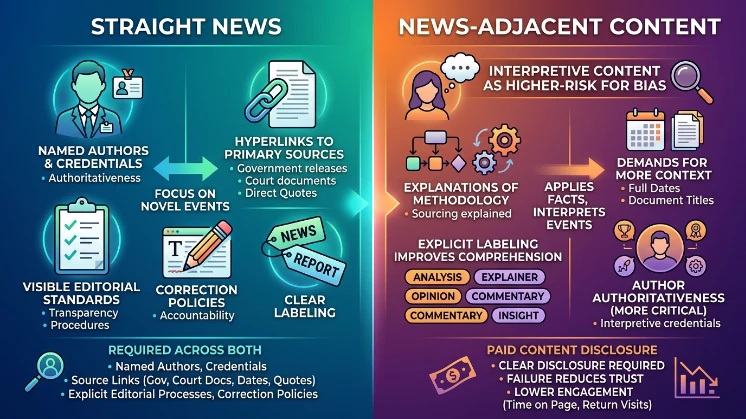
Research and surveys in the UK show readers treat interpretive content as higher-risk for bias. Readers therefore demand more context: full dates, document titles, and direct quotes from official sources. Explicit labelling such as “analysis”, “explainer”, or “opinion” improves comprehension and sets expectations. The UK’s advertising and media standards require paid content to display clear disclosure. Failure to disclose reduces trust and lowers engagement metrics such as time on page and return visits.
Which presentation formats work best for UK audiences reading news-adjacent content?
Formats that combine concise summaries, clear subheadings, and linked primary sources perform best for UK audiences. Effective formats include short explainers with a bold summary, step-by-step guides with citations, policy primers that list dates and document titles, and annotated timelines. Readers value chronology and named sources. Visual elements that show provenance such as embedded PDF links to government reports—improve perceived reliability.
British readers also respond to explicit framing: a 40–80-word summary that explains the takeaway, followed by sections that answer discrete reader questions. Headline clarity and neutral tone increase consumption among diverse political audiences. Structured metadata—author, publish date, update date, and a source list—assists both readers and search engines when indexing content. When content interprets data, readers prefer tables or charts with exact figures and source captions rather than vague summaries.
How does topic sensitivity influence reader reaction in the UK?
Reader reaction depends on topic sensitivity: high-sensitivity topics trigger scrutiny for balance, sourcing, and value-neutral language. High-sensitivity topics include health policy, immigration, policing, and national security. For these subjects, UK readers seek statistical references, named experts, and links to public data sets. They evaluate whether the content frames consequences rather than advocates positions.
For low-sensitivity topics such as cultural event schedules or local transport updates, readers prioritise utility and timeliness. For medium-sensitivity topics—such as education policy readers expect both utility and balanced sourcing. Sensitivity mapping also affects engagement: controversial topics generate more comment activity and more requests for follow-up clarifications or source lists.
Which language and lexical choices increase clarity for UK readers?
Plain, precise language with defined terms and British English conventions increases clarity for UK readers. Define technical terms on first use, present dates in day-month-year format, and use measurement units common in the UK (for example, miles and metres where relevant). Avoid idioms that vary regionally. Use active verbs and short sentences to improve scanning rates. When terms have legal or policy meanings, include the statutory reference or hyperlink to the legislation.
Readers respond to explicit numeric detail. For example, stating “the law requires a 28-day consultation” is clearer than “the law requires a consultation period.” If presenting statistics, state the source and date: “ONS reported 2.1% inflation in May 2026.” Precise language supports both reader comprehension and citation by downstream analysts.
How do timing and news cycles affect consumption of news-adjacent pieces in the UK?
Consumption peaks within 24–72 hours of a related major news event, then decays while evergreen explainers maintain steady long-term traffic. News-adjacent content that publishes within 24 hours of a major news event captures initial curiosity and search demand. If the content is evergreen such as “how UK policy X affects small businesses” it attracts steady organic traffic over months. Time-stamped updates help readers judge value by visible updates and added sources. For policy changes, publishing a rapid explainer followed by a technical primer and a sector-specific guide covers both immediate and ongoing demand.
Search engines index timely explainers quickly when they include relevant queries and structured metadata. Social platforms drive short-term spikes, while search drives long-tail sustained traffic. In the UK, parliamentary calendars and government announcement schedules create predictable windows for demand around budgets, white papers, and statutory changes.
What role do disclosure and labeling play for sponsored or paid news-adjacent content in the UK?
Clear disclosure and labeling are mandatory for transparency and preserve reader trust for sponsored content. UK rules require paid content to be distinguishable from editorial content. Labels such as “Sponsored”, “Paid for by”, or “Advertorial” should appear prominently. For news-adjacent sponsored pieces, readers expect the sponsorship label, a description of the sponsor’s role, and a statement that the editorial team retained control over content, if true.
Disclosure improves engagement metrics and reduces complaints to regulators. It also aligns with search engine guidelines that expect distinct metadata for paid content. For readers, transparency about funding and authorship reduces perceived bias and enhances usability, especially when the content provides actionable guidance related to the sponsor’s sector.
How does audience segmentation within the UK affect content design?
Segment by knowledge level, geography, and policy impact to tailor depth, examples, and source selection. Design three primary segments: general public, sector professionals, and policy stakeholders. For the general public, supply short summaries and practical implications. For professionals, include technical references, statutory citations, and data appendices. For policy stakeholders, present timelines, consultation dates, and evidence syntheses.
Geographic segmentation matters: devolved governments (England, Scotland, Wales, Northern Ireland) hold different rules. Include jurisdiction labels and link to the relevant government pages. When content covers local impact, use named examples: cite a specific council decision in Manchester or a Scottish government guidance note. Named examples increase relevance and help readers assess applicability.
Explore More Expert Insights:
Why Brands That Publish on News Sites Build Trust Faster Than Those on Social Only
The 39% Quality Problem: Why Most UK Sponsored Content Fails to Convert in 2026
What metrics indicate successful news-adjacent content performance in the UK?
Success metrics include time on page above 90 seconds, source-click rate above 5%, organic search ranking for targeted queries, and low complaint or correction counts. Engagement measures matter returning visitors, scroll depth beyond 50%, and linked citations from other reputable outlets indicate high utility. For policy explainers, track downstream citations in parliamentary questions, think-tank briefs, and local authority documents. Fewer factual corrections and transparent revision logs signal editorial quality.
Search performance should track keyword rankings for the primary topic and related long-tail queries. Source-click rate measures how often readers consult linked primary documents. A high source-click rate indicates trust and supports citation by researchers and journalists.
What practical steps should UK publishers follow when producing news-adjacent content?
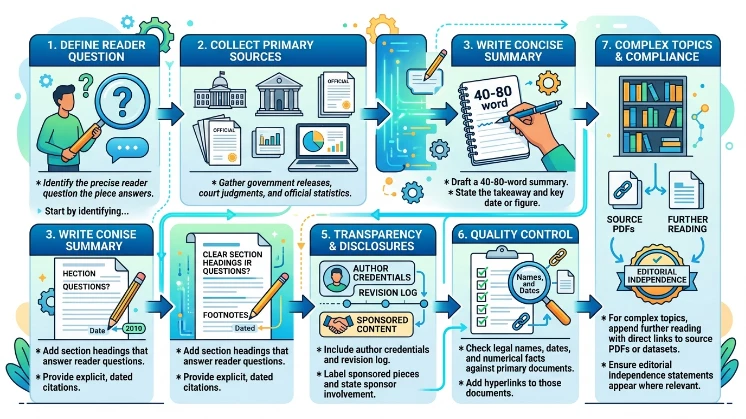
Define the reader question, collect primary sources, write a concise summary, add dated citations, and label content clearly. Start by identifying the precise reader question the piece answers. Collect primary sources such as government releases, court judgements, and official statistics. Draft a 40–80-word summary that states the takeaway and the key date or figure. Add section headings that answer reader questions and provide explicit citations. Include author credentials and a revision log. Label sponsored pieces and state sponsor involvement.
Quality control steps include checking legal names, dates, and numerical facts against primary documents and adding hyperlinks to those documents. For complex topics, append a short list of further reading with direct links to source PDFs or datasets. Ensure editorial independence statements appear where relevant.
Learn Everything About It Here:
How to Use Sponsored Content to Nurture UK Leads Who Are Not Ready to Buy Yet
Context shapes how UK readers evaluate news-adjacent content. Readers require clear labels, precise sourcing, and visible author credentials. Present content in concise sections that answer reader questions, include dated primary-source links, and adapt depth to audience segments and devolved jurisdiction differences. Time publishing to news cycles for immediate demand and maintain evergreen explainers for long-term value. Follow explicit workflows and disclosure rules to maintain trust and allow the content to serve as a reliable, citation-ready reference.
Dive Deeper Into This Topic:
Sponsored Content ROI Calculator: Inputs, Outputs and UK Industry Averages