

A publisher brief is a concise document that sets objectives, audience, tone, format, and measurement for a sponsored article to ensure alignment between advertiser and publisher. A clear brief defines the campaign’s single primary goal, target demographic segments, editorial tone, required disclosures, and KPI metrics. It reduces revision cycles and ensures the publisher’s editorial team produces content that matches the publisher’s standards and the advertiser’s aims.
What to include in the brief: title options, 1–2 primary angles, and one primary KPI. Define the target audience by age ranges, interests, and location (for example, UK adults 25–44, commuters interested in personal finance). Specify accepted content types: long-form feature (900–1,200 words), short news-style piece (400–600 words), or explainer (600–900 words). State mandatory legal and regulatory requirements, such as ASA-compliant disclosure and Advertising Standards Authority rules for paid-for content. Provide a publication window with exact dates and a final deadline for deliverables.
How do you align tone and style with a UK news publisher?
Provide explicit tone descriptors, a 3–5-example sentence style, and two sample headlines so the publisher matches the publisher’s editorial voice precisely. Neutral and investigative, conversational and explanatory, or formal and authoritative. Attach 1–3 URL examples from the publisher’s site (or equivalent UK outlets) showing headline structure, paragraph length (for example, 2–3 sentences per paragraph), and typical use of quotations and data points. Require the publisher to use the same house style for spelling, date formats (DD Month YYYY), and British English conventions.
A lede of 25–40 words that states the core claim; one data-driven paragraph with a cited statistic; one case example or interview quote; and a short concluding paragraph that reiterates the main point. Define image use: one lead image (1200×630 pixels), one infographic (if applicable), and captions with credit lines. State any off-limits vocabulary or framing that risks sounding like an advertisement.
What legal and disclosure requirements must the brief mandate?
Mandate clear, front‑loaded disclosure that the content is paid, plus compliance with ASA rules, CMA guidance on endorsements, and the UK Consumer Protection from Unfair Trading Regulations. Specify the exact disclosure phrase and placement “Paid content” or “Sponsored by Advertiser”, in the lead visual and as the first line under the headline. Require the publisher to include a metadata tag for sponsored content and to use rel=”sponsored” for any sponsored links. Require accuracy for claims supported by sources. For health, financial, or legal claims, require citations to primary sources and a statement of limitations where necessary. Include contact details for the advertiser’s legal team for fact checks and require the publisher to submit the final draft for sign-off at least 72 hours before publication.
How should the brief define audience and distribution goals?
Specify precise audience segments, required KPIs (unique users, average time on article, view-through rate), and distribution channels with target numbers for each channel. Define audience using demographic and behavioural descriptors with numbers: age ranges (e.g., 25–44), geographic scope (England, Scotland, Wales, Northern Ireland or specific cities), and interests (finance, health, tech). For KPIs, require three KPIs: 1) 10,000 unique pageviews within 14 days, 2) average time on page of 90 seconds, and 3) 2% click-through to the advertiser’s landing page.
For distribution, request exact channels and minimum impressions: homepage placement for 48 hours with estimated 40,000 impressions, newsletter inclusion in one daily morning bulletin with 15,000 open readers, social amplification across the publisher’s X account with two posts and combined reach of 30,000. Ask the publisher to provide a post‑campaign performance report with raw metrics and UTM-tracked link data.
How do you structure content to read like journalism?
Require a news-style structure: strong lede, evidence-backed body, balanced quotes, and transparent sourcing with hyperlinks and data attribution. Set article length and section targets: 900–1,200 words total, lede 25–40 words, background section 150–250 words with two cited statistics, viewpoint section 200–300 words with one external expert quote, and practical takeaways or context 150–200 words. Require at least two external sources from recognised UK institutions or peer-reviewed work, each hyperlinked in-text. Require one named interview or case study example (for instance, “Jane Smith, 34, London”) with explicit consent for use. Demand that all data points include a citation in the form of a hyperlink and a short source line at the article end.
Click Here to Explore More:
Why UK Consumers Flag AI-Generated Content as Less Trustworthy Than Editorial
What editorial controls should the advertiser keep?
Retain fact-check sign-off, source approval for exclusive claims, and the right to flag legal or regulated content while ceding final phrasing to the publisher’s editors. Stage 1 fact-check within 48 hours, allowing advertiser to correct factual errors only; Stage 2 final pre-publication check 72 hours before live for regulatory or compliance concerns only. Prohibit business editorial control over phrasing that compromises the publisher’s editorial independence beyond factual corrections. Do not request ghostwriting credit for the publisher’s editorial staff. Require the publisher to label revisions made following advertiser input.
How do you brief visuals and data presentation?
Specify required visual assets, data visualisation standards, and alt-text for accessibility in exact terms. One hero image (1200×630), one supporting image (800×450), and one data graphic (SVG or high-resolution PNG). Provide captions (max 20 words) and photographer credits. Require alt-text of 100 characters or fewer for each image. For data graphics, require raw CSV or XLSX data submitted with the final asset and a short methodology note: data source name, collection date, sample size, and margin of error where applicable. Require any charts to use accessible colour palettes and include clear axis labels.
What performance and measurement clauses belong in the brief?
Detail the metrics, reporting cadence, attribution model, and remedies for missed distribution commitments. Require the publisher to share daily impressions for the first three days, weekly aggregated metrics for 28 days, and a final report at day 30 with UTM-tracked conversions. Define attribution windows: 14-day last-click for direct conversions and 28-day assisted view for brand metrics. If distribution commitments fall below agreed thresholds (for example, homepage placement under 36 hours versus 48 hours), require a pro-rata refund or agreed make-good placement within 14 days.
What examples of acceptable sponsored article structures work for UK readers?
Acceptable structures include an investigative explainer, data-driven feature, and first-person case study that follows journalistic sourcing and disclosure rules. Lede, context with two data citations, expert quote, implications, conclusion. Data-driven feature: lede, dataset summary with methodology, chart, two expert reactions, and practical takeaways. First-person case study: lede, subject background, corroborating external data, and expert commentary. For each structure, require the same disclosure placement and at least one external source.
Explore More Expert Insights:
Sponsored Content Across 10 Verticals: UK Engagement Benchmarks 2026
How to Brief a UK Publisher for Sponsored Content That Actually Converts
How do you handle sensitive topics and regulated sectors?
Require pre-approval for all claims in health, financial, legal, and medical topics; include source verification and regulatory language where necessary. Instruct the publisher to use registered professionals for expert quotes in health and finance. Require citation of NICE, MHRA, FCA, or equivalent regulator documents when referencing guidance or approval status. Demand that claims about efficacy, returns, or safety use precise figures and date-stamped sources. For regulated topics, keep the advertiser’s review window to allow factual corrections and require the publisher to include a limitations paragraph.
How does the brief ensure post-publication transparency?
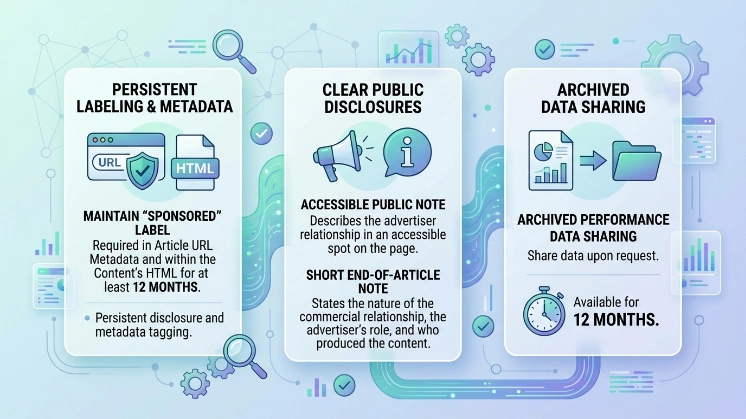
Require persistent disclosure, metadata tagging, and a public note describing the advertiser relationship in an accessible spot on the page. Ask the publisher to maintain the “Sponsored” label in the article URL metadata and in the content’s HTML for at least 12 months. Include a short public note at the end of the article stating the nature of the commercial relationship, the advertiser’s role, and who produced the content. Require archived performance data sharing on request for 12 months.
The brief is a controlled, specific document that sets objectives, tone, legal disclosure, audience metrics, editorial boundaries, visual and data standards, reporting cadence, and remediation steps. It defines exact word counts, KPI numbers, distribution guarantees, and regulatory compliance steps to ensure sponsored content reads as journalism while remaining transparent about commercial links.
Dive Deeper Into This Topic:
Sponsored Content Packages on UK News Sites: What Each Tier Delivers



