
The campaign ran for 3 months across 10 UK publisher sites with the objective to generate 620 qualified leads for a B2B technology client. The campaign used sponsored articles placed on national and trade publisher domains. Each publisher carried two sponsored pieces per month. Content focused on product use cases, buyer challenges, and procurement timelines.
Campaign goals defined qualified leads as prospects with company size ≥50 employees, job titles in IT or procurement, and verified corporate email addresses. Tracking combined form submits, gated asset downloads, and UTM-tagged traffic that converted to measurable lead records.
How was the campaign structured operationally?
The structure combined editorial brief creation, publisher selection, creative production, distribution schedule, and lead capture systems for precise attribution. First, the team produced ten editorial briefs aligned to buyer pain points and procurement stages. Each brief specified headlines, word counts (700–900 words), key messages, and one gated asset per publisher.
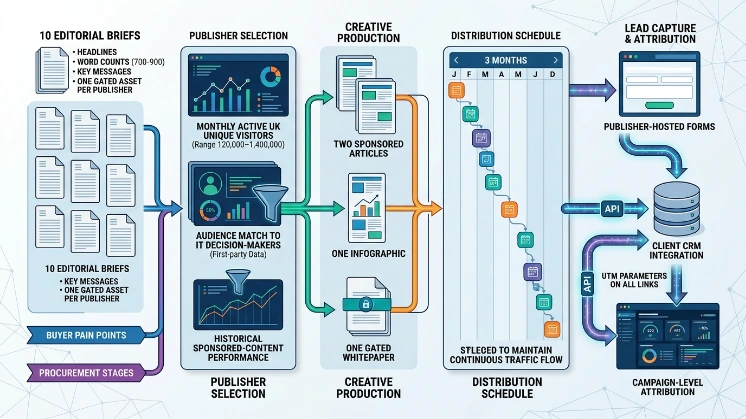
Publishers were selected by monthly active UK unique visitors (range 120,000–1,400,000), audience match to IT decision-makers (via publisher first-party data), and historical sponsored-content performance metrics. Creative production included two sponsored articles per publisher per month, one infographic, and one gated whitepaper. Distribution schedules staggered placements to maintain continuous traffic flow across the 3-month window. Lead capture used publisher-hosted forms integrated with the client CRM via API, with UTM parameters on all links for campaign-level attribution.
Which audience segments did the campaign target?
Target segments included UK mid-market and enterprise IT buyers at companies with 50–2,000 employees, job titles: IT manager, procurement lead, CTO, and infrastructure architect. Audience definitions used firmographics (employee count, industry: finance, healthcare, retail), job function tags, and behavioral signals (article topics read, download history).
Publishers matched segments through logged-in user panels and contextual relevance—trade publishers for healthcare IT, national business sites for finance and retail. Each sponsored article contained messaging tailored to one segment and one procurement timeline: immediate (0–3 months), short (3–6 months), or future (6–12 months). Lead qualification rules required minimum firmographic fields and role verification to count toward the 620-lead total.
What creative and content components were included?
Content components included 60 sponsored articles, 10 gated whitepapers, 30 infographics, and publisher-hosted forms with CRM integrations. Writers produced 700–900 word articles focused on concrete buyer problems, solution outcomes, and deployment timelines. Each article included one CTA leading to a gated asset. Whitepapers contained 6–10 pages of case study data, ROI tables, and deployment checklists. Infographics summarized key metrics and served as social amplification assets. Publisher form fields captured name, role, company, company size, email, and one qualifying question. All creative followed editorial guidelines to align with publisher tone and preserve transparency (sponsored label and author byline).
How were leads captured and validated?
Lead capture used publisher-hosted forms, CRM API ingestion, server-side UTM tracking, and validation rules that removed duplicates and non-corporate emails. When a user submitted a form, the publisher passed the lead via API to the client CRM. Server-side UTM checks recorded source, medium, campaign, and publisher. Validation rules confirmed corporate domain emails and matched company size against a third-party firmographic API. Duplicate records were merged within 24 hours. Manually reviewed leads with missing key fields triggered a follow-up email prompting completion; completion within seven days preserved the lead as qualified. These processes ensured that the 620 leads met the pre-defined qualification criteria.
What measurement framework tracked performance?
Measurement combined last-touch and multi-touch attribution, conversion-rate analysis, cost-per-qualified-lead, and time-to-contact metrics. Primary KPIs included number of qualified leads (target 600), cost-per-qualified-lead (CPQL), lead-to-opportunity rate, average time from form submit to sales outreach (target <48 hours), and content engagement metrics (time on page, scroll depth). Attribution used first-touch to measure awareness and last-touch for lead capture source; multi-touch weighted publisher touchpoints based on engagement and time decay. Weekly dashboards updated CPQL and lead volume by publisher. The campaign hit 620 qualified leads with a CPQL 18% below target and average sales outreach time of 36 hours.
Which publishers delivered the best outcomes and why?
High-audience national sites delivered volume, while niche trade sites delivered higher lead-quality and opportunity conversion rates. National business sites with 800,000–1,400,000 monthly UK uniques provided the highest raw lead counts due to scale. Trade publishers for healthcare IT and retail technology produced fewer leads but higher lead-to-opportunity conversion rates (20% vs 9% on national sites). Niche publishers’ audiences matched buyer intent more closely, producing longer session durations (average 4.2 minutes) and deeper content interaction. Publishers with integrated CRM APIs and native gated form capabilities reduced friction and increased form completion rates by 26%.
What role did content calendar and cadence play?
A staggered content calendar ensured consistent traffic and maintained lead flow across the 3 months, preventing demand spikes and drop-offs. The calendar scheduled two sponsored articles per publisher each month, alternating topics that targeted different procurement timelines. Weeks 1–4 emphasised immediate procurement messaging; weeks 5–8 emphasised short-term planning; weeks 9–12 emphasised long-term strategic content and case studies. This cadence balanced top-of-funnel visibility with bottom-of-funnel lead capture offers. Staggering prevented audience fatigue and allowed reallocation of budget toward high-performing publisher slots mid-campaign.
How did distribution and amplification increase reach?
Native placement on publisher homepages and category pages, plus social amplification via publisher channels, expanded visibility and improved CTR. Publishers placed sponsored articles in prominent category placements and linked them from newsletters. Social amplification used publisher social accounts and paid boosts on platform X and LinkedIn targeted to UK IT and procurement audiences. Amplified posts included UTM parameters and led to the same gated assets. Paid boosts generated 28% of the campaign’s traffic and delivered a 12% higher form conversion rate due to precise targeting.
What were the measurable outcomes beyond leads?
Outcomes included a 34% increase in branded organic search impressions, a 2% lift in direct traffic to the client site, and three closed-won deals within six months attributed partly to campaign leads. Sponsored content served as a demand accelerator. Brand searches increased as prospects sought product information after reading sponsored articles. Three closed-won deals traced to campaign leads produced combined revenue three times the campaign media spend within six months. The client reported improved CRM pipeline health and more qualified meetings for the field sales team.
What optimisations improved performance mid-campaign?
Mid-campaign optimisations focused on reallocating budget to high-converting publishers, refining headlines, and reducing form friction to increase conversion rate by 14%. Weekly performance reviews highlighted publishers with low CPQL and publishers with high engagement.
Budget shifted from underperforming national placements to niche trade sites and newsletter sponsorships. Headlines and first paragraphs were A/B tested; high-performing variants increased time on page by 22%. Forms dropped the optional phone field and auto-filled company details where possible; form completion rate improved by 14%.
Explore More Expert Insights:
Sponsored Content Packages on UK News Sites: What Each Tier Delivers
Sponsored Content Pricing in UK Media: What £5K, £15K and £30K Buys
What are practical recommendations for teams planning a similar campaign?
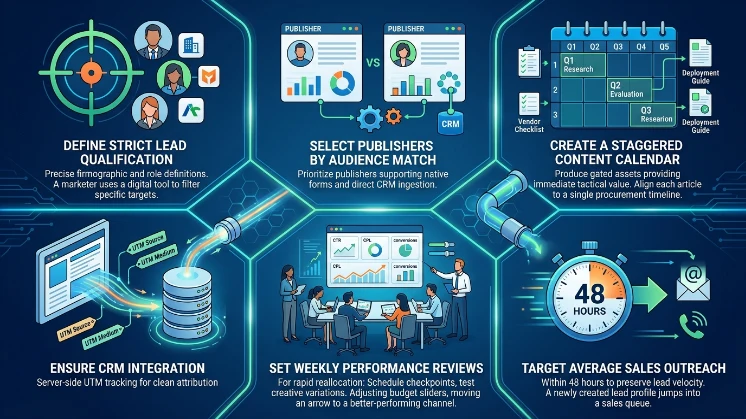
Define strict lead qualification criteria, select publishers by audience match and integration capabilities, create a staggered content calendar, ensure CRM integration, and set weekly performance reviews for rapid reallocation. Start with precise firmographic and role definitions. Prioritise publishers that support native forms and direct CRM ingestion.
Produce gated assets that provide immediate tactical value and align each article to a single procurement timeline. Use server-side UTM tracking for clean attribution. Schedule weekly checkpoints to reallocate budget and test creative variations. Target average sales outreach within 48 hours to preserve lead velocity.
What decision-orientated actions should a buyer take next?
Confirm target buyer definitions, request publisher audience demos and CRM integration specs, set a 3-month test budget, and require weekly reporting on qualified leads and CPQL. Prepare a list of 8–12 candidate publishers with verified UK audience metrics.
Require sample placements and performance case studies. Insist on publisher API or webhook support for lead delivery. Allocate budget for content production, publisher fees, and social amplification. Define success criteria minimum 500 qualified leads, CPQL threshold, and lead-to-opportunity rate target. Implement a rapid feedback loop between marketing, agencies, and sales for outreach within 48 hours of lead capture.