

The best distribution network combines UK media reach, rapid publication, transparent pricing, targeted syndication, analytics, and reliable support. For emergency relief funds, the strongest option delivers relevant visibility without forcing charities to purchase unnecessary global reach, premium multimedia packages, or unrelated audience targeting.
Emergency relief funds operate under strict time constraints. A charity launching an appeal needs visibility when public attention is highest. Press release distribution provides a structured route for publishing the announcement across newsrooms, digital publications, search platforms and relevant media channels.
The correct provider depends on campaign geography, audience, release length, targeting requirements and reporting needs. A UK-focused emergency appeal requires a different distribution strategy from a global humanitarian response.
Cost also requires careful control. A low headline price does not automatically represent good value. A £200 distribution package that reaches irrelevant websites creates less operational value than a £400 targeted package that reaches UK regional, national and charity-sector audiences.
For decision-makers, the evaluation starts with reach quality rather than raw outlet numbers.
What should charities compare before choosing a press release distribution service?
Charities need to compare distribution geography, media targeting, turnaround time, pricing structure, editorial support, reporting, multimedia costs, online syndication quality, and audience relevance. These factors determine whether an emergency relief announcement generates useful visibility within a controlled campaign budget.
UK distribution coverage
UK coverage includes national, regional and specialist media. National outlets provide broad awareness. Regional publications provide geographic relevance. Charity and humanitarian publications reach audiences already interested in relief activity.
A provider with geographic targeting gives organisations greater control over distribution. PR Newswire, for example, states that its network supports targeting by country, region, city, industry and other audience categories.
Speed and turnaround
Emergency campaigns require rapid execution. The distribution provider needs a clear submission process, editorial review procedure and publication schedule.
A same-day announcement requires a provider with a documented rapid-distribution workflow. Delayed publication reduces the value of time-sensitive fundraising news.
Reporting
A useful report identifies measurable distribution outcomes. Important metrics include:
- Number of published placements
- Online publication URLs
- Geographic reach
- Audience impressions
- Search visibility
- Referral traffic
- Engagement
- Publication timestamps
These metrics help charities assess whether distribution expenditure generated useful exposure.
Pricing transparency
A transparent pricing model separates the core distribution fee from optional services. Additional charges often relate to multimedia, premium targeting, international distribution, translation or enhanced reporting.
For a restricted emergency campaign budget, these extras require evaluation before purchase.
Which press release networks provide strong options for UK emergency campaigns?
PR Newswire, GlobeNewswire and specialist UK-focused distribution providers represent distinct options for emergency relief campaigns. The appropriate choice depends on whether the charity prioritises global scale, targeted distribution, UK relevance, cost control, or a combination of these requirements.
PR Newswire
PR Newswire provides large-scale international distribution with UK capabilities. Its current UK service describes access to more than 440,000 newsrooms, websites, direct feeds, journalists and influencers across more than 170 countries and 40 languages.
For an emergency relief fund operating across multiple countries, this scale provides extensive distribution infrastructure.
For a UK-only charity appeal, however, purchasing global reach without a strategic reason increases unnecessary campaign expenditure. The key decision is selecting the appropriate geographic package.
GlobeNewswire
GlobeNewswire provides targeted global news distribution alongside media monitoring and related PR functions. Its service supports targeting by region, industry and audience.
GlobeNewswire also positions its distribution infrastructure around search and AI discovery. Its current platform describes distribution across newsrooms, search engines and AI platforms.
This makes the service relevant when an emergency fund needs both immediate publication and durable online discoverability.
UK-focused distribution providers
UK-focused services prioritise domestic media coverage rather than broad international distribution. These providers suit campaigns where the principal audience consists of UK donors, volunteers, local communities and domestic media organisations.
A UK-specific service also supports regional targeting. For example, a relief fund supporting communities in Greater Manchester benefits from distribution aimed at Greater Manchester publications rather than an international audience with limited relevance.
How can a charity distribute an emergency relief fund announcement on a tight budget?
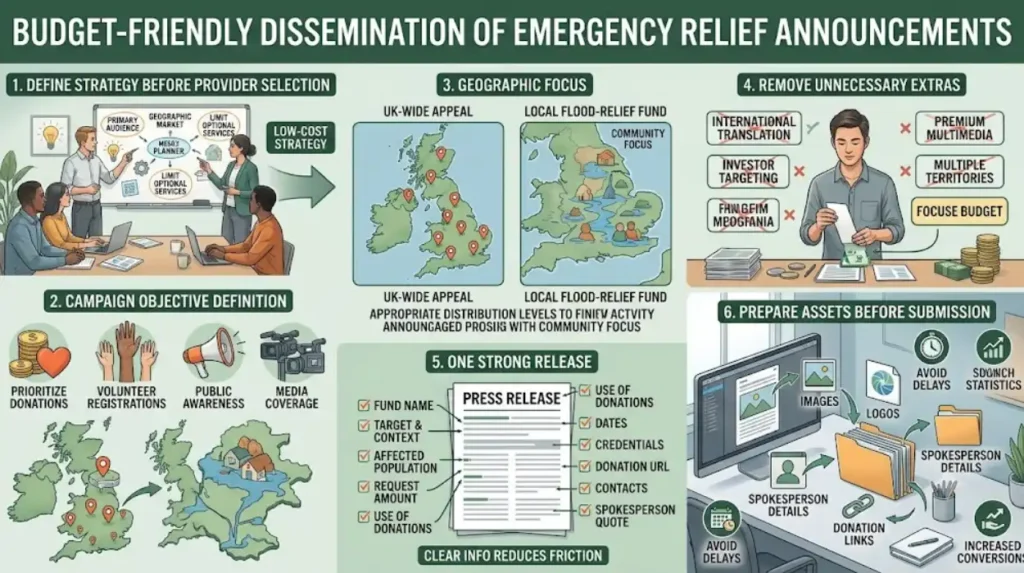
A charity can control costs by defining one primary audience, selecting one geographic market, limiting optional services, using a concise release, preparing assets before submission, and measuring useful coverage rather than paying for the largest available distribution network.
Budget control starts before selecting the provider.
The charity first defines the campaign objective. An emergency relief fund can prioritise donations, volunteer registrations, public awareness or media coverage. Each objective requires a different distribution emphasis.
The second step defines geography. A UK-wide appeal requires national and regional distribution. A local flood-relief fund requires regional distribution around affected communities.
The third step removes unnecessary extras.
For example, a charity launching a £100,000 emergency food fund does not automatically require international translation, investor targeting, premium multimedia placement and multiple distribution territories.
Use one strong release
One focused press release provides the core campaign asset.
The release needs:
- Fund name
- Fundraising target
- Emergency context
- Affected population
- Amount requested
- How donations will be used
- Launch date
- Charity credentials
- Donation URL
- Contact information
- Spokesperson quotation
Clear information reduces editorial friction and improves usability across syndicated publications.
Prepare assets before distribution
Images, logos, statistics, spokesperson details and donation links need preparation before submission.
A missing donation URL creates an avoidable conversion problem. A missing spokesperson contact creates an avoidable media-response problem.
Preparation also reduces turnaround delays.
How should charities choose between national, regional and specialist distribution?
National distribution works for UK-wide emergencies, regional distribution works for location-specific crises, and specialist distribution works for defined audiences. Combining two relevant layers creates broader coverage without purchasing unrelated international reach.
National distribution
National distribution suits emergencies affecting multiple UK regions.
Examples include:
- National disaster-relief funds
- UK-wide humanitarian appeals
- Cost-of-living emergency campaigns
- Large-scale public health fundraising
- Nationwide refugee-support initiatives
National coverage supports broad awareness and donor acquisition.
Regional distribution
Regional distribution works when the emergency has a strong geographic centre.
Examples include a flood-relief fund for Yorkshire, a community recovery fund in Wales, or an emergency housing campaign in London.
Regional publishers provide local context. Their audiences also have stronger geographic relevance.
Specialist distribution
Specialist outlets reach defined sectors.
For humanitarian organisations, relevant categories include charity media, nonprofit publications, development-sector publications and social-impact media.
Specialist coverage adds contextual relevance that general distribution does not provide.
How does press release distribution support donor and volunteer conversion?
Press release distribution supports conversion by placing a clear emergency message in front of relevant audiences and directing that attention towards a specific action. The release needs one prominent destination, measurable links, credible evidence, and consistent campaign messaging.
Distribution itself is not the donation mechanism.
The press release creates an information pathway. The donation page creates the conversion pathway.
This distinction matters when evaluating campaign performance.
A charity can measure:
Distribution → publication → referral traffic → donation-page visits → donations
For volunteer campaigns, the pathway becomes:
Distribution → publication → referral traffic → volunteer page → registrations
The campaign therefore requires consistent URLs and tracking parameters.
For example, a charity can create a dedicated landing page such as /emergency-relief-fund and use campaign-specific tracking parameters. Referral data then identifies traffic generated by distributed coverage.
The same approach supports the long-term strategy discussed in:
Post-campaign momentum. Press visibility becomes more valuable when it continues directing audiences towards measurable actions after the initial announcement.
What reporting features matter most when the emergency campaign budget is limited?
Budget-conscious charities need reporting that connects distribution activity with measurable outcomes. Publication records, referral traffic, geographic coverage, engagement data, and campaign tracking provide stronger decision evidence than large headline figures about total network size.
A report containing thousands of syndicated URLs does not automatically demonstrate campaign success.
Decision-makers need to identify useful placements.
A practical report separates:
- Distribution metrics — where the release was sent.
- Publication metrics — where the release appeared.
- Audience metrics — how much potential exposure the placements generated.
- Traffic metrics — how many users reached the campaign page.
- Conversion metrics — how many users donated or registered.
This structure supports future budget allocation.
If regional coverage generates strong referral traffic while broad international syndication generates none, the next campaign can allocate more budget to relevant UK distribution.
Is a low-cost press release distribution service always the best choice?
The cheapest distribution service is not automatically the most cost-effective choice. Value depends on relevant reach, publication quality, targeting, reporting, turnaround time, and the proportion of campaign expenditure that contributes directly to the emergency fundraising objective.
A low-cost service can become expensive when it produces poor relevance.
For example, a £150 package that generates 300 irrelevant placements provides weaker strategic value than a £300 package producing 30 relevant UK publications with measurable referral traffic.
Cost per placement therefore provides limited information.
Charities need to evaluate cost per relevant placement and cost per measurable campaign action.
This approach also protects restricted fundraising budgets from unnecessary PR expenditure.
How should a charity select the final distribution network?
The final provider choice requires matching campaign requirements with distribution geography, audience relevance, turnaround, reporting, total cost, and conversion infrastructure. Charities need a documented comparison before committing funds to an emergency relief campaign.
A practical selection scorecard includes:
| Decision factor | Priority |
|---|---|
| UK media reach | Very high |
| Regional targeting | High |
| Rapid turnaround | Very high |
| Transparent pricing | Very high |
| Online syndication | High |
| Reporting | Very high |
| Charity-sector relevance | High |
| Multimedia support | Medium |
| International distribution | Campaign dependent |
| AI and search visibility | High |
For a UK emergency relief fund, the provider needs to demonstrate relevant UK reach first. Global scale becomes important only when the campaign has an international audience.
The distribution decision also needs to connect with the organisation’s wider communications plan. Continuous visibility matters when donor fatigue affects humanitarian fundraising. The earlier educational discussion on:
Continuous press presence explains why repeated, relevant communication supports sustained public awareness.
For organisations already planning volunteer acquisition, post-campaign momentum provides the next strategic layer. The distribution campaign does not end when the release is published. Its traffic, media relationships, search visibility and campaign assets need continued use.
What is the most cost-efficient strategy for launching an emergency relief fund?
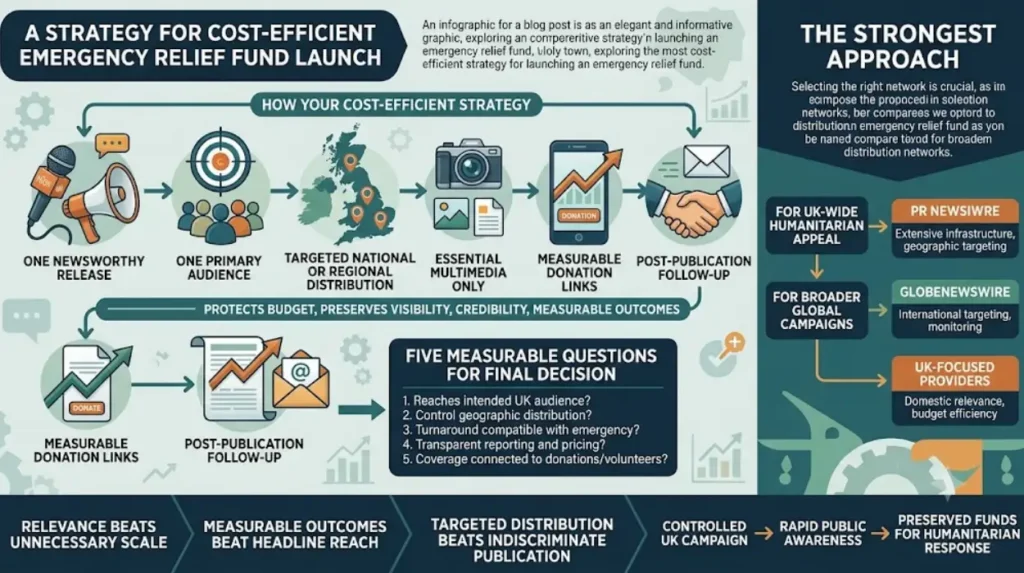
The most cost-efficient strategy uses one newsworthy release, one primary UK audience, targeted national or regional distribution, essential multimedia only, measurable donation links, and post-publication follow-up. This structure protects budget while preserving visibility, credibility, and measurable campaign outcomes.
The strongest approach is not simply selecting the largest press release network.
It is selecting the network that matches the emergency fund’s actual communication requirement.
For a UK-wide humanitarian appeal, a large network such as PR Newswire provides extensive distribution infrastructure and geographic targeting. For broader global campaigns, GlobeNewswire provides international targeting and integrated monitoring capabilities. UK-focused providers provide another route when domestic relevance and budget efficiency take priority.
The final decision needs to consider five measurable questions:
- Does the network reach the intended UK audience?
- Can the charity control geographic distribution?
- Is the turnaround compatible with the emergency?
- Are reporting and pricing transparent?
- Can the resulting coverage be connected to donations or volunteer registrations?
Explore More Expert Insights:
Time Intelligence Media Group Service Guide: Custom Distribution Built for Cause-Driven Disrupters
Selecting a Public Sector Wire: A Compliance Checklist for Announcing Large Government Grants
A press release distribution network becomes commercially useful when these requirements align.
For emergency relief funds, relevance beats unnecessary scale, measurable outcomes beat headline reach, and targeted distribution beats indiscriminate publication. A controlled UK campaign therefore provides a practical foundation for rapid public awareness while preserving funds for the humanitarian response itself.



