Real estate sponsored content is paid editorial-style media content that promotes a property brand, development, service, or market position while providing useful information to a defined audience. It combines commercial messaging with structured editorial content.
Sponsored content differs from a conventional advertisement because it uses an article, market feature, interview, project profile, or expert commentary as the primary format. The content carries a clear commercial purpose while focusing on information relevant to property audiences.
For UK real estate businesses, the audience includes property investors, developers, landlords, estate agents, commercial property buyers, housing professionals, and prospective purchasers. Each audience requires different messaging.
A residential developer, for example, can use sponsored content to explain a new development, highlight its location, present sustainability specifications, and establish the project’s market positioning.
A commercial property company can focus on investment opportunities, office demand, regeneration activity, or changing requirements across UK property markets.
The objective is not simply to publish an article. The objective is to place relevant commercial information in front of an audience that has a defined interest in property.
Businesses researching the broader role of this approach can review:
Real Estate Sponsored Content Reaches for additional consideration-stage context.
Why do UK real estate brands use sponsored content?
UK real estate brands use sponsored content to communicate detailed property information, establish market visibility, support campaigns, and reach relevant audiences through structured media placements. The format gives businesses space to explain projects, services, expertise, and commercial propositions clearly.
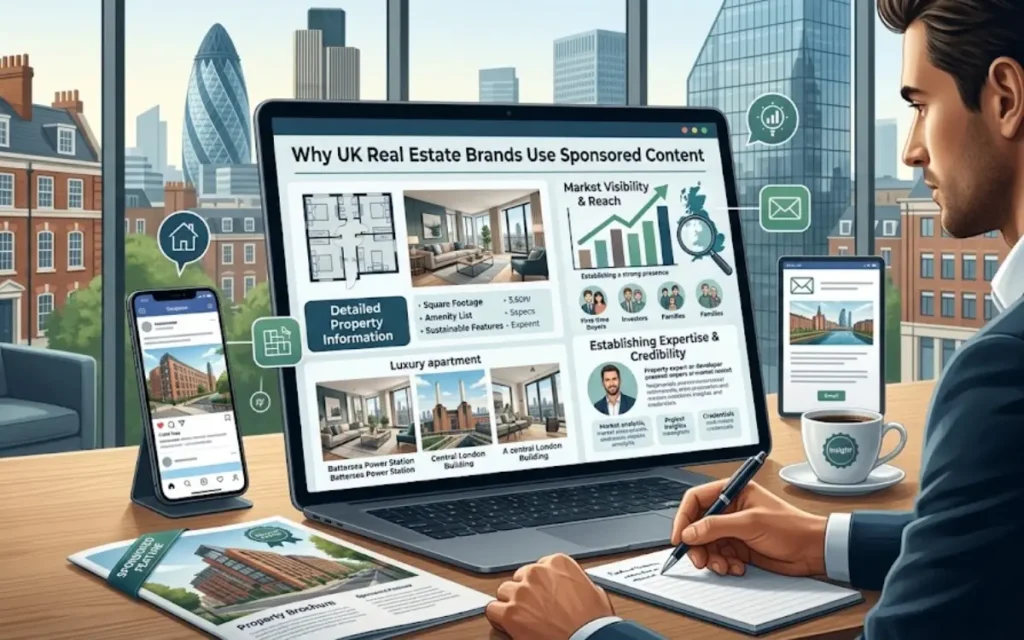
Real estate purchasing decisions involve substantial information. Property specifications, location, planning information, investment characteristics, developer credentials, sustainability features, and market conditions all influence audience evaluation.
Standard display advertising provides limited space for these details. Sponsored articles provide a larger content environment.
Property development campaigns
Developers use sponsored content to introduce residential and commercial projects. A campaign can cover development location, property types, amenities, transport access, sustainability measures, completion stages, and investment considerations.
For example, a London residential development can use an article to explain its location strategy and project features before directing interested audiences towards the developer’s property information.
Commercial property campaigns
Commercial property brands use sponsored content to communicate information about offices, retail units, industrial facilities, logistics sites, and mixed-use developments.
The content can address tenant requirements, transport connectivity, local economic activity, floor space, building specifications, and business infrastructure.
Real estate service campaigns
Estate agents, property consultants, mortgage specialists, surveying firms, architects, and property technology providers can also use sponsored content.
Their content focuses on expertise and solutions rather than one individual property.
How does Time Intelligence Media Group deliver real estate sponsored content?
Time Intelligence Media Group delivers real estate sponsored content through a structured process covering campaign objectives, audience definition, content development, media placement, publication, and performance review. Each stage connects the commercial message with the intended UK property audience.
The process begins with campaign requirements. The business defines the subject, audience, geographical focus, commercial objective, and preferred content format.
1. Campaign objective
The first specification identifies the purpose of the campaign.
Common objectives include:
- Promoting a property development
- Increasing awareness of a real estate brand
- Supporting an investment campaign
- Communicating market expertise
- Promoting property services
- Supporting a launch or announcement
- Increasing visibility among UK property audiences
A campaign promoting a new build development requires different content from a campaign promoting commercial property advisory services.
2. Audience definition
Audience selection determines the content direction.
Relevant UK audiences include residential buyers, property investors, developers, landlords, tenants, estate agents, construction professionals, and commercial decision-makers.
Geographical targeting also matters. A Manchester development requires different contextual positioning from a London office project or an Edinburgh residential scheme.
3. Content development
The content is structured around a defined topic. The article includes relevant property terminology, factual project information, commercial context, and a clear brand connection.
Suitable formats include project features, expert articles, market commentary, property guides, development profiles, and company-led thought leadership.
4. Media placement
The completed sponsored content is positioned through an appropriate media distribution strategy.
Placement selection considers audience relevance, publication context, geographical relevance, and campaign objectives.
This stage connects the content with publications and audiences that align with the real estate campaign.
5. Publication and reporting
After publication, campaign records provide evidence of completed placements and content delivery.
Reporting can include publication details, live URLs, campaign information, and relevant performance indicators where available.
What does a real estate sponsored content campaign include?
A real estate sponsored content campaign includes a defined topic, target audience, commercial message, editorial format, brand information, media placement strategy, publication assets, and reporting. These components create a structured campaign rather than an isolated promotional article.
Campaign brief
The campaign brief defines the subject and commercial objective. It establishes what the content needs to communicate and which audience it targets.
Sponsored article
The article provides the main communication asset. Its structure combines informative content with the brand’s commercial message.
Brand positioning
Brand positioning establishes the role of the real estate company within the article. The content identifies the business, its service, project, expertise, or market proposition.
Media distribution
Distribution connects the article with selected media environments. The publication strategy reflects the intended audience and campaign purpose.
Reporting
Reporting documents the campaign outcome. It provides a record of publication and supports internal marketing evaluation.
How does sponsored content help real estate brands explain complex offers?
Sponsored content gives real estate brands sufficient editorial space to explain property specifications, investment propositions, development features, locations, and services. This detailed format supports audiences that require more information before evaluating a property-related commercial proposition.
Real estate products contain multiple specifications. A residential development can include property sizes, tenure information, amenities, transport connections, energy features, local services, and completion details.
A commercial property campaign can include building size, location, accessibility, tenant requirements, facilities, and surrounding business infrastructure.
Sponsored content allows these details to appear within a coherent article structure.
Example: residential development
A property developer launching a 200-unit residential scheme can publish content covering:
- Development location
- Housing types
- Transport connections
- Local amenities
- Sustainability features
- Development timeline
- Developer credentials
The article creates one structured information source for the campaign.
Example: commercial development
A commercial property company promoting a new office development can focus on:
- Floor space
- Transport links
- Building facilities
- Sustainability specifications
- Local business environment
- Tenant requirements
The format supports a more complete explanation than a short advertising placement.
How does Time Intelligence Media Group support the buyer journey?
Time Intelligence Media Group supports the real estate buyer journey by connecting educational information, consideration-stage content, and decision-focused sponsored campaigns. The approach gives property brands a structured way to communicate with audiences at different stages.
The buyer journey begins with awareness. An audience member identifies a property trend, development, service, or investment topic.
The consideration stage follows. The audience compares information, providers, locations, projects, and commercial propositions.
The decision stage focuses on specific brands, developments, and services.
A sponsored content campaign operates most effectively when its message matches the audience’s position within this journey.
Businesses reviewing the awareness stage can also connect their content strategy with:
Real estate brands publish sponsored content to maintain topical continuity across the funnel.
What results can UK real estate brands target through sponsored content?
UK real estate brands can use sponsored content to target measurable campaign outcomes including media visibility, audience exposure, brand awareness, project communication, thought leadership, referral traffic, and broader digital presence across relevant property-focused campaigns.
The exact outcome depends on campaign design and measurement.
Brand visibility
Sponsored content puts the brand name within a structured media article. This supports repeated exposure when campaigns use relevant subjects and consistent positioning.
Project awareness
Property developers can use sponsored content to introduce developments to audiences before or during sales and marketing campaigns.
Expertise positioning
Property consultants and professional service firms can publish expert-led content addressing market issues, planning, investment, development, or property management.
Digital referral activity
Where publication arrangements support links, sponsored content can direct audiences towards relevant project or service pages.
Campaign documentation
Published articles create identifiable campaign assets that marketing teams can reference in wider communications.
When is real estate sponsored content the right choice?
Real estate sponsored content fits campaigns that require detailed communication, controlled messaging, defined media placement, and direct association between a property brand and published content. It is particularly relevant for developments, property services, investment campaigns, and market positioning.
Sponsored content is relevant when the campaign requires more explanation than a standard advertisement provides.
It also fits campaigns where brand control is important. The business supplies the commercial message and campaign information rather than relying entirely on independent editorial selection.
New development launches
A new residential or commercial project requires detailed communication. Sponsored content provides a dedicated format for introducing the project.
Property investment campaigns
Investment-focused businesses can publish content explaining market opportunities, investment strategies, locations, and relevant property characteristics.
Professional property services
Surveyors, consultants, agents, architects, and property technology companies can use sponsored content to explain specialist services.
Market positioning
Established real estate companies can publish expert-led content around property trends, development activity, sustainability, investment, and market changes.
How should a UK real estate brand evaluate a sponsored content provider?
A UK real estate brand should evaluate a sponsored content provider through audience relevance, media placement quality, content standards, campaign process, reporting, transparency, and experience with property-sector communication. These criteria establish whether the service matches defined campaign requirements.
Audience relevance
The provider needs access to media environments that match the intended UK property audience.
Content quality
The content must communicate the commercial message clearly while maintaining a professional editorial structure.
Placement transparency
The campaign process needs clear information about publication arrangements and deliverables.
Reporting
The provider needs to document published content and campaign outputs.
Sector understanding
Real estate campaigns involve terminology and commercial considerations that differ from technology, healthcare, finance, or retail campaigns.
Campaign scalability
A provider needs a process that supports one-off project campaigns as well as recurring sponsored content programmes.
What makes Time Intelligence Media Group suitable for a real estate sponsored content campaign?
Time Intelligence Media Group provides a structured sponsored content approach for real estate brands seeking controlled messaging, relevant media exposure, professional content development, and documented campaign delivery across UK-focused property marketing initiatives.
The service is positioned around the practical requirements of sponsored media campaigns.
The campaign starts with the property’s commercial objective and target audience. Content development then translates those requirements into a publication-ready format.
Media placement connects the finished content with relevant audiences. Reporting provides campaign documentation after publication.
This structure is suitable for property developers, estate agencies, commercial property companies, property consultants, investment firms, construction businesses, and property technology providers.
For a developer, the campaign can centre on a specific development.
For an estate agency, it can focus on market expertise or a specialist service.
For a property consultancy, it can communicate professional knowledge and market positioning.
For a proptech company, it can explain how its technology addresses a defined property-sector problem.
The campaign format changes according to the commercial objective while retaining the same core process: define, develop, place, publish, and review.
How can a real estate brand start a sponsored content campaign?

A real estate brand can start by defining its campaign objective, target UK audience, property topic, key commercial message, preferred content format, and desired media exposure. These specifications create the foundation for an actionable sponsored content campaign.
Start with one clearly defined campaign objective.
Identify the audience by property interest, professional role, geography, or purchasing stage.
Define the core subject. Examples include a new development, property investment strategy, commercial property service, residential project, or property technology solution.
Prepare the essential facts, brand information, project details, and supporting assets.
Then establish the publication and distribution requirements.
Explore More Expert Insights:
SaaS Sponsored Content by Time Intelligence Media Group
Healthcare Sponsored Content by Time Intelligence Media Group
Time Intelligence Media Group can structure these requirements into a sponsored content campaign designed around the UK real estate market.
The strongest campaigns maintain one clear subject, one defined audience, and one measurable commercial purpose. This keeps the content focused and makes campaign evaluation more precise.