
Trust signals in telemedicine banner advertising are visual, informational, and credibility-focused elements that encourage users to complete healthcare registrations, schedule virtual consultations, and create patient accounts after previously interacting with telemedicine platforms in the United Kingdom.
Trust signals help reduce hesitation during healthcare decision-making. Patients often evaluate credibility before submitting personal information or booking online consultations. Telemedicine platforms use banner advertisements to reinforce legitimacy, transparency, and healthcare reliability.
Common trust signals include verified doctor credentials, secure patient communication references, encrypted consultation messaging, NHS-related compliance language, patient satisfaction statistics, and consultation availability indicators. These elements appear repeatedly during remarketing campaigns.
Banner advertisements targeting decision-stage users focus on reassurance instead of awareness. At this stage, users already understand telemedicine services and previously interacted with healthcare websites, appointment pages, or informational resources.
Healthcare conversion campaigns in the United Kingdom often highlight operational clarity. Examples include “same-day online GP appointments,” “secure prescription requests,” and “regulated virtual consultations.” These statements explain concrete healthcare functions directly.
How do banner ads convert telemedicine interest into patient signups?
Telemedicine platforms convert user interest into patient signups by displaying highly targeted banner advertisements that reinforce healthcare trust, simplify appointment processes, highlight patient benefits, and repeatedly guide returning users toward completed registration actions and virtual consultation bookings.
Conversion-focused banner advertising operates through behavioural retargeting. Users who previously visited telemedicine websites receive follow-up advertisements across news websites, mobile applications, healthcare content platforms, and search partner networks.
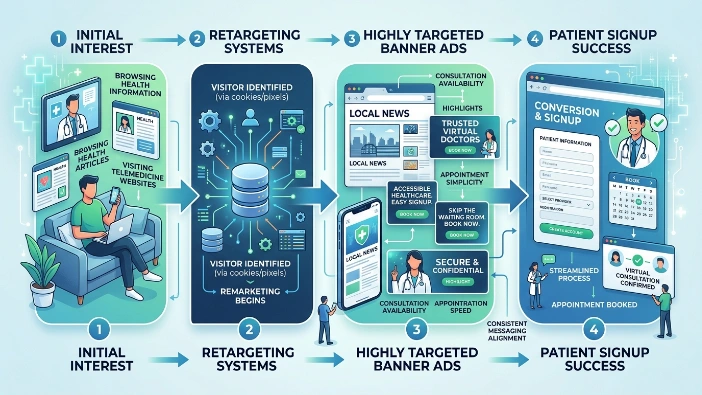
The conversion process follows a structured sequence. First, users interact with healthcare content or visit telemedicine websites. Second, remarketing systems identify these visitors. Third, banner advertisements display trust-focused messaging. Fourth, users return and complete signup actions.
Healthcare banner messaging changes during this stage. Awareness campaigns explain telemedicine concepts. Conversion campaigns focus on patient action. Advertisements frequently highlight consultation availability, appointment simplicity, registration speed, and healthcare accessibility.
Landing page alignment also improves conversion rates. Banner advertisements connect users to pages specifically designed for appointment booking, patient registration, or online consultation scheduling. Consistent messaging between banners and landing pages improves user continuity.
Mobile optimisation remains critical. In the United Kingdom, healthcare searches frequently occur on smartphones. Fast-loading registration pages and simplified appointment systems reduce abandonment during signup processes.
Healthcare marketers also use sequential messaging strategies. One advertisement highlights verified clinicians. Another emphasises secure communication systems. Another promotes extended appointment availability. This progression builds layered trust before patient registration.
Why do trust-focused banner ads improve telemedicine conversion rates?
Trust-focused banner advertisements improve telemedicine conversion rates because healthcare users prioritise security, legitimacy, professional credibility, and patient transparency before sharing medical information, creating accounts, or scheduling remote healthcare consultations through digital healthcare platforms.
Healthcare decisions involve personal data and medical concerns. Users evaluate platform reliability before completing signup forms. Banner advertisements addressing these concerns reduce uncertainty during decision-making.
Verified healthcare messaging strengthens credibility. Examples include references to licensed clinicians, regulated healthcare systems, patient confidentiality standards, and encrypted consultation technology.
Repetition also improves familiarity. Users exposed to healthcare advertisements multiple times recognise platform messaging more quickly. Familiarity increases confidence during registration and appointment booking stages.
Conversion-focused banner ads frequently contain measurable operational details. Examples include “24-hour appointment availability,” “online GP consultation within 30 minutes,” and “digital prescription management.” Specific healthcare information improves clarity.
Trust messaging also supports patient expectations around privacy. Telemedicine users expect secure communication systems and protected medical records. Banner campaigns therefore emphasise secure digital infrastructure and patient confidentiality standards.
Healthcare marketers in the United Kingdom increasingly combine educational messaging with conversion-focused design. Advertisements explain consultation steps while guiding users toward patient signup actions.
What types of trust signals appear in telemedicine banner campaigns?
Telemedicine banner campaigns use professional credentials, patient review summaries, secure platform indicators, healthcare compliance messaging, appointment accessibility information, consultation statistics, and transparent healthcare process explanations to strengthen user confidence before patient registration completion.
Professional healthcare credentials remain one of the strongest trust indicators. Banner advertisements often reference certified doctors, registered healthcare professionals, and regulated clinical systems.
Patient review messaging also appears frequently. Examples include “rated highly by online consultation users” and “trusted for digital healthcare appointments.” These references strengthen perceived reliability.
Security indicators support healthcare privacy expectations. Telemedicine advertisements regularly reference encrypted video consultations, protected patient data systems, and secure online communication infrastructure.
Healthcare compliance messaging improves operational transparency. Banner campaigns in the United Kingdom frequently include references to regulated healthcare standards, secure prescription systems, and patient confidentiality frameworks.
Operational clarity functions as another trust signal. Advertisements explaining appointment timelines, consultation availability, and prescription delivery systems reduce confusion during patient decision-making.
Visual design also influences trust perception. Healthcare banners use clean layouts, medical imagery, readable typography, and structured spacing to communicate professionalism and healthcare legitimacy.
Video-enabled display advertisements are becoming increasingly common. Short healthcare explainer visuals help users understand registration processes and online consultation systems before signup completion.
How does remarketing strengthen telemedicine patient acquisition?
Remarketing strengthens telemedicine patient acquisition by reconnecting healthcare platforms with previously engaged users through repeated trust-focused advertising exposure that reinforces healthcare credibility, improves familiarity, and increases completed consultation registration rates across digital environments.
Remarketing targets users who already demonstrated interest in telemedicine services. These users previously visited healthcare pages, explored online consultations, or reviewed appointment information without completing signup actions.
Healthcare remarketing campaigns focus on continuity. Advertisements remind users about services they previously explored. This repeated visibility improves recognition and reinforces healthcare relevance.
Different audience groups receive different remarketing messages. Users visiting mental health pages receive mental wellness consultation advertisements. Users exploring prescription systems receive medication management banners.
Dynamic remarketing technology personalises advertising experiences. Banner systems display healthcare-related messaging connected to previous browsing behaviour and consultation interests.
Frequency management remains important during healthcare remarketing. Excessive advertising exposure creates fatigue. Effective campaigns balance repeated visibility with user experience optimisation.
Remarketing campaigns also improve cost efficiency. Platforms target already interested users instead of broad untargeted audiences. This approach increases relevance and improves healthcare signup performance metrics.
Many telemedicine platforms integrate remarketing with appointment abandonment systems. Users who begin registration processes but exit before completion receive follow-up advertisements encouraging consultation completion.
What design strategies improve telemedicine signup-focused banner ads?
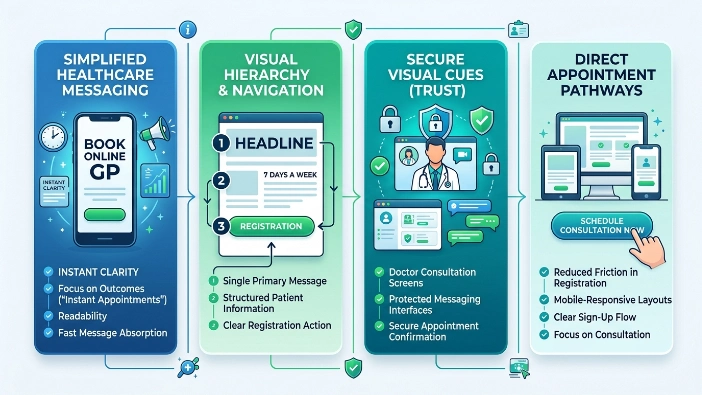
Effective telemedicine signup-focused banner advertisements use simplified healthcare messaging, clear appointment pathways, mobile-responsive layouts, secure visual cues, structured patient information hierarchy, and direct consultation-focused calls to action that reduce friction during registration processes.
Healthcare banner advertisements require immediate clarity. Users spend limited time viewing display advertisements. Conversion-focused designs therefore prioritise readability and visual simplicity.
Headline messaging focuses on healthcare outcomes and operational convenience. Examples include “Book an Online GP Consultation Today” and “Secure Virtual Appointments Available Seven Days a Week.”
Visual hierarchy improves patient navigation. Most successful healthcare banners contain one primary message, one supporting healthcare detail, and one clear registration action.
Secure healthcare imagery strengthens trust perception. Examples include doctor consultation screens, protected messaging interfaces, patient dashboard visuals, and secure appointment confirmation graphics.
Mobile responsiveness remains essential. Healthcare users frequently complete signup actions through smartphones. Optimised mobile banners improve engagement and reduce registration abandonment.
Fast-loading advertisement formats also improve performance. Heavy visual elements slow loading times and reduce interaction rates. Lightweight responsive creatives improve user retention during browsing sessions.
Healthcare conversion campaigns increasingly use personalised messaging variations. Different age groups, healthcare interests, and consultation categories receive tailored banner experiences based on audience segmentation data.
Explore More Expert Insights:
How Dental Clinics Turn Treatment Interest Into Paid Procedures Using Retargeting Ads
How Healthcare Providers Increase Consultation Bookings Using Final Stage Banner Campaigns
How do telemedicine platforms measure signup conversion from banner ads?
Telemedicine platforms measure banner advertisement conversion performance through completed patient registrations, appointment booking rates, consultation requests, landing page engagement metrics, return visitor behaviour, cost-per-acquisition analysis, and healthcare-specific conversion tracking systems across digital advertising channels.
Patient signup tracking measures how many users create healthcare accounts after interacting with advertisements. This metric directly connects banner campaigns with registration outcomes.
Appointment booking analysis evaluates completed consultation scheduling activity. Healthcare marketers monitor consultation type, booking timing, and registration pathway performance.
Landing page engagement metrics reveal user behaviour after advertisement interaction. Platforms analyse session duration, registration form completion rates, and page navigation patterns.
Return visitor analysis measures how frequently users revisit healthcare platforms before conversion. Many patients complete registrations after multiple interactions with telemedicine advertisements.
Cost-per-acquisition analysis calculates advertising efficiency. This metric measures the advertising spend required to generate one completed patient signup.
Cross-device tracking also supports conversion measurement. Users often begin healthcare research on mobile devices and complete registration on desktop systems. Integrated analytics identify these patterns.
Healthcare platforms additionally monitor trust-related engagement signals. Examples include patient review interactions, security information page visits, and clinician profile engagement metrics.
How are telemedicine conversion banner strategies evolving in the United Kingdom?
Telemedicine conversion banner strategies in the United Kingdom are evolving through AI-driven audience targeting, privacy-focused advertising systems, personalised healthcare messaging, predictive patient engagement analysis, and integrated digital healthcare conversion optimisation technologies designed for higher patient signup efficiency.
Artificial intelligence improves healthcare audience segmentation. Advertising systems analyse browsing behaviour, consultation interests, and engagement history to improve banner relevance.
Predictive analytics now support patient acquisition strategies. Platforms identify users more likely to complete consultation bookings based on behavioural signals and interaction history.
Privacy-focused advertising practices continue expanding due to healthcare data expectations and digital regulation changes. Telemedicine platforms increasingly prioritise consent-based targeting and transparent patient communication systems.
Personalised healthcare messaging is becoming more refined. Mental health users, chronic care patients, prescription management audiences, and general consultation seekers receive specialised advertising experiences.
Integrated healthcare ecosystems are also shaping banner strategy evolution. Appointment scheduling systems, patient communication portals, and healthcare dashboards now connect directly with advertising remarketing systems.
Video-enabled healthcare banners continue growing across mobile environments. Short educational consultation explainers improve engagement and simplify healthcare registration understanding.
Readers wanting foundational insight into telemedicine awareness campaigns can read:
How Telemedicine Platforms Acquire Users Using Banner Ads
Readers exploring trust-building strategies before patient conversion can explor:
How Telemedicine Platforms Build User Trust Using Display Remarketing Ads