

A content extension strategy is a planned sequence that converts one-day event assets into 30 distinct, publishable items distributed across news sites and owned channels. This strategy defines which event outputs become articles, interviews, opinion pieces, data stories, photo essays, and video segments. It assigns formats, deadlines, distribution targets, and measurement metrics.
A content extension strategy treats the conference as a source of discrete, verifiable entities: speakers, research findings, quotes, statistics, visuals, and attendee data. For UK audiences, it aligns with national and regional media calendars, press cycles, and topical beats such as politics, business, technology, and education. The strategy maps assets to news site formats: short news briefs, longer features, analysis pieces, expert Q&As, and localised reporting. It also schedules follow-up pieces timed at 1, 3, 7, 14, and 30 days to maintain visibility and permit incremental editorial angles.
How do you prepare before the conference to enable 30 days of content?
Preparation requires asset templates, a content calendar, assigned writers, and approved legal clearances completed at least 14 days before the event. Preparation prevents last-minute bottlenecks and ensures rapid publication. Create standard templates for news briefs (300–500 words), features (800–1,200 words), data-led stories (with charts), and video scripts (30–90 seconds). Pre-authorise interview consent forms and image usage rights for speakers and sponsors. Prepare a media list of UK news sites segmented by audience type: national, trade, regional, and specialist.
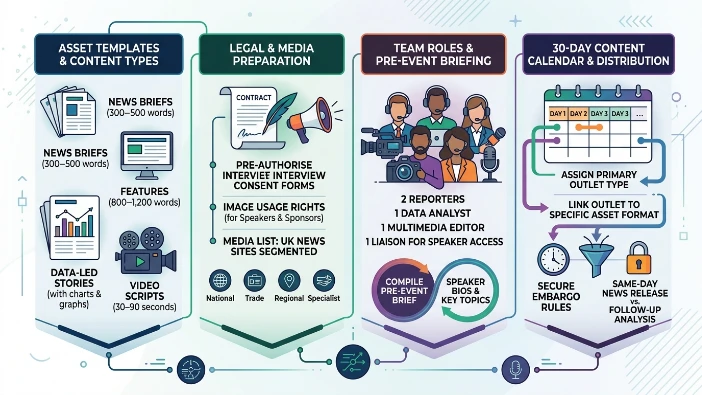
Schedule roles for content capture two reporters, one data analyst, one multimedia editor, and one liaison for speaker access. Compile a pre-event brief with speaker bios and key topics and circulate it to the team. Build a 30-day content calendar that assigns a primary outlet type for each day and links each outlet to a specific asset format. Secure embargo rules and clarify which items are suitable for same-day news release versus follow-up analysis.
What content types convert an event into 30 publishable stories?
Use news briefs, feature articles, Q&As, opinion pieces, data stories, localised reports, photo essays, and short-form videos to make 30 distinct items. Each content type addresses different editorial needs. News briefs supply quick facts and immediate reporting on announcements and research. Feature articles provide context and narrative around major talks. Q&As deliver verified expert insight. Opinion pieces interpret implications for sectors such as finance or healthcare. Data stories visualise attendee surveys or research results. Localised reports adapt national findings for city and regional newsrooms. Photo essays and short-form videos offer multimedia hooks that news sites embed.
Assign counts for a 30-item plan: 6 news briefs, 6 feature articles, 4 Q&As, 4 opinion pieces, 4 data stories, 3 localised reports, and 3 multimedia packages. Produce each item with a clear lead, three to five verifiable facts, and at least one attributable quote. Tag each story with keywords and speaker names to support syndication across UK news sites.
How do you capture high-quality assets during a one-day conference?
Capture assets using a checklist of speaker quotes, presentation slides, live polls, attendee survey results, high-resolution photos, and short-form video clips. Deploy a two-person reporting pair per track: one to record verbatim quotes and one to photograph and record video. Use professional audio recorders for quotes and soundbites. Request presentation slide decks from speakers in advance and again on-site. Run live polls during sessions and collect at least 200 responses for statistically meaningful micro-surveys. Conduct five-minute exit interviews with 20 attendees to collect reaction quotes and one-sentence testimonials.
Label every asset with metadata: speaker name, session title, time, and rights clearance. Transcribe audio within 12 hours. Tag slides and data sources for fact-checking. Export short-form videos in 16:9 and 9:16 aspect ratios with captions. Produce a same-day news brief from the keynote with two verified quotes and one key statistic to submit to national news wires.
How do you structure the 30-day publishing calendar?
Structure the calendar with a launch cluster (days 0–3), analysis cluster (days 4–10), deep-dive cluster (days 11–20), and follow-up cluster (days 21–30). Days 0–3 focus on immediate reporting: keynote summary, headline announcement, and one rapid-response data brief. Days 4–10 deliver analysis: sector impacts, policy implications, and expert Q&As. Days 11–20 provide features and data stories: trend pieces, regional adaptations, and visual explainers. Days 21–30 publish follow-ups and outcomes: attendee surveys, implementation case studies, and metrics-driven retrospectives.
Assign each publication slot to a target outlet type. For example, place the keynote summary with national news sites on day 0, regional adaptations with local newsrooms on days 5 and 7, and trade-focused features with specialist sites on days 10 and 14. Reserve multimedia packages for mid-cycle publication to reinvigorate coverage. Log every placement and feedback in a tracking sheet that records editorial contacts, publication time, and reach estimates.
What pitching approach secures placements on UK news sites?
Pitch with concise, angle-driven emails that include one verified statistic, one attributable quote, and a clear publication window. Tailor each pitch to the outlet’s beat and morning editorial schedule. For national outlets, highlight newsworthiness and exclusivity for day-zero briefs. For trade outlets, emphasise sector-specific data and practical implications. For regional outlets, submit localised data or an attendee from the region as the central figure. Attach a short media pack: 150-word synopsis, speaker bio, one high-resolution image, and an embargo date if relevant.
Use follow-up reminders at 24 and 72 hours. Offer a short interview slot with the speaker within 48 hours of the event. Supply pre-written copy for rapid turnaround, labelled clearly for editorial use. Track responses and pivot unused assets to owned channels or syndication partners.
What legal and ethical checks ensure safe distribution across news sites?
Obtain signed consent for quotes and images, verify data sources, and apply privacy rules for attendee information before publishing. Collect written permission from speakers for direct quotes and image use during registration. Verify all presented data against original sources and include citations. Anonymise personal data when publishing attendee feedback unless the attendee gives explicit consent. Follow UK copyright law for slides and third-party images. Retain permission logs and make them available to editors upon request.
For survey and polling data, publish methodology and sample size. Note regional weighting where applicable. Disclose any commercial relationships or sponsorships connected to the event.
What metrics measure the success of a 30-day content rollout?
Measure reach, engagement, referral traffic, earned media value, and editorial placements across target outlets with weekly reporting. Track pageviews and unique visitors per item, social shares, average time on page, and backlinks. Monitor referral traffic from each news site to your core report or landing page. Calculate earned media value using standard UK market CPM benchmarks and list exact placements achieved by day. Count the number of editorial pickups in national, trade, and regional outlets. Set targets: 50,000 combined impressions, 20 editorial placements, 1,000 referral visits, and 10 backlinks within 30 days as example benchmarks for a medium-sized UK conference.
Produce weekly roll-ups at days 7, 14, and 30 that compare results to targets and note which angles performed best. Use those learnings to refine the next conference cycle.
What benefits arise from extending a one-day conference into 30 days of news coverage?
Extending coverage increases sustained visibility, improves SEO through diverse keyword entries, and produces measurable referral traffic and links for long-term discoverability. A 30-day cadence converts single-event momentum into sustained editorial interest. News briefs capture immediate attention. Features and data stories generate backlinks and longer session times. Localised reporting expands regional reach. Multimedia packages increase embedding and social engagement. The cumulative result is broader reach and a searchable content archive that continues to attract traffic after the event.
Explore More Expert Insights:
Live Event Coverage Formats: Which Gets the Most UK Shares — Video, Live Blog or Recap?
How to Build a Pre-Event Media Strategy That Fills Seats and Generates Coverage
How do UK-specific factors change the plan?
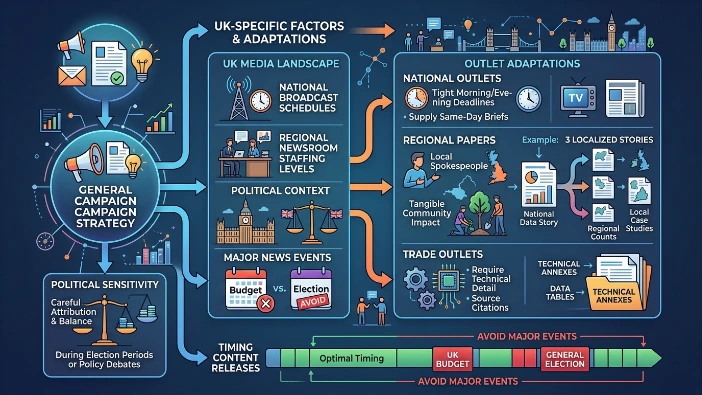
UK factors include editorial deadlines tied to national broadcast schedules, regional newsroom staffing levels, and sensitivity to political context; adapt timing and angles accordingly. National outlets follow tight morning and evening deadlines; supply same-day briefs to match their cycles. Regional papers prefer local spokespeople and tangible community impact. Trade outlets require technical detail and source citations. Political sensitivities require careful attribution and balance during election periods or policy debates. Time content releases to avoid major UK news events such as budget announcements or national elections when possible.
For regionalisation, convert one national data story into three localised variants using regional attendee counts and case studies. For trade outlets, add technical annexes and data tables to the feature package.
How do you iterate and improve for the next conference?
Review placement data, editorial feedback, and asset performance to refine templates, pitching lists, and timing for the next cycle. Audit which story types delivered the best referral traffic and backlinks. Record which outlets responded fastest and which pitches were declined. Update asset templates and consent forms based on bottlenecks.
Check the Complete Explanation:
How Short-Form Video Changed What UK Event Coverage Looks Like in 2026
Increase pre-event outreach to top-performing outlets and adjust the 30-day calendar to foreground the highest-performing content types. Maintain a repository of approved quotes and images for reuse. Repeat the process with updated benchmarks and a target to increase placements by a fixed percentage, such as 25%, year over year.
Explore More Useful Information:
In-House Event PR vs Managed Media Coverage: A Real Cost Analysis for UK Teams



