

In-house event PR uses internal staff and resources to handle publicity, while managed media coverage employs external agencies or managed services to secure placements and run campaigns. In-house teams execute tasks using employees on payroll. Managed media coverage uses contracted specialists, third-party vendors, or PR agencies.
Entities include staff roles (press officers, content producers), agency roles (account directors, media buyers), and service types (earned media, paid amplification, content syndication). Define scope by deliverables: media lists, press releases, interviews, thought-leader placements, and measurement reports. For UK teams, include national outlets, trade publications, and local regional press in scope definitions.
How do you calculate the total cost for in-house event PR?
Total in-house cost equals salaries, benefits, overhead, software, freelance top-ups, and opportunity cost summed over the campaign period. Start with direct staff costs. Multiply each staff member’s annual salary by the fraction of time allocated to the event. Example: a PR manager on £45,000 per year working 20% on the event equals £9,000. Add employer National Insurance and pension contributions at the applicable UK rates (for example, employer NIC ~13.8% and pension minimum 3% where relevant) to compute total employment cost. Include recruitment and training amortised over one year if new hires are required.
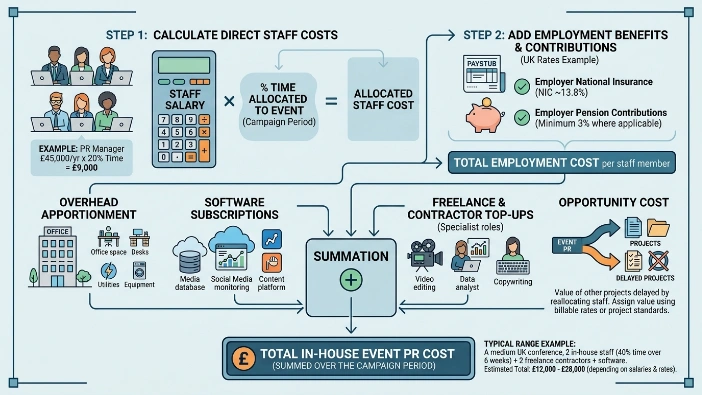
Office space, equipment, and utilities apportioned to the campaign. Include software subscriptions: media databases, monitoring tools, and content platforms. Add freelance and contractor fees for specialist tasks such as video editing, data analysis, or copywriting. Calculate opportunity cost as the value of other projects delayed by reallocating staff; assign this a dollar value using billable rates or internal project value standards.
Sum these elements to report a campaign cost for the event window. For example, a medium-sized UK conference with two in-house staff dedicating 40% time over six weeks, plus two freelance contractors and software, can total between £12,000 and £28,000 depending on salaries and contractor rates.
How do you calculate the total cost for managed media coverage?
Managed coverage cost equals agency fees, third-party placement costs, media buying, production fees, and reporting fees agreed in the contract. Begin with the agency retainer or project fee. Agencies charge monthly retainers or fixed project fees. A UK PR agency retainer for an event campaign ranges from £3,000 to £10,000 per month for mid-market services. Add one-off production costs: press pack design, video production, and photography. Include paid placement or media buying budgets for sponsored content, display ads, or native advertising. Add syndication fees for distribution partners and wire services where used.
Account for measurement and reporting fees, which agencies often bundle or itemise. Include contingency for extra outreach, rapid response, or crisis management. Calculate the total campaign cost over the active period. For a managed campaign covering pre-event, live-day, and 30-day follow-up, expect total costs between £15,000 and £60,000 depending on scope, paid amplification, and agency seniority.
What are the measurable outputs for each approach?
Measure outputs as placements secured, reach (audience size), referral traffic, backlinks, social engagement, and earned media value. For in-house PR, track the number of press releases issued, interviews arranged, contributed articles placed, and social posts published. Measure reach by estimated circulation of outlets and digital audience metrics. Record referral visits and session duration from news sites. Track backlinks and domain authority impact. For managed coverage, agencies add placement lists, estimated reach, press clippings, and often an earned media value calculation using UK market CPM equivalents. Agencies may provide conversion tracking tied to landing pages, enabling direct comparison of referrals-to-leads.
Compare outputs with campaign objectives. For a UK B2B event, target metrics could include 25 editorial placements across trade media, 10 national mentions, 5 backlinks from domains with Domain Rating over 50, and 2,000 referral visits within 30 days.
How do fixed and variable costs compare between models?
In-house PR has higher fixed employment and overhead costs, while managed coverage shifts to variable fees tied to campaign scope and duration. In-house fixed costs include salaries and long-term subscriptions that remain regardless of campaign count. Variable costs include freelance fees and production per event. Managed coverage has lower fixed overhead for the client and higher variable costs because agencies bill per campaign or month. For organisations running more than three large events per year, fixed in-house costs amortise better and reduce per-event cost. For one-off events or pilot projects, managed coverage offers predictable, short-term expenditure without long-term hiring commitments.
Calculate break-even: divide annual in-house incremental cost by the average agency cost per event. If in-house incremental cost is £40,000 per year and agency cost per similar event is £10,000, break-even occurs after four events.
What qualitative differences affect ROI calculations?
Qualitative differences include control over messaging, editorial relationships, speed of response, and depth of industry expertise. In-house teams maintain direct control over messaging and faster internal approvals. Agencies provide established media relationships and specialist skills in outreach, content placement, and paid amplification. Evaluate how these differences influence conversion rates and lead quality. For UK policy-focused events, agency relationships with national political correspondents increase the probability of policy coverage. For highly technical events, in-house subject-matter knowledge can improve accuracy and reduce fact-check cycles.
Translate qualitative differences into quantitative adjustments. For example, assign a 10% higher conversion probability to agency-secured national placements if agency relationships historically yield 30% higher pickup rates. Document source data for these adjustments within ROI models.
How do you model ROI for both approaches?
Model ROI by comparing incremental revenue attributable to media coverage against the total campaign cost over a defined attribution window. Define the attribution window: immediate (0–30 days) and extended (31–180 days). Track leads generated from media referrals using UTM-tagged landing pages and CRM source fields. Assign conversion rates and average deal value to calculate revenue per lead. Subtract total campaign cost to compute net return. Express ROI as (Net Return / Campaign Cost) × 100.
Build sensitivity scenarios: conservative, base, and aggressive. Use conversion rates from historical data. Example: 2,000 referral visits, 1.5% conversion to leads equals 30 leads; at an average deal value of £4,000 and a 20% close rate results in £24,000 revenue. If campaign cost equals £12,000, net return is £12,000 and ROI is 100%.
When is in-house PR more cost-effective for UK teams?
In-house PR proves cost-effective when organisations run four or more large events per year or need sustained, rapid-response communications. Cost-effectiveness depends on event frequency, required specialist skills, and speed of response. High-frequency event programmes justify fixed employment costs through amortisation. Situations requiring immediate messaging changes, such as policy responses during UK regulatory updates, benefit from in-house control. Internal teams integrate with other departments for rapid approvals and cross-functional campaigns, reducing lead time for press responses.
When is managed media coverage more cost-effective for UK teams?
Managed coverage is more cost-effective for single events, pilot campaigns, or when access to senior media relationships and paid amplification is essential. Use managed services when the campaign requires specialised outreach or where in-house teams lack senior contacts. Managed coverage scales quickly for one-off launches and absorbs workload peaks without permanent hires. For campaigns requiring paid placements on national portals or complex native advertising, agencies manage media buying and creative production efficiently, reducing procurement time.
Explore More Expert Insights:
How One UK Industry Summit Secured 38 Published News Articles in 5 Days
Events Media Coverage Service: What a Full Package Includes From Setup to Publish
How should teams decide which model to use for a specific event?
Decide by comparing expected campaign outputs, event frequency, in-house capacity, and the cost-per-key-output metric against agency proposals. Calculate expected outputs and assign monetary value to key outputs: national placements, trade backlinks, referral visits, and leads. Compute cost-per-key-output for both models. Factor in intangibles: control needs, risk tolerance, and strategic priorities. Consider hybrid models: keep strategic communications in-house and outsource media buying and production. For example, a UK university running research dissemination events can maintain academic messaging in-house and hire agencies for national press outreach and paid channels.
Learn More Here:
How Short-Form Video Changed What UK Event Coverage Looks Like in 2026
What contractual and governance practices protect ROI in managed contracts?
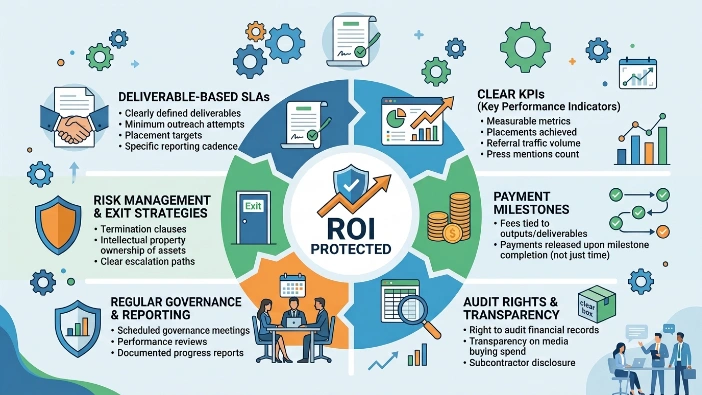
Include deliverable-based SLAs, clear KPIs, payment milestones, and audit rights in agency contracts to protect ROI. Define specific deliverables such as minimum number of outreach attempts, placement targets, and reporting cadence. Set KPIs tied to measurable metrics: placements, referral traffic, and press mentions. Structure fees with milestones tied to outputs. Include termination clauses and intellectual property ownership of produced assets. Require transparency on media buying spend and subcontractors. Add regular governance meetings and escalation paths.
For More Details, Explore:
How to Turn a One-Day UK Conference Into 30 Days of Content Across News Sites



