Case study banner campaigns are structured digital advertising formats that present verified customer outcomes, performance metrics, and implementation results of software products. These banners distribute condensed case study insights across display networks to build credibility during the consideration stage.
Case study banner campaigns compress long-form success stories into visual ad units. They include measurable results such as percentage improvements, time savings, cost reductions, and operational gains. Software brands use them to communicate proven value without requiring users to read full reports.
These banners typically appear on business websites, industry blogs, and programmatic ad networks. The format focuses on evidence instead of promotional claims. Each banner highlights a single outcome statement supported by real usage data.
Case study banners differ from generic display ads because they rely on documented customer performance rather than feature descriptions. They function as trust signals within the mid-funnel marketing stage where users evaluate multiple software solutions.
How do case study banner campaigns build trust in the MOFU stage?
Case study banner campaigns build trust by presenting verified performance outcomes, reducing uncertainty, and reinforcing product credibility through real customer evidence during the consideration stage where buyers compare multiple software options.
The MOFU stage focuses on evaluation and comparison. Users already understand their problem and now assess solutions. Case study banners provide structured proof points that reduce perceived risk.
Trust is built through three mechanisms. First, quantified outcomes show measurable results such as “40% faster workflow completion.” Second, industry relevance aligns outcomes with similar business environments. Third, repetition across multiple placements reinforces consistency of claims.
This format supports cognitive validation. Buyers do not rely on marketing claims alone. They interpret repeated evidence across banners as confirmation of product reliability. A funnel-aligned message structure is used across awareness and decision paths.
A unified navigation line applies across stages:
How SaaS Brands Scale Growth Using Programmatic Banner Ads
TOFU content invites structured learning, MOFU content guides evaluation through verified insights, BOFU content supports final decision-making through outcome validation and conversion clarity.
What components make a high-performing case study banner campaign?
High-performing case study banner campaigns contain four components: quantified outcome data, industry context, visual hierarchy, and concise proof statements that communicate measurable impact within seconds of user attention.
Each component supports rapid comprehension. Quantified outcomes include percentages, time reductions, or revenue impact. These numbers replace abstract messaging with measurable evidence.
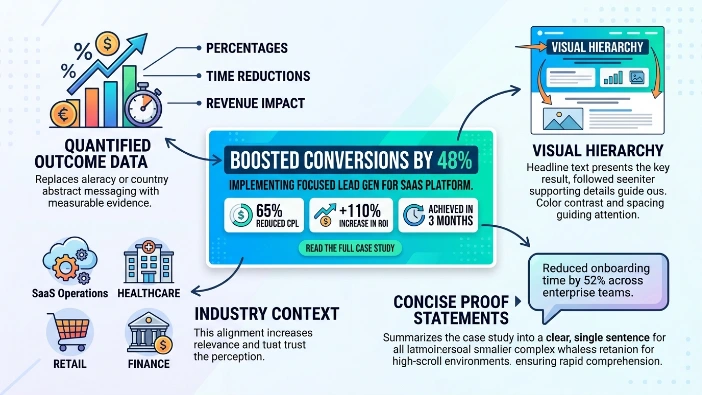
Industry context identifies the business sector such as finance, healthcare, retail, or SaaS operations. This alignment increases relevance and improves trust perception.
Visual hierarchy ensures the most important data appears first. Headline text presents the key result, followed by supporting context in smaller text. Color contrast and spacing guide attention flow.
Proof statements summarize the case study into one sentence. Example structure includes “Reduced onboarding time by 52% across enterprise teams.” This ensures clarity in high-scroll environments.
These components function together to compress complex case studies into digestible trust signals for display environments.
How do software brands structure case study narratives for banners?
Software brands structure case study narratives for banners by converting full customer success stories into three elements: problem context, implemented solution, and measurable outcome condensed into a single visual message.
The narrative structure begins with a clearly defined business problem. This includes inefficiencies, cost issues, or operational delays faced by a customer segment.
The second element describes solution implementation. This remains brief and avoids technical overload. It focuses on software adoption and integration within existing workflows.
The final element highlights measurable outcomes. This includes improvements such as productivity gains, cost reductions, or process acceleration.
In banner format, these three elements are compressed into a single headline statement. Full narrative depth is removed while retaining essential credibility indicators.
This structure ensures clarity within limited ad space while maintaining case study integrity.
How is audience targeting applied in case study banner distribution?
Audience targeting in case study banner distribution uses behavioral signals, industry segmentation, and intent-based data to display relevant case study outcomes to users most likely to evaluate or purchase software solutions.
Behavioral targeting identifies users who previously visited product pages, pricing pages, or comparison content. These users show active evaluation intent.
Industry segmentation ensures case study relevance. A logistics case study is shown to supply chain professionals, while a finance automation case study is shown to banking audiences.
Intent-based targeting uses search and browsing behavior. Users researching software categories such as CRM, analytics, or automation receive corresponding case study banners.
Programmatic advertising platforms distribute these banners across publisher networks. This ensures repeated exposure during the consideration phase.
Relevance increases trust because users see outcomes aligned with their operational environment.
What metrics measure trust impact in case study banner campaigns?
Trust impact in case study banner campaigns is measured through engagement rate, click-through rate, assisted conversions, view-through conversions, and downstream pipeline influence within attribution models.
Engagement rate tracks how often users interact with banners compared to impressions served. Higher engagement indicates relevance.
Click-through rate measures immediate response to case study messaging. Strong CTR reflects clarity of outcome communication.
Assisted conversions track users who interact with banners but convert later through other channels. This measures indirect influence on decision-making.
View-through conversions capture users who see banners and convert without clicking. This reflects passive trust-building impact.
Pipeline influence measures how many qualified leads are generated after exposure. This connects banner campaigns to revenue outcomes.
These metrics together evaluate both direct and indirect trust-building effectiveness.
Explore More Expert Insights:
How SaaS Companies Increase Feature Adoption Using Banner Advertising Funnels
How Tech Startups Educate Prospects Using Solution-Based Banner Ads
How do case study banners support progression from awareness to decision stage?
Case study banners support progression by shifting users from general awareness of software solutions to validated consideration and finally to decision readiness through repeated exposure to verified performance outcomes.
At the awareness stage, users understand general software categories. Case study banners introduce evidence of real-world effectiveness.
During consideration, repeated exposure strengthens comparison between vendors. Users evaluate performance metrics across multiple banners.
At the decision stage, accumulated trust reduces hesitation. Users recognise consistent outcomes and validated customer success.
This progression follows structured funnel movement.
Explore:
How Software Brands Convert Case Study Readers Into Customers Using Trust-Based Banner Ads
Case study banners function as transitional assets. They do not directly sell but reinforce decision confidence through evidence accumulation.
This structured exposure reduces uncertainty across each funnel stage.
What industries use case study banner campaigns most effectively?

Industries with complex buying cycles and high-value software decisions use case study banner campaigns most effectively, including SaaS, fintech, healthcare technology, enterprise automation, and data analytics sectors.
SaaS companies use case study banners to demonstrate subscription ROI and user adoption improvements. These metrics influence trial-to-paid conversion behavior.
Fintech companies highlight transaction efficiency, fraud reduction, and compliance improvements. These outcomes support risk-sensitive decision-making.
Healthcare technology firms use operational efficiency and patient management improvements as key trust indicators.
Enterprise automation providers emphasize productivity gains and cost reduction metrics. These directly influence procurement decisions.
Data analytics platforms showcase improved decision accuracy and reporting efficiency. This supports enterprise-level adoption decisions.
Each industry relies on measurable performance data to validate software investment decisions.