

Pharmaceutical events generate newsworthy information about clinical research, scientific conferences, product developments, medical education, industry partnerships, and corporate announcements. UK news coverage must present this information accurately while respecting pharmaceutical advertising, medicines promotion, privacy, and editorial standards.
Pharma event coverage differs from promotional pharmaceutical advertising. A news article reports a genuine event or development for an editorial audience. Promotional content communicates a commercial message designed to influence purchasing, prescribing, or product use. This distinction affects the regulatory framework, wording, evidence, disclosures, and editorial treatment applied to coverage.
For organisations planning UK media coverage, regulatory compliance starts before distribution. The event story requires accurate source material, appropriate claims, transparent commercial context, and clear separation between editorial reporting and paid promotion. Understanding these requirements helps communications teams select suitable distribution approaches and reduce compliance risks.
What does compliant pharma event coverage mean in the UK?
Compliant pharma event coverage presents verifiable event information accurately, avoids unsupported medicinal claims, distinguishes editorial content from promotion, protects personal data, identifies commercial relationships, and follows applicable UK pharmaceutical, advertising, privacy, and journalistic standards throughout publication.
Compliance is not based on one regulation. Pharmaceutical event communications intersect with several UK frameworks and industry standards.
The Medicines and Healthcare products Regulatory Agency (MHRA) regulates medicines and medical devices within its statutory remit. The Association of the British Pharmaceutical Industry (ABPI) Code establishes standards for pharmaceutical companies and their interactions with healthcare professionals and the public. The Advertising Standards Authority (ASA) administers the UK advertising codes, including rules developed with the Committee of Advertising Practice (CAP).
Privacy requirements also apply when event coverage contains personal information. The UK General Data Protection Regulation (UK GDPR) and the Data Protection Act 2018 govern the handling of personal data.
Editorial journalism operates differently from advertising. A genuine news report does not automatically become pharmaceutical advertising because it discusses a medicine or pharmaceutical company. The content, purpose, presentation, payment arrangement, and commercial influence determine the applicable requirements.
Which UK regulations and standards affect pharmaceutical event coverage?
UK pharma event coverage requires attention to medicines advertising rules, the ABPI Code, ASA and CAP requirements, UK GDPR, data protection legislation, intellectual property considerations, and general editorial accuracy, with the applicable standard determined by content and publication purpose.
Medicines advertising and promotion rules
The UK regulates medicinal product promotion through legislation and established industry standards. Communications that promote prescription medicines require particular attention to claims, audience, presentation, and supporting evidence.
A conference report stating that a company presented Phase III trial results is materially different from an article stating that a medicine is the safest or most effective treatment. The second formulation introduces a comparative medical claim that requires appropriate substantiation and regulatory consideration.
The ABPI Code
The ABPI Code applies to member pharmaceutical companies and establishes requirements covering areas such as promotion, interactions with healthcare professionals, scientific information, transparency, and conduct.
For event communications, the Code becomes particularly relevant when pharmaceutical companies communicate information connected with medicines, healthcare professionals, sponsorship, hospitality, or scientific activities.
ASA and CAP standards
Advertising content falls within the UK advertising framework. Paid advertorials, sponsored content, promotional landing pages, and other marketing formats require appropriate treatment.
Editorial coverage and advertising therefore require different compliance assessments. A paid article presented as independent journalism creates a transparency problem. Clearly identifying advertising or sponsorship protects the distinction between editorial and commercial communication.
Data protection
Event coverage often contains names, photographs, job titles, quotations, contact information, or professional affiliations. Personal data requires appropriate handling.
For example, publishing a photograph of a speaker requires consideration of the lawful basis for processing, the circumstances in which the photograph was obtained, and any relevant privacy expectations.
How is a pharma event story checked before UK distribution?
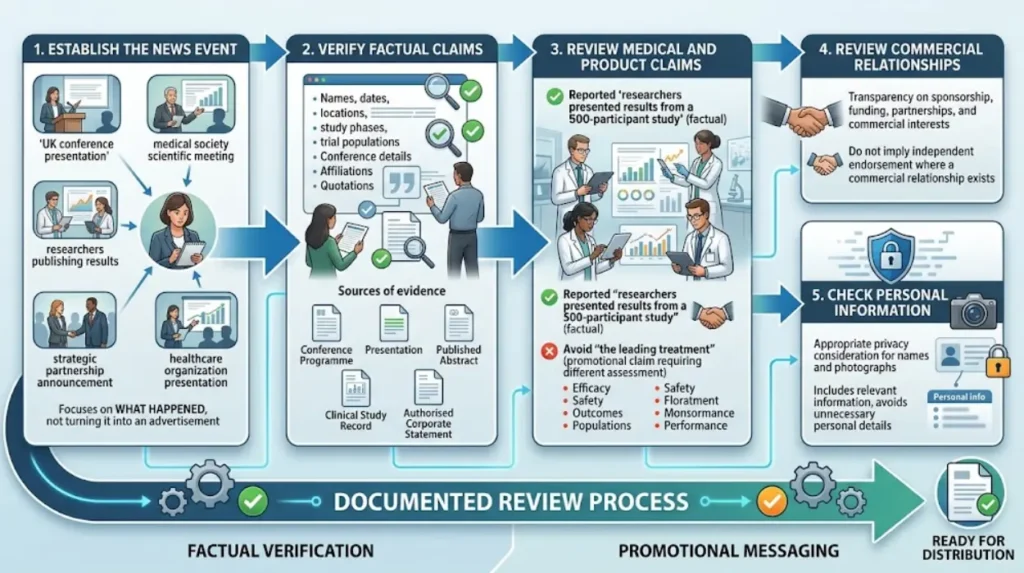
A compliant workflow checks the event facts, medical claims, product references, quotations, personal data, commercial relationships, images, disclosures, and publication format before distribution, creating a documented review process that separates factual verification from promotional messaging.
1. Establish the news event
The first step identifies the factual event.
Examples include:
- A pharmaceutical company presenting new research at a UK conference.
- A medical society hosting a scientific meeting.
- Researchers publishing results discussed during an industry event.
- A company announcing a strategic partnership.
- A healthcare organisation presenting findings at a professional congress.
The article then focuses on what happened rather than turning the event into a product advertisement.
2. Verify factual claims
Names, dates, locations, study phases, trial populations, conference details, affiliations, and quotations require verification.
A press release stating that a company presented results at a conference needs supporting source material. The conference programme, presentation, published abstract, clinical study record, or authorised corporate statement provides evidence for the relevant facts.
3. Review medical and product claims
Medical terminology receives additional scrutiny. Claims about efficacy, safety, treatment outcomes, patient populations, or comparative performance require appropriate evidence.
A compliant article avoids transforming a limited study finding into a broad treatment claim.
For example, reporting that “researchers presented results from a 500-participant study” is factual. Describing the product as “the leading treatment” introduces a promotional or comparative claim requiring a different assessment.
4. Review commercial relationships
Sponsorship, funding, partnerships, and commercial interests require transparency.
If a pharmaceutical company sponsors an event, the coverage needs accurate treatment of that relationship. The article must not imply independent endorsement where a commercial relationship exists.
5. Check personal information
Names and photographs require appropriate privacy consideration. Sensitive personal information receives particular care.
Event coverage does not require unnecessary personal details. The article includes information relevant to the news story and avoids publishing unrelated personal data.
What content creates the highest compliance risk?
The highest-risk areas include unsupported medical claims, exaggerated efficacy statements, misleading comparisons, concealed sponsorship, inaccurate trial descriptions, unverified quotations, inappropriate patient information, and advertising presented as independent editorial reporting.
Unsupported medical claims
Claims require evidence appropriate to their nature. Statements about treatment effectiveness, safety, superiority, or clinical outcomes receive greater scrutiny than basic event facts.
Exaggerated scientific findings
Scientific results require context. An early-stage study does not establish the same evidence level as a completed randomised controlled trial with published results.
Event coverage therefore identifies the study stage and avoids presenting preliminary findings as established clinical conclusions.
Hidden sponsorship
Readers need to understand commercial relationships. Sponsored material requires appropriate disclosure. Editorial independence also requires clear boundaries between a media outlet’s editorial function and an advertiser’s commercial objectives.
Misleading comparisons
Comparative claims require particular care.
Statements such as “more effective than existing treatments” represent a specific comparative assertion. The article requires evidence that directly supports the comparison and accurately defines the population, endpoints, study design, and relevant comparator.
How should pharmaceutical event coverage distinguish news from advertising?
News coverage reports an independently relevant event using factual information, while advertising promotes a product, service, or organisation; distinguishing the two requires appropriate editorial treatment, transparent sponsorship disclosure, controlled claims, and publication formats that do not mislead audiences.
The distinction becomes important when organisations evaluate UK media distribution.
A standard news release can provide factual information to journalists and publishers. A sponsored article follows advertising or commercial-content requirements. A company-controlled webpage operates under a different communication context again.
The same pharmaceutical event can therefore produce several content formats:
- Editorial news report — focuses on verified news.
- Press release — provides source information for media use.
- Sponsored article — carries commercial disclosure.
- Corporate announcement — communicates directly through owned media.
- Advertising material — promotes a product or service under advertising rules.
Understanding these categories prevents communications teams from treating every publication format as equivalent.
Teams evaluating compliant approaches can use:
Pharma Events to examine the broader process behind pharmaceutical event coverage.
What should a compliant UK pharma event release contain?
A compliant release contains a clear event angle, verified facts, accurate scientific context, attributed quotations, transparent commercial relationships, appropriate product terminology, evidence-based claims, relevant source information, and wording that separates legitimate news from pharmaceutical promotion.
Event identification
The headline and opening paragraph identify the event, organisation, location, date, and primary news development.
Scientific context
Scientific claims require enough context to prevent misleading interpretation. Relevant information includes study phase, participant numbers, research setting, endpoints, publication status, or presentation status where applicable.
Accurate quotations
Quotes require approval from the appropriate speaker or source. They retain the speaker’s intended meaning and do not introduce unsupported medical claims.
Clear attribution
The release identifies who conducted research, presented findings, funded a study, or made a statement.
Attribution improves transparency and gives journalists a reliable basis for verification.
Appropriate disclosures
Sponsorship, commercial partnerships, and other relevant relationships receive clear treatment where required.
Controlled product references
Product names and medicinal claims receive particular review. The article does not insert promotional language merely to increase keyword relevance.
How can organisations evaluate different UK pharma media coverage options?
Organisations can evaluate coverage options by checking editorial independence, regulatory review procedures, disclosure practices, publication standards, audience relevance, distribution scope, content control, and reporting transparency before selecting a UK pharmaceutical media coverage approach.
Media distribution options differ in their editorial processes and publication models.
A specialist healthcare publication often has an audience interested in clinical research, pharmaceutical policy, medical technology, or healthcare business. A national news outlet addresses a broader audience. Regional publications provide geographical relevance.
The evaluation process therefore focuses on suitability rather than publication volume alone.
Key questions include:
- What editorial standards govern submitted pharmaceutical content?
- How are medical claims reviewed?
- How are sponsored relationships disclosed?
- Does the publication distinguish editorial content from advertising?
- What evidence supports scientific statements?
- How are quotations and images verified?
- How is personal information handled?
- What reporting confirms where content appeared?
This assessment provides a practical middle stage between understanding compliance principles and selecting a specific distribution solution.
What are the benefits of regulatory discipline in pharma event coverage?
Regulatory discipline improves factual accuracy, transparency, editorial credibility, claim control, privacy management, and publication consistency, while giving pharmaceutical organisations a structured method for communicating legitimate event news without confusing editorial reporting with promotional pharmaceutical advertising.
Compliance supports reliable communication across the publication lifecycle.
Accurate claims reduce factual correction requirements. Transparent sponsorship disclosure protects audience understanding. Evidence-based scientific reporting gives journalists clearer source material. Controlled personal data reduces unnecessary privacy exposure.
Regulatory discipline also improves internal workflows. Communications, medical, legal, compliance, and public relations teams can review defined content elements rather than assessing an entire release without structure.
For example, a pharmaceutical conference announcement can be reviewed through separate checks for event facts, study information, medical claims, commercial relationships, quotations, images, and personal data.
When is compliant pharma event coverage most useful?
Compliant pharma event coverage is most useful for scientific conferences, pharmaceutical research announcements, healthcare partnerships, medical education events, clinical study presentations, corporate milestones, and industry meetings where factual reporting requires clear regulatory and editorial boundaries.
Scientific conferences
Coverage can report presented research, speakers, study findings, and conference developments while preserving scientific context.
Clinical research events
Coverage can explain study presentations using accurate participant, methodology, phase, and outcome information.
Healthcare partnerships
Announcements involving pharmaceutical companies, research institutions, healthcare providers, and technology organisations require clear identification of the parties and the nature of the partnership.
Medical education events
Coverage can report educational sessions, expert speakers, and professional discussions without converting educational information into unsupported product promotion.
Corporate pharmaceutical events
Company milestones, facility developments, investment announcements, and strategic partnerships provide business-news angles that do not require unnecessary medicinal claims.
For organisations assessing publication scale and compliance together,
Pharma Event News Coverage provides a focused route into multi-site UK pharma event coverage.
How can teams maintain compliance after publication?
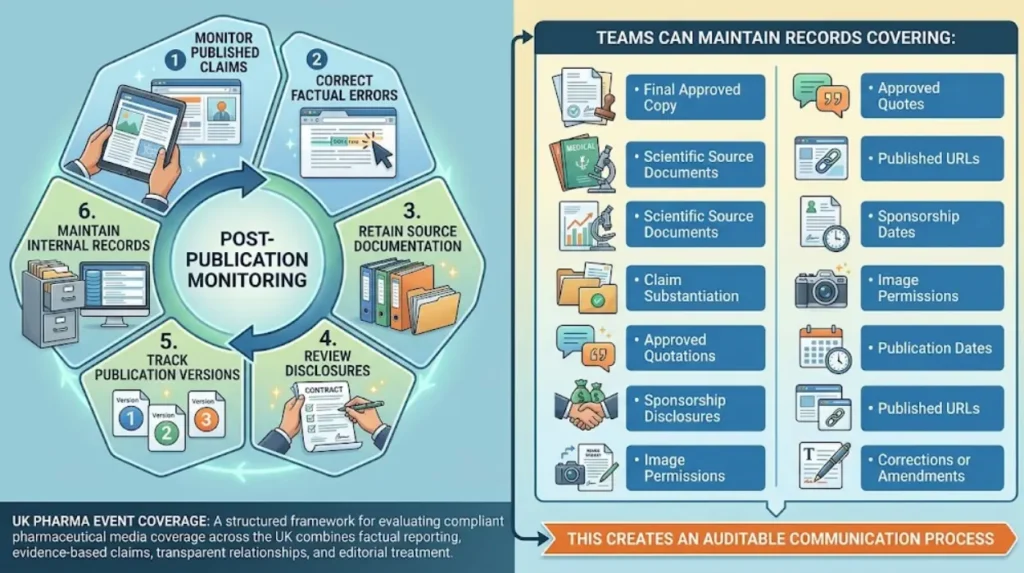
Compliance does not end at distribution; teams maintain standards by monitoring published claims, correcting factual errors, retaining source documentation, reviewing disclosures, tracking publication versions, and maintaining an internal record of approvals and evidence supporting pharmaceutical event communications.
Post-publication monitoring identifies inconsistencies between approved source material and published articles.
Teams can maintain records covering:
- Final approved copy.
- Scientific source documents.
- Claim substantiation.
- Approved quotations.
- Sponsorship disclosures.
- Image permissions.
- Publication dates.
- Published URLs.
- Corrections or amendments.
This creates an auditable communication process.
Explore More Expert Insights:
What a Full Event Coverage Package Includes Across 15 Sites
How Expo Coverage Turns Booths Into 15 News Stories
UK pharma event coverage therefore depends on more than securing media visibility. The core process combines factual reporting, evidence-based claims, transparent commercial relationships, privacy controls, and appropriate editorial treatment. These elements provide a structured framework for evaluating compliant pharmaceutical media coverage across the UK.



