

Pharmaceutical events generate news opportunities across the United Kingdom when their announcements contain verified information, clear public relevance, and responsible health communication. Conferences, medical congresses, product launches, research meetings, industry forums, and healthcare exhibitions each create different editorial angles for UK media.
Compliant pharmaceutical event coverage depends on the relationship between newsworthiness, evidence, regulatory context, and editorial accuracy. A pharma event is not automatically newsworthy because it involves a pharmaceutical organisation. The event content must provide a factual reason for journalists and publications to report it.
Understanding this process helps communication teams distinguish promotional event material from information that supports responsible UK news reporting.
What makes a pharmaceutical event newsworthy in the UK?
A pharmaceutical event becomes newsworthy when it presents verified developments, relevant industry information, credible expert participation, research discussion, policy implications, or significant healthcare issues that provide a legitimate editorial reason for UK media coverage.
Newsworthiness describes the qualities that make information relevant to a publication’s audience. In pharmaceutical communications, these qualities require particular attention because health-related claims affect public understanding.
A pharma event gains stronger editorial relevance when it addresses a defined subject rather than simply promoting attendance. Examples include a discussion of emerging clinical research, a regulatory development, a major healthcare policy issue, or an industry-wide challenge.
Which pharma events commonly attract news interest?
Several event formats generate distinct news angles:
- Medical conferences: Present research findings, clinical discussions, and expert perspectives.
- Pharmaceutical exhibitions: Showcase industry technologies, manufacturing developments, and professional collaboration.
- Healthcare forums: Examine policy, access, regulation, and healthcare delivery.
- Research symposia: Focus on scientific evidence and specialist findings.
- Industry leadership events: Address pharmaceutical markets, operational developments, and sector trends.
The editorial value depends on the information presented at the event rather than the event format alone.
How does UK pharmaceutical regulation affect event news coverage?
UK pharmaceutical news coverage operates within a regulatory environment that prioritises accurate, evidence-based communication and responsible presentation of medicines, healthcare claims, clinical information, and promotional content to protect public understanding.
The UK regulatory environment includes several important entities and frameworks. The Medicines and Healthcare products Regulatory Agency (MHRA) regulates medicines and medical devices in the UK. The Association of the British Pharmaceutical Industry (ABPI) represents innovative pharmaceutical companies and maintains a Code of Practice governing pharmaceutical promotion.
The Human Medicines Regulations 2012 also form an important legal framework for medicines in Great Britain. Promotional communication involving prescription medicines requires particular care because promotional claims have specific regulatory requirements.
Event coverage is not identical to pharmaceutical advertising. Editorial reporting and promotional communications have different purposes. However, information supplied to journalists still requires factual accuracy and careful wording.
What regulatory issues affect pharmaceutical event information?
Key considerations include:
- Accuracy of medicine-related statements
- Evidence supporting scientific claims
- Clear distinction between editorial information and promotion
- Correct presentation of clinical findings
- Appropriate descriptions of medicines and medical devices
- Avoidance of unsupported efficacy or safety claims
- Accurate identification of speakers and organisations
- Appropriate handling of patient information
These considerations influence how an event announcement is prepared before distribution to UK media.
For readers comparing regulatory approaches and communication frameworks,
UK regulatory standards for pharma event coverage provides the next educational stage.
What information needs verification before a pharma event is reported?

Pharmaceutical event information requires verification of dates, venues, speakers, organisations, research references, regulatory statements, product descriptions, statistics, and quotations before publication to maintain factual accuracy and responsible healthcare communication.
Verification creates the factual foundation of compliant event coverage. Every externally supplied detail requires a reliable source.
Basic event information includes the event name, date, location, agenda, participating organisations, and speaker identities. Scientific information requires additional verification because incorrect descriptions can change the meaning of research findings.
Which details require particular attention?
A pharmaceutical event announcement typically requires verification of:
- Event details — date, venue, programme, registration information, and event purpose.
- Speaker information — names, professional positions, affiliations, and relevant credentials.
- Research references — study titles, publication details, datasets, and research status.
- Product information — medicine names, indications, regulatory status, and manufacturer details.
- Statistics — source, date, population, methodology, and numerical accuracy.
- Quotes — speaker identity and exact wording.
- Regulatory claims — regulator name, decision status, approval information, and applicable jurisdiction.
Verification also prevents outdated regulatory information from appearing in event reporting.
How should pharmaceutical event claims be written for UK news audiences?
Pharmaceutical event claims should use precise factual language, identify their evidence, distinguish established findings from ongoing research, and avoid exaggerated conclusions about medicines, treatments, clinical outcomes, or healthcare benefits.
Clear language reduces ambiguity. A statement about a clinical study requires accurate description of what the study demonstrated.
For example, a statement that a study “demonstrated efficacy” carries a different meaning from “investigated efficacy.” The correct wording depends on the evidence and study design.
The same principle applies to regulatory decisions. An event announcement must distinguish between an application, regulatory review, recommendation, authorisation, approval, and commercial availability.
Why does terminology matter?
Pharmaceutical terminology has specific meanings. Terms such as clinical trial, authorised, approved, indication, efficacy, safety, adverse event, and real-world evidence cannot be used interchangeably.
A news announcement that uses these terms accurately gives journalists a clearer factual basis for reporting.
Claims also require appropriate context. A clinical result without information about the study population, endpoint, or research stage provides an incomplete representation of the evidence.
How does the event programme create legitimate news angles?
A pharmaceutical event programme creates news angles by identifying specific discussions, research findings, regulatory developments, expert contributions, policy issues, technological developments, and industry subjects with measurable relevance to UK healthcare audiences.
An event programme contains multiple potential editorial subjects. The strongest angle identifies one specific development rather than presenting the entire event as news.
A conference featuring 20 sessions does not require all 20 sessions to appear in a news announcement. One session containing a significant research discussion can provide a clearer editorial focus.
What event elements can generate coverage?
Examples include:
- New research presented by recognised researchers
- Discussion of pharmaceutical regulation
- Healthcare policy developments
- Pharmaceutical manufacturing innovation
- Drug development trends
- Clinical research findings
- Digital health technologies
- Patient access issues
- Expert analysis of industry developments
- Significant partnerships announced during the event
Each angle requires factual support.
A strong news angle also answers basic journalistic questions: What happened? Who is involved? Where did it happen? When does it happen? Why does it matter? What evidence supports the statement?
How do journalists assess pharmaceutical event announcements?
UK journalists assess pharmaceutical event announcements by examining news value, factual accuracy, evidence, relevance to their audience, regulatory sensitivity, source credibility, timing, and the availability of specific information that supports independent editorial reporting.
Journalists work with limited space and defined editorial priorities. An event announcement therefore needs a clear reason for coverage.
A headline focused only on registration or attendance has limited editorial information. A headline identifying a significant research presentation, policy discussion, or industry development provides a clearer news proposition.
What makes an event announcement easier to assess?
A journalist can evaluate an announcement more efficiently when it contains:
- A specific news angle
- Accurate event information
- Named experts
- Relevant evidence
- Clear research context
- Concise supporting facts
- Verified quotations
- Contact information
- A clear explanation of the event’s subject
This structure separates useful news information from general promotional copy.
What is the difference between pharmaceutical event promotion and news coverage?
Pharmaceutical event promotion encourages attendance or participation, while news coverage reports information with editorial relevance, factual support, and public or professional interest rather than functioning primarily as an advertisement for the event.
Event promotion commonly focuses on registration, ticket availability, sponsorship, speakers, networking, and attendance benefits.
News coverage focuses on developments that have independent information value. A pharmaceutical event can contain both promotional and editorial material, but the two communication purposes remain distinct.
Which content belongs in an editorial news angle?
Editorially relevant content includes research presentations, regulatory developments, expert findings, sector analysis, policy discussions, and significant announcements.
Promotional content includes phrases centred exclusively on urgency, commercial benefits, attendance incentives, or exaggerated claims about an organisation’s importance.
The distinction matters because editorial publications maintain their own standards for relevance and independence.
How does evidence support compliant pharma event coverage?
Evidence supports compliant pharmaceutical event coverage by allowing journalists to verify scientific statements, understand research context, assess numerical claims, identify regulatory status, and distinguish documented findings from unsupported promotional assertions.
Evidence can take several forms. A scientific statement can reference a published study. A regulatory statement can identify an official decision. A statistical claim can identify its source and methodology.
The evidence must correspond directly with the claim.
What types of evidence are relevant?
Examples include:
- Peer-reviewed research
- Clinical trial records
- Official regulatory documents
- Government publications
- Public health statistics
- Academic research
- Recognised industry reports
- Official event documentation
The status of evidence also matters. Preliminary research requires different wording from established clinical evidence. A conference presentation is not automatically equivalent to peer-reviewed publication.
Why is accurate speaker identification important for pharma events?
Accurate speaker identification establishes authority, enables journalistic verification, prevents attribution errors, and gives readers appropriate context about the professional expertise and organisational affiliations behind pharmaceutical event discussions.
Speaker information frequently forms part of event news coverage. Incorrect titles, affiliations, qualifications, or organisational relationships create factual problems.
A speaker’s current professional position requires verification before publication. Organisational names also require consistent treatment.
What speaker details need checking?
Important details include:
- Full name
- Professional title
- Organisation
- Department or specialist area
- Relevant credentials
- Role at the event
- Subject of the presentation
Correct attribution protects the integrity of both the event information and resulting media coverage.
How do timing and context affect UK pharma event coverage?
Timing affects pharmaceutical event coverage because journalists prioritise information according to publication schedules, current healthcare developments, regulatory activity, research announcements, and the relevance of an event to immediate UK news agendas.
Event announcements work within editorial calendars. A conference announcement issued several weeks before an event serves a different purpose from reporting a significant finding presented during the event.
Context also determines relevance. A pharmaceutical event discussing a newly announced regulatory framework has greater immediate relevance when the regulatory development directly affects the sector.
When does event timing become particularly important?
Timing becomes important around:
- Major regulatory decisions
- New research publications
- Healthcare policy announcements
- Significant industry developments
- International medical congresses
- Major pharmaceutical conferences
- Government consultations
Accurate timing prevents event information from becoming outdated before publication.
How does compliant coverage benefit pharmaceutical event communication?
Compliant coverage improves the quality of pharmaceutical event information by combining accurate facts, evidence-based claims, responsible terminology, verified sources, and clear editorial context for UK healthcare and pharmaceutical audiences.
Compliance supports communication quality. It does not guarantee publication because editorial decisions remain independent.
Accurate event coverage also creates a clearer public record of discussions, research presentations, regulatory developments, and industry developments.
For example, coverage of a pharmaceutical conference can explain a new research presentation without presenting preliminary findings as established medical conclusions.
What outcomes does responsible coverage support?
Responsible event reporting supports:
- Better public understanding
- More accurate industry information
- Clearer research communication
- Easier journalistic verification
- Reduced risk of misleading claims
- Stronger factual consistency across publications
- Better distinction between evidence and promotion
These outcomes depend on the quality of the information supplied to media organisations.
Explore More Expert Insights:
7 Reasons Your Event Needs Professional News Coverage
What Expo News Coverage Delivers for UK Brands
What should organisations understand before seeking UK pharma event coverage?
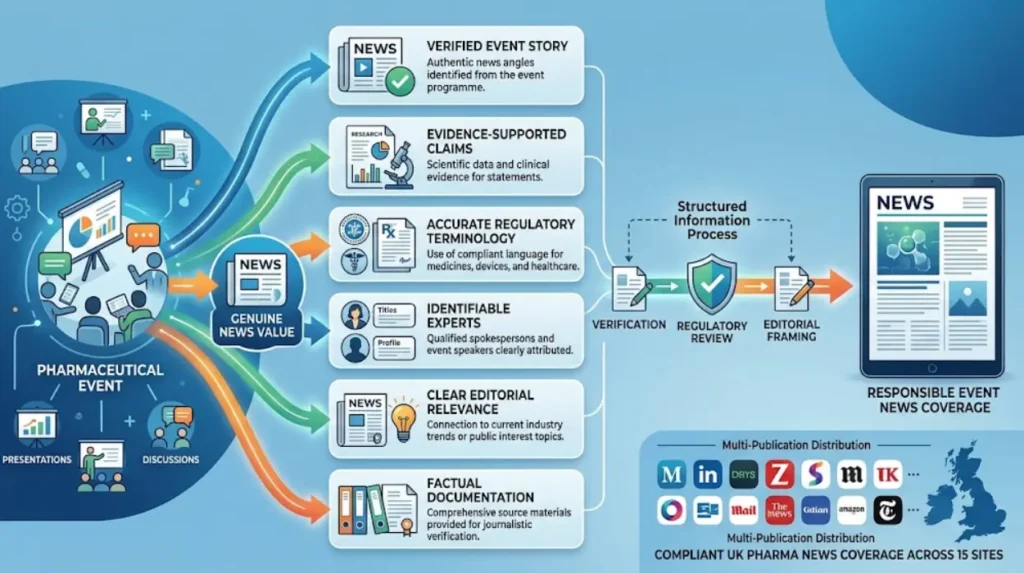
Organisations seeking UK pharmaceutical event coverage need a verified event story, evidence-supported claims, accurate regulatory terminology, identifiable experts, clear editorial relevance, and factual documentation that enables journalists to assess and report the information responsibly.
The process starts with the event itself. A clear programme identifies the subjects that generate genuine news value. Verification then establishes the accuracy of each factual claim.
Regulatory review provides an additional control for medicine, medical device, clinical, and healthcare statements. Editorial framing then converts the verified information into a news-focused narrative.
Pharmaceutical event coverage therefore depends on more than announcing an event. It requires a structured information process that connects newsworthiness, evidence, regulation, accuracy, and editorial relevance.
For readers examining the next stage of multi-publication pharmaceutical event reporting,
Compliant UK pharma news coverage across 15 sites provides a more specific view of publication distribution.
The central principle remains consistent: UK pharmaceutical event news coverage earns credibility through accurate information, appropriate evidence, responsible terminology, and a clear editorial reason for reporting the event.



