
An authoritative press release presents the commercial change, reason, scale, timing, and business impact in a structured format. It gives journalists verified facts first, separates operational details from promotion, and makes the announcement easy to assess quickly and accurately.
Major inventory clearances and business pivots require precise communication. A clearance announcement can involve excess stock, discontinued products, warehouse changes, retail strategy, or a shift in product focus. A pivot announcement can involve new markets, revised operations, product repositioning, or changes in commercial priorities.
The press release layout must reflect these facts clearly.
The first paragraph establishes the announcement. The following sections provide evidence, context, executive commentary, operational details, and contact information.
A structured format also supports media discovery. Journalists often assess multiple announcements during a working day. Clear headlines, concise summaries, factual descriptions, and accessible supporting information reduce the time required to understand a story.
Brands targeting consumer and lifestyle media also need to understand how editorial teams assess product-related information. This connects directly with the wider topic of:
What does an authoritative release communicate?
A strong release answers six core questions:
- What is happening?
- Which products, operations, or markets are affected?
- Why is the change happening?
- When does it take effect?
- What does the change mean for customers or partners?
- Who can provide additional information?
These questions establish the factual foundation before promotional claims appear.
How should the headline communicate a major inventory clearance?
The headline must state the central commercial development using specific language about the inventory clearance, product range, operational change, or strategic pivot. It must identify the organisation and avoid exaggerated claims that obscure the announcement.
The headline is the primary entry point for journalists, search engines, and syndication systems. It needs to describe the actual news.
For example:
UK Homeware Brand Announces Major Inventory Clearance Ahead of Product Range Restructure
This headline identifies the company type, location, action, and strategic context.
A weaker headline would use phrases such as “Huge Savings Event” or “Unmissable Opportunity”. Those phrases describe promotion rather than news.
Which details belong in the headline?
Use details with clear editorial value:
- Inventory clearance
- Product discontinuation
- Range restructuring
- Warehouse consolidation
- Retail channel change
- New market entry
- Manufacturing transition
- Brand repositioning
The headline must remain concise. A practical target is approximately 10 to 16 words.
The subheadline can provide one additional fact. For example, it can identify the number of products affected, the announcement date, or the commercial reason for the change.
What information belongs in the opening paragraph?
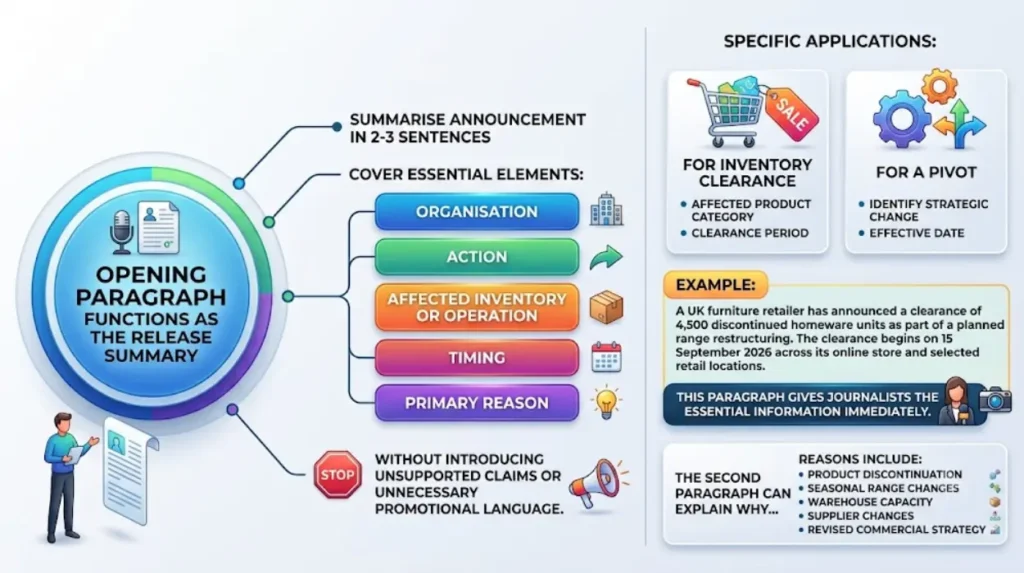
The opening paragraph must summarise the announcement in two or three sentences, covering the organisation, action, affected inventory or operation, timing, and primary reason without introducing unsupported claims or unnecessary promotional language.
The opening paragraph functions as the release summary.
For an inventory clearance, include the affected product category and clearance period. For a pivot, identify the strategic change and its effective date.
For example:
A UK furniture retailer has announced a clearance of 4,500 discontinued homeware units as part of a planned range restructuring. The clearance begins on 15 September 2026 across its online store and selected retail locations.
This paragraph gives journalists the essential information immediately.
The second paragraph can explain why the change is taking place. Reasons include product discontinuation, seasonal range changes, warehouse capacity, supplier changes, or a revised commercial strategy.
Why does specificity matter?
Specific numbers strengthen factual credibility.
Instead of writing “thousands of products”, state “4,500 units”.
Instead of “several stores”, state “12 stores”.
Instead of “a major reduction”, state “a 30% reduction in the active product range”.
Specificity gives journalists usable information and creates clearer search entities around the announcement.
How should the body of the press release explain the clearance or pivot?
The body should explain the operational change in a logical sequence: what changed, why it changed, which products or operations are affected, when implementation occurs, and what customers, retailers, suppliers, or partners need to know.
The body provides the evidence behind the headline.
For an inventory clearance, explain the affected product categories, quantity, sales period, distribution channels, and product status.
For a pivot, explain the previous operating model, the new direction, implementation date, and affected business functions.
What should a clearance section include?
A useful inventory clearance section can include:
- Number of units affected
- Product categories
- Product names or ranges
- Clearance start and end dates
- Sales channels
- Geographic availability
- Stock availability conditions
- Product discontinuation details
For example, a consumer electronics company clearing 8,000 discontinued accessories can identify the affected product families and state whether replacement products remain available.
What should a pivot section include?
A business pivot requires operational clarity.
Include the new market, product category, distribution strategy, customer segment, or commercial model.
For example, a retailer moving from a broad 2,000-SKU catalogue to a focused 600-SKU range needs to explain which categories remain, which categories are discontinued, and when the revised range becomes active.
How should evidence and supporting facts be presented?
Supporting facts must validate the announcement through measurable information, documented changes, dates, quantities, operational details, and relevant market context. Each factual statement must remain specific enough for journalists to verify and reproduce accurately.
Evidence distinguishes an announcement from a promotional statement.
Useful evidence includes sales data, inventory quantities, operational milestones, product counts, store numbers, launch dates, warehouse locations, and documented strategic changes.
A release can also include a short explanation of the commercial context.
For example, a retailer can state that a product line is being discontinued after a scheduled range review. It can then identify the replacement category and implementation date.
Which claims require particular care?
Avoid unsupported claims such as:
- “The UK’s leading clearance”
- “The biggest transformation in the sector”
- “Unprecedented customer demand”
- “Revolutionary retail strategy”
Use measurable facts instead.
“Sales increased by 18% across the category during the previous financial year” provides a verifiable statement when supported by company records.
This approach also improves the information quality available to search engines and AI systems assessing the release.
How should executive quotes strengthen the announcement?
An executive quote should explain the business rationale behind the clearance or pivot, add context unavailable in the factual summary, and identify the intended direction without repeating information already stated in the opening paragraphs or body sections.
A quote provides interpretation rather than duplicate information.
The spokesperson should explain why the change matters to the business.
For example:
“The clearance completes the final stage of our 2026 range review. We are reducing discontinued lines and increasing space for products that align with our revised homeware strategy.”
The quote adds strategic context.
What makes a quote useful?
A strong quote answers one question that the factual sections do not fully answer.
It can address:
- Why the company made the change
- What the new strategy prioritises
- How implementation will proceed
- What customers can expect
- What the change means for future operations
Avoid placing product specifications, prices, dates, or basic inventory numbers inside a quote when those details already appear elsewhere.
How should product and customer information be organised?
Product information must distinguish discontinued inventory from continuing products, identify affected categories clearly, and explain customer-facing conditions such as availability, dates, channels, replacements, refunds, warranties, or delivery arrangements.
Inventory clearance announcements often contain substantial product information. Poor organisation makes this information difficult to extract.
Use short paragraphs or bullet points when several product categories require identification.
For example:
- Furniture: 1,800 units
- Lighting: 1,200 units
- Home accessories: 1,500 units
The release can then explain whether these products are permanently discontinued or temporarily discounted.
Customer-facing information also requires precision. State the applicable dates, sales channels, geographical restrictions, and relevant purchase conditions.
This prevents journalists from publishing incomplete information.
How should the press release close with media and company information?
The closing section should provide the company description, media contact details, relevant website information, announcement date, and supporting resources. It gives journalists a clear route to verification, interviews, imagery, product information, and additional factual material.
The final section creates an efficient media reference point.
A standard structure includes:
About the company
Provide two or three sentences describing the organisation, sector, location, core products, and established business activity.
Media contact
Include:
- Contact name
- Job title
- Email address
- Telephone number
- Company website
Supporting resources
Relevant assets include product photographs, executive headshots, logos, product specifications, fact sheets, and corporate information.
These resources support journalists preparing articles after reviewing the release.
Which press release layout works best for major retail pivots?
The most effective layout follows a fixed sequence: headline, subheadline, dateline, opening summary, supporting facts, operational explanation, executive quote, product or customer information, company background, media contact, and supporting resources.
This structure keeps the news at the top and supporting information below it.
A practical layout is:
- Headline
- Subheadline
- Dateline
- Opening paragraph
- Business rationale
- Inventory or operational details
- Executive quote
- Customer or partner information
- Additional facts
- About the company
- Media contact
- Supporting resources
The same structure works across retail, consumer goods, fashion, homeware, electronics, beauty, food, and other consumer categories.
For larger campaigns, the release can also connect with relevant retail and consumer syndication networks when broader distribution is part of the communications strategy. More detailed evaluation of:
Retail and consumer syndication networks belongs at the decision stage.
How can brands improve the release before distribution?
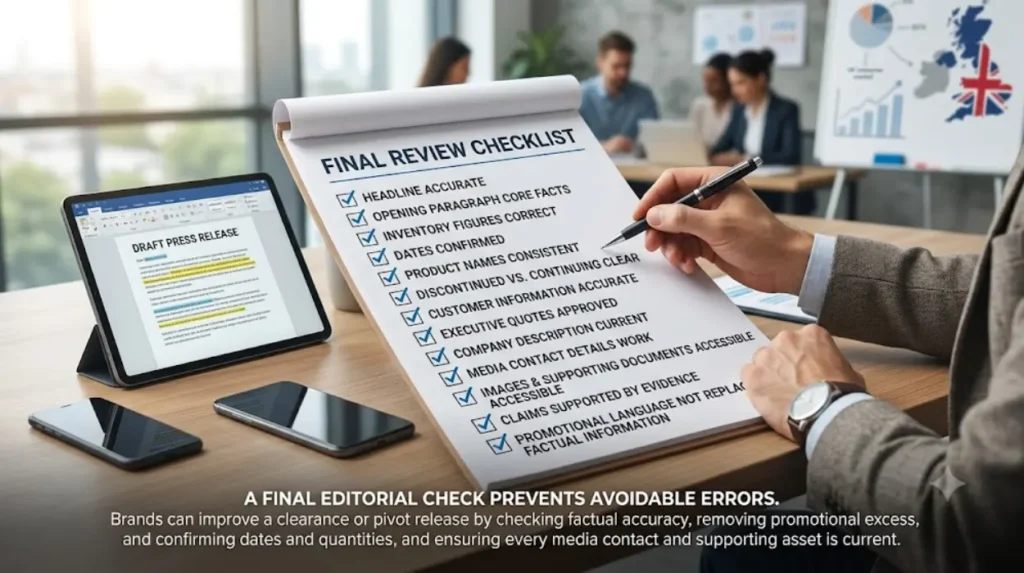
Brands can improve a clearance or pivot release by checking factual accuracy, removing promotional excess, confirming dates and quantities, validating executive quotes, reviewing customer information, and ensuring every media contact and supporting asset is current.
A final editorial check prevents avoidable errors.
What should the final review confirm?
Check these elements before distribution:
- Headline accurately describes the announcement.
- Opening paragraph contains the core facts.
- Inventory figures are correct.
- Dates are confirmed.
- Product names are consistent.
- Discontinued and continuing products are clearly separated.
- Customer information is accurate.
- Executive quotes are approved.
- Company description is current.
- Media contact details work.
- Images and supporting documents are accessible.
- Claims are supported by evidence.
- Promotional language does not replace factual information.
Explore More Expert Insights:
Maximizing Post-Launch Momentum: Turning Product Syndication into Long-Tail Search Traffic
Designing a Press Distribution Strategy for Strategic Co-Branded Retail Partnerships
A release built around these principles provides journalists with usable information from the first paragraph through to the contact section.
For major inventory clearances and strategic pivots, the layout is not simply a formatting decision. It determines how efficiently the announcement communicates its news value, supporting evidence, operational implications, and relevance to the UK consumer market.