
Banner advertising is a digital display ad format that uses static or animated visuals placed on web pages or apps to drive awareness and clicks to a game download page; it delivers measurable impressions, clicks, and click-through rates.
Banner advertising is a defined, visual ad unit served on websites, mobile apps, and in-app inventories. A banner contains an image, short headline, and a click target linking to an app store listing or landing page. Ad servers deliver banners to specific placements based on targeting rules. Tracking pixels and SDKs record impressions, clicks, installs, and post-install events for attribution.
Banner delivery uses real-time bidding or programmatic direct buys. Inventory is priced by CPM (cost per 1,000 impressions), CPC (cost per click), or CPA (cost per acquisition). Mobile banners use formats such as leaderboards, medium rectangles, and mobile banners sized for device screens. Desktop banners use standard web sizes. Creative files follow technical specifications: file size limits, allowed formats (JPEG, PNG, GIF, HTML5), and maximum animation length.
How do gaming companies structure banner campaigns to increase downloads?
Campaigns use segmented audience targeting, phased creative rotations, and optimised bid strategies to move users from awareness to the app store and generate installs at defined cost thresholds.
Campaign structure begins with audience definition by demographics, device type, geography, interests, and app affinity. Budgets allocate to awareness and performance phases. Creative rotation tests multiple visuals and messages. Measurement layers assign conversion windows and attribution windows, typically 7-day click and 24-hour view. Bid strategies select either CPM to maximise reach or CPA to optimise installs.
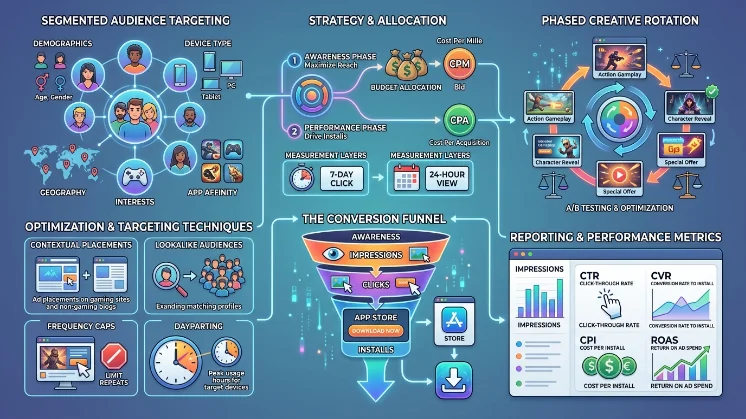
Targeting includes contextual placements on gaming content and non-gaming sites with high engagement. Lookalike audiences replicate profiles of existing high-value players. Frequency caps limit repeated exposures to reduce ad fatigue. Dayparting places higher bids during peak usage hours for target devices. Reporting uses key metrics: impressions, CTR (click-through rate), CVR (conversion rate to install), CPI (cost per install), and ROAS (return on ad spend).
What creative elements in banners drive higher download rates?
High-performing banners use clear visuals, concise headlines, a prominent value point, and a clickable call area that links directly to the store listing, tested across multiple variants for statistical lift.
Visuals show core gameplay, a main character, or an app interface screenshot sized for legibility on mobile. Headlines use 3–6 words that state the main hook, such as “Free PvP Battles” or “New Puzzle Levels.” Value points quantify benefits, for example “100+ Levels” or “Join 5M Players.” Animation length stays under 15 seconds and loops once. Colors use contrast to increase visibility; buttons use distinct colors with 44×44 px tap targets for accessibility.
A/B tests compare static versus animated creatives, different headlines, and alternative value propositions. Creative performance segments by placement and device. Best-performing creatives guide subsequent production. All creative assets include brand-safe content and follow platform advertising policies.
Which targeting methods produce the most installs from banner ads?
Targeting methods that combine demographic filters, contextual relevance, and behavior-based lookalikes produce the highest install volumes when monitored and refined by performance data.
Demographic targeting includes age ranges and region. Device targeting separates iOS and Android for optimised store links. Contextual targeting matches banners to pages about mobile games or genre-specific content. Behavioral targeting relies on prior app usage signals, such as recent game installers. Lookalike targeting uses seeded lists of high-LTV players to find similar users. Retargeting reaches users who clicked but did not install or who installed but did not complete onboarding.
Attribution links correlate creative, placement, and targeting to install events. Teams set target CPIs and adjust bids toward placements that hit those thresholds. Exclude lists prevent ads from showing to current users to avoid wasted spend.
How do measurement and attribution ensure banners increase downloads?
Measurement uses deterministic tracking and probabilistic signals to attribute installs, compare CPIs, and evaluate downstream retention and revenue metrics across a defined attribution window.
Install tracking uses SDK integration with attribution partners to record click-to-install and view-to-install paths. Conversion windows often use 7-day click and 1-day view windows. Deterministic attribution links a click ID to an install event. Probabilistic modeling supplements where deterministic data is limited. Key performance indicators include CPI, CTR, CVR (click-to-install), D1 and D7 retention rates, ARPDAU (average revenue per daily active user), and LTV (lifetime value) at 30 and 90 days.
Reporting dashboards segment performance by campaign, creative, placement, and audience. Statistical significance tests evaluate creative changes. Cohort analysis measures retention and revenue per install cohort to ensure installs convert into paying players.
What bid and budget strategies lower cost per install?
Budget pacing, automated bidding toward target CPIs, and allocation shifts from low-performing placements to high-converting placements lower CPI while preserving scale.
Start with test budgets across multiple placements to gather performance data. Use automated bid strategies that optimise for installs at a target CPI. Set daily caps per placement to control spend. Reallocate funds weekly from placements with CPI above target to placements with CPI below target. Implement manual bid overrides for high-value placements during peak hours. Use bid multipliers for device types or regions with higher conversion rates.
Maintain a reserve budget for scaling winners. Monitor frequency to avoid diminishing returns. Apply creative refresh every 7–14 days for campaigns running over 30 days to sustain CTRs.
What campaign components affect download quality and retention?
Download quality depends on user acquisition targeting, landing page alignment, onboarding experience, and post-install engagement flows tracked by retention and revenue metrics.
Targeting that prioritises high-intent users produces higher-quality installs. Landing pages and store listings must match banner creative messaging and visuals to set correct expectations. Onboarding flows inside the app must minimise time-to-first-play and highlight core loops. Post-install push notifications and tutorial prompts drive initial engagement. Measure D1, D7, and D30 retention to evaluate quality. High LTV cohorts require higher CPI thresholds; allocate more budget to channels that deliver such cohorts.
Explore More Expert Insights:
How Film Studios Drive Movie Buzz Using Banner Ads
How TV Channels Boost Viewership Using Display Campaigns
What are practical use cases where banners effectively increase game downloads?
Banners increase downloads for new game launches, seasonal event promotions, and re-engagement pushes that bring lapsed players back to updated content.
For a new game launch, banners build initial awareness by driving high impressions across genre-relevant placements. Seasonal event promotions use limited-time creative to lift short-term installs for in-event monetisation. Re-engagement banners target previous installers with new content updates and link to deep-linked store pages or app open intents. Each use case uses targeted creative and measured attribution to compare CPI and retention outcomes.
How do teams optimise banner campaigns over time?
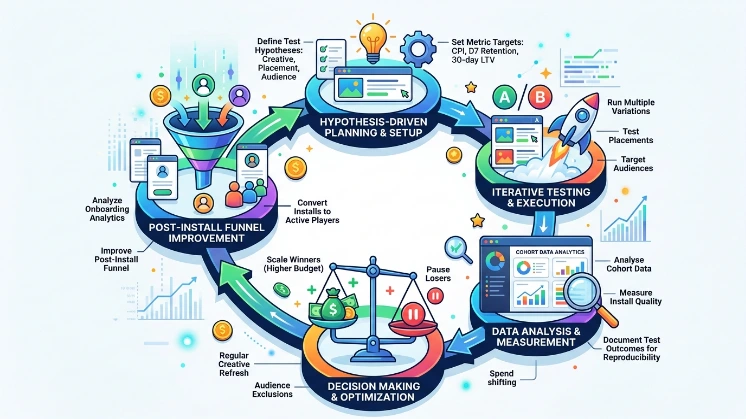
Teams run iterative tests, analyse cohort data, and shift spend toward placements and creative that show sustained CPI, retention, and revenue metrics above defined thresholds.
Optimisation begins with hypothesis-driven tests on creative, placement, and audience. Teams set metric targets for CPI, D7 retention, and 30-day LTV. They pause underperforming segments and scale winners. Regular creative refresh and audience exclusions maintain efficiency. Post-install funnels receive improvements based on onboarding analytics to convert installs into active players. Documentation records test outcomes for reproducibility.
For More Details, Explore:
How Gaming Companies Build Player Interest Using Banner Campaigns
Banner advertising is a structured, measurable channel that gaming companies use to increase downloads through targeted delivery, creative testing, bid optimisation, and strict measurement of install quality. Campaigns succeed when targeting, creative, landing experience, and post-install engagement align and when teams continuously optimise using concrete performance thresholds.
For More Information, Explore:
Gaming Banner Ads That Turn Interest Into Active Player Conversions