A film trailer ad is a short video clip used to promote a movie across digital channels; it focuses on key scenes, runtime, and release details to drive ticket purchases. A film trailer ad uses edited footage from the film, a soundtrack, and on-screen text to communicate genre, tone, cast, runtime, and release date. This format runs on platforms such as streaming services, social media feeds, connected TV, and cinema pre-roll. Traditional advertising includes static posters, radio spots, TV commercials longer than 30 seconds, and print ads. Trailer ads concentrate on cinematic content and emotional hooks; traditional ads often prioritise broader brand messages or multi-product campaigns.
Components that define a trailer ad include a hook (5–10 seconds), narrative beats (15–60 seconds), call-to-action elements (ticket links, release date), and platform-specific versions (6s bumper, 15s mid-roll, 30s social cut). A clear definition enables teams to measure reach, view-through rate, and conversion to ticket sales.
How do studios measure the effectiveness of trailer ads for box office conversions?
Studios measure trailer ad effectiveness using view-through rate, click-through rate, ticket conversion rate, and incremental revenue attributed to the ad. Measurement uses deterministic and probabilistic attribution. Deterministic attribution links ad clicks to ticket purchases when users click directly to a ticketing page and complete checkout. Probabilistic attribution models correlate exposure and sales when direct clicks are absent, using aggregated audience signals and time-series analysis.
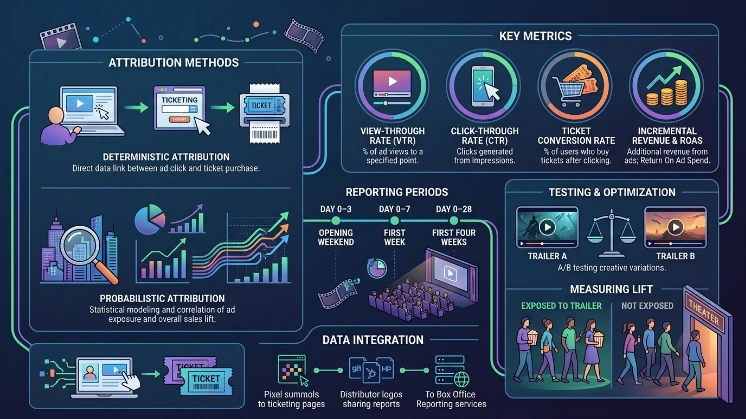
Key metrics include view-through rate (VTR), completion rate, click-through rate (CTR), cost per conversion, and return on ad spend (ROAS). Studios run A/B tests on creative variations and track lift by comparing exposed and unexposed cohorts. Reporting periods typically span opening weekend (Day 0–3), first week (Day 0–7), and first four weeks. Accurate measurement requires pixel placement on ticketing pages, partner reporting from distributors, and integration with box office reporting services.
What is the process for creating a trailer ad campaign that drives ticket sales?
The process includes audience definition, creative production, platform selection, testing, and scaling based on performance data. First, teams define target audiences by genre, age bracket, and location. For the United Kingdom, studios segment by region (England, Scotland, Wales, Northern Ireland), city tiers, and cinema chains. Next, creative teams produce multiple cuts: 6-second bumpers, 15-second social edits, 30-second flagship trailers, and 60-second extended trailers for premium placements. Each cut contains specific messaging: release date and ticket link for 6–15s, plot hook and star names for 30–60s.
Platform selection follows audience mapping. Connected TV and streaming reach broad audiences during prime viewing hours. Social feeds target younger demographics with short cuts and interactive formats. Programmatic video buys target intent signals and contextual placements. Testing uses controlled experiments: creative A/B tests, audience splits, and frequency capping experiments. Performance data informs scaling decisions; high-converting creative receives increased spend and premium placements for peak weekend exposure.
Which creative elements increase conversion from trailer ads to ticket purchases?
Clear release dates, direct ticketing links, star recognition, and emotionally charged scenes increase conversion rates. Release dates and ticket links reduce friction between interest and purchase. Star recognition functions as a trust signal and drives initial consideration. Emotional scenes that convey stakes and genre clarity motivate viewers to act. Short captions with explicit calls such as “Buy tickets for release date” guide user behavior. Sound design and pacing influence completion rates; trailers with music peaks aligned to visual beats maintain attention through the CTA.
Different edits serve different intents: punchy 6–15 second cuts create awareness; 30–60 second cuts deepen intent with plot context; extended trailers or TV spots support premium placements and repeat exposure. Each creative must include a final frame with ticketing URL, cinema listings, or QR code for in-theatre promotions.
Discover the Full Information:
How Film Studios Drive Movie Buzz Using Banner Ads
How do studios select channels and placements to maximise ticket sales in the UK?
Studios select channels by matching audience segments to platform reach, using connected TV, social platforms, programmatic video, and cinema pre-roll as primary placements. Connected TV provides large-screen engagement and high viewability during prime-time hours. Social platforms deliver scalable reach with demographic targeting for ages 16–34. Programmatic video secures contextual inventory across news, lifestyle, and entertainment sites, focusing on impression quality metrics. Cinema pre-roll captures active moviegoers and drives same-day ticket purchases. Out-of-home digital signage supports local awareness near cinemas.
Channel mix depends on budget, target demo, and release window. For wide releases, studios allocate at least 25–40% of digital spend to connected TV and 20–30% to social formats. Programmatic video and search-retargeting capture mid-funnel intent. Timing concentrates high-frequency exposure during the two weeks before release and spikes on opening weekend.
What role does targeting and segmentation play in trailer ad performance?
Precise targeting reduces wasted impressions and increases conversion by matching creatives to audience preferences and purchase intent. Segmentation uses demographic data, behavioural signals, and past cinema attendance. Demographic segments include age groups (16–24, 25–34, 35–49, 50+). Behavioural segments include fans of specific genres, followers of lead actors, and users who recently engaged with movie-related content. Location-based targeting ensures regional availability and cinema proximity. Frequency caps prevent overexposure; recommended caps run between 3–8 impressions per week per user before release.
Retargeting converts engaged viewers into ticket buyers. Viewers who watch 50% or more of a trailer enter a retargeting pool. Retargeting ads present direct ticket links and local showtimes. Studios use lookalike audiences to expand reach to users with similar viewing patterns as known ticket buyers.
What are the legal and distribution considerations for trailer ads in the UK?
Studios must secure rights clearance, classification compliance, and distributer agreements for all ad assets before running campaigns. Rights clearance covers music, actor likenesses, and third-party footage. The British Board of Film Classification (BBFC) and advertising standards regulate content and age-appropriate messaging. Ads that include age-restricted content must use platform age-gating controls and comply with Advertising Standards Authority (ASA) rules on harmful or misleading content.
Distribution agreements with cinema chains and digital platforms define permitted ad formats, pre-roll lengths, and scheduling. Ticket retailers require tracking parameters and may apply fees for direct linking. Studios must log impressions and conversions per contractual reporting standards.
What are proven measurement strategies that tie trailer ads to box office revenue?
Combine deterministic tracking with lift studies and controlled geo-tests to attribute incremental box office revenue to trailer ads. Deterministic tracking uses click-to-ticket pathways and tracking pixels on ticketing pages. Lift studies compare exposed and unexposed population cohorts over the opening weekend to measure incremental ticket sales. Controlled geo-tests run campaigns in selected regions while holding other regions as control, then compare regional box office performance. Time-series models assess pre- and post-campaign trends while controlling for other marketing activity.
Reporting integrates ad platform metrics with box office reporting. Studios report ROI as incremental gross box office revenue divided by media spend for the campaign window, typically Day 0–7.
Explore More Expert Insights:
TV Channel Ads That Turn Program Interest Into Viewer Conversions
Streaming Display Ads That Convert Watch Intent Into Active Users
What outcomes should studios expect from high-performing trailer ad campaigns?
High-performing campaigns increase opening-weekend box office revenue, improve seat-fill rate for opening shows, and lower cost per ticket sold. Expected outcomes include measurable lift in weekend box office, higher advance ticket sales, and increased online showtime searches. Performance benchmarks depend on film scale: for wide releases, studios target a 5–20% uplift in opening-weekend revenue attributable to digital trailer ads. Cost per ticket targets vary by market and are lower for strong IP and star-led films.
Examples include regional campaigns that increase evening show occupancy or targeted retargeting that converts engaged viewers into advance ticket purchases. Studios allocate budget dynamically to maximise these outcomes as data arrive.
How should marketing teams optimise trailer ad campaigns during the release window?
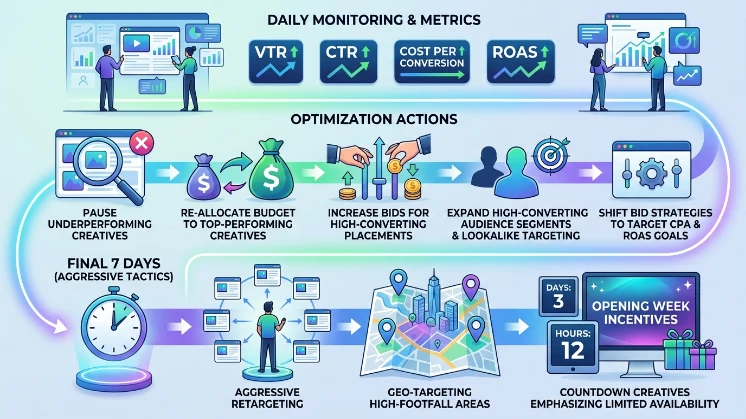
Optimise by re-allocating budget to top-performing creatives, increasing bids for high-converting placements, and applying aggressive retargeting in the final 7 days. Teams monitor VTR, CTR, cost per conversion, and ROAS daily during the release window. Underperforming creatives pause after clear statistical underperformance. High-converting audience segments receive expanded budgets and lookalike targeting. Bid strategies shift to target CPA or ROAS goals on platforms that support those models. Final week tactics include geo-targeting high-footfall areas and showing countdown creatives that emphasise limited availability or opening-week incentives.
Learn Everything About It Here: