
A banner campaign uses static or animated visual ads placed across websites and apps to deliver targeted messages to potential players. Banner campaigns display creatives, call-to-action text, and tracking pixels to drive awareness, clicks, and installs. They run on demand-side platforms (DSPs), ad exchanges, and publisher networks with defined targeting parameters.
Banner campaigns function through three core steps. First, advertisers create ad creatives sized to standard formats (for example 300×250, 728×90, 320×50). Second, advertisers set targeting: demographics (age 18–45), interests (mobile gaming, consoles), geolocation (United Kingdom regions), and contextual inventory. Third, programmatic systems bid in real time to display the banner to relevant users. Tracking pixels and SDKs record impressions, clicks, and installs for attribution.
Key entities: creatives are image or HTML5 files; ad servers deliver creatives and record impressions; DSPs manage bids and budgets, attribution providers match installs to ad events. Real examples include campaigns using 300×250 banners on mainstream news sites and 320×50 banners inside mobile ad placements.
How do banner campaigns target potential players?
Banner campaigns target players using demographic filters, interest signals, device data, and behavioral retargeting. Advertisers select demographics such as age and gender, specify device types (Android or iOS), and apply interest categories like “strategy games” or “puzzle games.” Contextual targeting places banners on content-relevant pages, for example gaming news on UK websites. Behavioral targeting uses prior web activity and app usage to find high-intent users. Retargeting shows banners to users who clicked but did not install, or to previous players for reactivation.
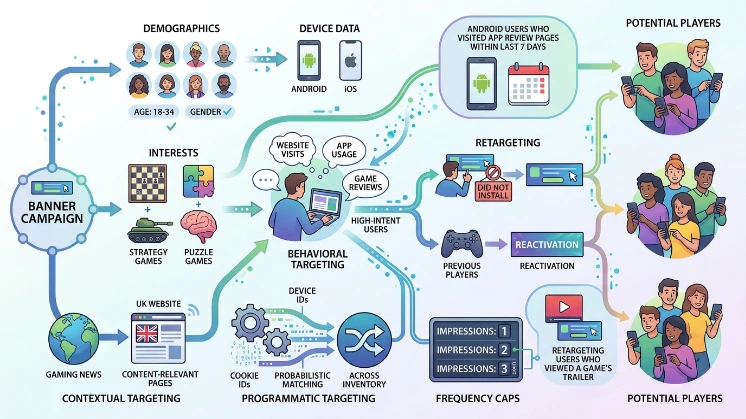
Programmatic targeting uses cookie IDs, device IDs, and probabilistic matching to reach users across inventory. Frequency caps limit ad exposure per user, for example 3 impressions per day, to prevent fatigue. Real examples include targeting Android users who visited app review pages within the last 7 days, and retargeting users who viewed a game’s trailer.
What creative elements increase player interest in banner ads?
Effective banner creatives combine concise headlines, strong visuals, readable fonts, and clear value statements within the visual frame. Headlines use direct language such as “Free to Play” or “Join 10M Players.” Visuals show gameplay action, character portraits, or interface snapshots sized to the ad format. Use text overlays under 10 words to remain legible on mobile. Include quick visual cues of progression, rewards, or social features. Use localized language and culturally relevant visuals for the United Kingdom when appropriate.
A creative set often includes multiple sizes and versions for A/B testing. Tracking performance by creative variant reveals which elements drive the highest click-through rates (CTR) and install conversion rates. Real examples include a 728×90 banner showing a key in-game reward image and a 320×50 banner showing a bold numeric reward like “+100 Gems.”
How do banner campaigns measure and attribute player interest?
Banner campaigns measure interest through impressions, clicks, click-through rate, installs, and post-install events tracked by ad tags and SDKs. Impressions indicate reach; clicks measure direct engagement; CTR equals clicks divided by impressions. Install attribution links installs to ad clicks or view-through events using an attribution window, for example 7 days for click-throughs and 1 day for view-throughs. Post-install events such as registration, first purchase, and level completion measure user quality. Cost metrics include cost per mille (CPM), cost per click (CPC), and cost per install (CPI).
Attribution systems match ad events with store installs using device identifiers and hashed data. Fraud detection filters invalid installs and click injection. Real examples show campaigns optimising toward a 30-day retention metric or a specific cost-per-acquisition KPI.
What campaign structures convert interest into downloads?
Campaigns convert interest into downloads by layering awareness placements, targeted prospecting, and retargeting sequences tied to optimized creatives and attribution data. Start with broad awareness placements to build reach, then run prospecting segments using lookalike audiences derived from high-value players. Use contextual placements on gaming and entertainment sites for relevance. Implement retargeting sequences for users who engaged but did not install. Sequence creatives to move users along the funnel: initial teaser banners, mid-funnel feature banners, and final conversion banners with install prompts.
Budget allocation often follows a ratio such as 40% prospecting, 40% retargeting, and 20% awareness testing. Real examples include a campaign that used initial 300×250 banners on news sites, followed by targeted 320×50 mobile banners for users who clicked a trailer.
How do banner campaigns use A/B testing and optimisation?
Banner campaigns test creatives, messaging, placements, and bid strategies, and they optimise by shifting budget to top performers based on statistically significant results. Run controlled A/B tests comparing two creative variants while holding targeting and bid constant. Measure primary metrics such as CTR and CPI, with significance thresholds set at a 95% confidence level when sample sizes exceed predetermined minimums. Optimise by pausing low-performing creatives, reallocating budget, and scaling placements with lower CPI and higher retention. Use dayparting to schedule ads during peak engagement hours, for example 18:00–22:00 local time for UK mobile users.
Optimisation includes creative refreshes every 14–21 days to reduce banner fatigue. Real examples include iteratively replacing static images with short HTML5 animations that increased CTR by a measurable percentage.
What are the main technical components required for banner campaigns?
Technical components include creatives in standard ad sizes, an ad server, a demand-side platform (DSP), tracking pixels or SDKs, and an attribution provider. Creatives must follow IAB standards such as 300×250 and 320×50. Ad servers host creatives and record impressions. DSPs manage bids across exchanges and programmatically place ads. Tracking pixels fire on impressions and clicks. Mobile SDKs record installs and in-app events. Attribution providers consolidate data, match ad events to installs, and report performance.
Additional components include fraud detection services, data-management platforms for audience segments, and analytics dashboards for reporting. Real examples include using an attribution provider to match ad clicks with App Store installs and an ad server to A/B test creative variants.
Explore More Expert Insights:
How Film Studios Nurture Audience Hype Using Trailer Ads
How TV Channels Build Program Interest Using Banner Advertising
What benefits do banner campaigns provide to gaming companies?
Banner campaigns drive measurable increases in awareness, website visits, app installs, and first-time registrations with controlled spend and scalable reach. They deliver predictable impressions and clicks across targeted inventory. Banner campaigns provide rapid testing of messaging with direct performance metrics. They enable geographic targeting across UK regions and device-level optimisation for mobile platforms. Campaigns support lifecycle marketing by enabling retargeting and re-engagement for existing players.
Measured outcomes include changes in install volume and CPI, uplift in organic searches following awareness pushes, and quantified retention improvements when campaigns target high-intent segments. Real examples include an increase in daily installs after a focused retargeting burst tied to a new feature launch.
How do gaming companies use banner campaigns across specific use cases?
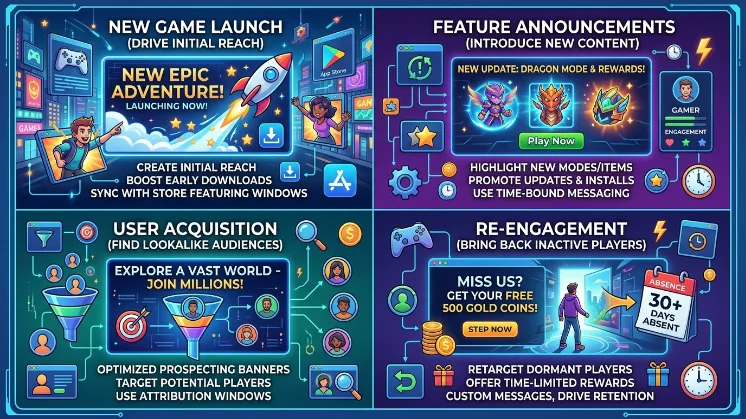
Gaming companies deploy banner campaigns for launches, feature announcements, user acquisition, and re-engagement of dormant players. For launches, banners create initial reach and drive early downloads. For feature announcements, banners highlight a new mode or reward and direct users to update or install. For user acquisition, optimised prospecting banners target lookalike audiences. For re-engagement, retargeting banners offer time-limited rewards to return inactive players.
Each use case uses tailored creatives, time-bound messaging, and attribution windows aligned to the campaign goal. Real examples include launch banners timed with store featuring windows and re-engagement banners offering in-game currency to users absent for 30+ days.
Learn More Here:
How Gaming Companies Increase Downloads Using Banner Advertising
Banner campaigns are structured, measurable systems that use creatives, programmatic targeting, and attribution to build player interest and convert that interest into downloads. They operate through defined technical components and testing frameworks and support multiple campaign objectives including launches, acquisition, and reactivation.
For conversion-focused creative examples see the following:
Gaming Banner Ads That Turn Interest Into Active Player Conversions