Display campaigns are targeted digital banner and rich-media ads placed across websites and apps to raise awareness and drive audience interest in TV programming. Display campaigns use visual creatives, targeting signals, and frequency controls to show ads to selected user groups across the open web and programmatic networks.
Display campaigns are digital advertising efforts that rely on image, GIF, HTML5, or video-in-banner formats. TV channels use them to introduce schedules, promote episodes, and highlight presenters. Core components include creative assets (static or animated banners), targeting parameters (demographics, interests, and contextual signals), delivery platforms (ad exchanges and demand-side platforms), and measurement tags (impression, viewability, and click trackers). Display campaigns run alongside other digital channels such as social, connected TV (CTV), and search advertising to form a coordinated awareness push.
How do display campaigns increase program awareness?
Display campaigns increase awareness by delivering high-frequency, targeted ad impressions to audiences before and during a show’s launch window. Campaigns concentrate impressions around key dates such as premiere weeks and schedule changes to build recognition and recall.
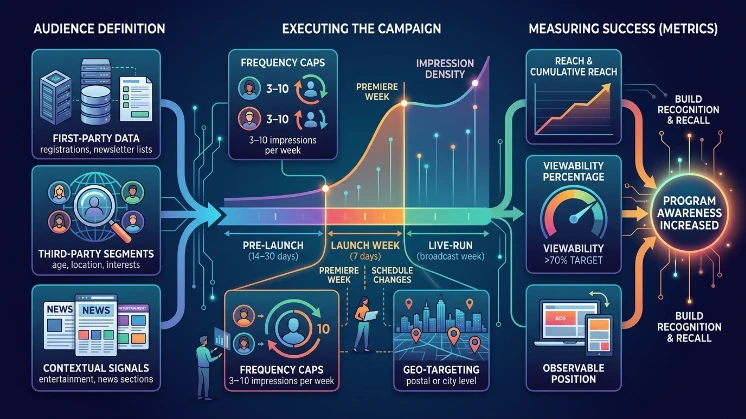
The process begins with audience definition. TV channels identify viewership profiles using first-party data (registrations, newsletter lists), third-party segments (age, location, interests), and contextual signals (entertainment, news sections). Next, channels set campaign windows: pre-launch (14–30 days), launch week (7 days), and live-run (broadcast week). Frequency caps ensure each user sees ads a set number of times, commonly 3–10 impressions per week. Performance metrics focus on reach, cumulative reach, and viewability percentage. High viewability rates (above 70%) indicate impressions were in an observable position on the page. Campaigns also use geo-targeting at postal or city level, useful for region-specific channels or broadcasts.
What targeting methods do channels use in display campaigns?
Channels use demographic, contextual, behavioural, and device targeting to place creatives in front of audience segments most likely to engage. Targeting combines data sources and algorithms to match ad placements with user intent signals and content context.
Demographic targeting segments by age groups (e.g., 18–24, 25–34, 35–54), gender, and household income bands. Contextual targeting places ads on pages related to TV listings, entertainment news, and relevant genres such as comedy or drama. Behavioural targeting relies on signals like recent searches, site visits, and content consumption patterns. Device and environment targeting separate desktop, mobile, and connected-TV environments to tailor creative sizes and formats. Lookalike targeting expands reach by finding users with similar attributes to known viewers. Geo-targeting limits delivery to defined regions; for UK campaigns this often uses county or city boundaries such as Greater London or Manchester. Time-of-day targeting concentrates impressions during peak planning hours (evenings 18:00–22:00) and morning schedule-check windows (07:00–09:00).
What creative formats drive the best response?
High-contrast static banners, animated HTML5, and video-in-banner formats drive initial attention and higher engagement for TV promos. Creatives that clearly show program title, broadcast time, and channel logo produce measurable lift in recall metrics.
Static images deliver fast load times and broad compatibility across ad environments. HTML5 animated creatives enable richer storytelling with brief motion sequences and can include countdowns to premieres. Video-in-banner offers short trailers or highlight clips of 6–15 seconds, optimised for muted autoplay with captions. Size standards follow IAB guidelines; commonly used sizes include 300×250, 728×90, 970×250, and responsive fluid formats for mobile. Creative rotation prevents ad fatigue; channels typically rotate 3–5 variations per placement. Tracking pixels and viewability tags attach to creatives for third-party verification of impression quality.
How do channels measure campaign success?
Channels measure success with reach, frequency, viewability, brand lift surveys, and digital engagement metrics such as clicks and on-site session increases. Measurement combines ad-server data, third-party verification, and audience panels to assess both exposure and audience intent.
Primary metrics include unique reach (number of distinct users exposed), frequency (average impressions per user), and viewability rate (percentage of impressions meeting viewability thresholds, commonly 50% in-view for one second for display). Secondary metrics include click-through rate (CTR), landing page sessions, and time on site following ad exposure. Brand lift studies use pre- and post-exposure surveys to quantify changes in awareness, interest, and intent to watch. Incrementality tests split audiences into exposed and control cohorts to isolate campaign impact on viewing behaviour. For linear conversions, channels correlate ad exposure windows with uplifts in live tune-in or streaming starts during broadcast windows.
Must-Read Detailed Guide:
How TV Channels Build Program Interest Using Banner Advertising
How do channels integrate display campaigns with broadcast and digital strategy?
Channels align display campaigns with broadcast schedules, social promotion, and on-demand placements to create a unified promotional wave. Integration ensures consistent messaging across paid, owned, and earned channels and drives coordinated audience responses.
The integration process begins with shared timelines and creative assets across teams. Creative themes, taglines, and imagery stay consistent across TV spots, display banners, and social posts. Program-specific landing pages host schedules, episode previews, and sign-up forms for reminders. Display campaigns then drive traffic to these landing pages while social ads amplify clips and behind-the-scenes content. Data sharing uses common identifiers or hashed email lists to match exposures across platforms while respecting privacy rules. Synchronisation with broadcast logs enables time-aligned retargeting: users who saw a promo but did not tune in receive follow-up display ads after the episode airs. Attribution models include view-through attribution windows of 24–72 hours to credit display exposure for subsequent streams or catch-up views.
What budget and bidding strategies work for TV display campaigns?
Channels use CPM budgets for broad awareness with bid adjustments for premium inventory and high-viewability placements. Bidding strategies prioritise reach and viewability metrics over direct-response KPIs.
Budgeting divides spend into pre-launch and launch windows, often allocating 40% pre-launch, 40% launch week, and 20% live-run. CPM (cost per mille) remains the primary pricing model for awareness buys. Viewable CPM (vCPM) bids pay for impressions that meet viewability thresholds. Programmatic guaranteed deals secure premium inventory on target sites and cost 10–30% above open-auction CPMs for guaranteed placement. Bid shading and floor-price management optimise spend across exchanges. Frequency capping prevents oversaturation; typical caps range from 3 to 8 impressions per user per week. Teams monitor pacing daily to ensure reach targets are on track.
What legal and privacy constraints affect display campaigns in the UK?
Display campaigns in the UK must comply with data protection laws and advertising standards that limit personal data use and require clear ad labelling. Privacy rules restrict third-party cookie usage and require lawful bases for personal data processing.
The UK’s data protection framework requires lawful grounds for processing personal data and clear transparency in data use. Advertisers move from cookie-based targeting to cohort, contextual, and first-party data strategies. Consent signals from CMPs guide personalised ad delivery. The Advertising Standards Authority (ASA) enforces clarity; ads must not mislead and must be clearly labelled as advertising in editorial environments. Channels must honour opt-out signals and provide links to privacy notices on landing pages. Measurement using deterministic identifiers requires consent or suitable contractual arrangements.
Explore More Expert Insights:
How Streaming Services Increase Trial Signups Using Banner Ads
How OTT Platforms Grow Subscribers Using Banner Advertising
What benefits do display campaigns deliver for TV channels?
Display campaigns deliver measurable increases in awareness, higher tune-in rates during launch periods, and larger catch-up viewership after airings. Campaigns provide scalable reach across device types and measurable data for audience planning.
Benefits include targeted reach to defined demographic groups, efficient frequency delivery for building recall, and measurable uplift through brand lift studies and tune-in correlation analyses. Display campaigns complement linear TV by capturing online decision moments, driving viewers to schedule reminders, and increasing on-demand consumption. Channels use campaign data to optimise future programming promotion and refine audience segments for subsequent series.
What specific use cases show display campaign impact?
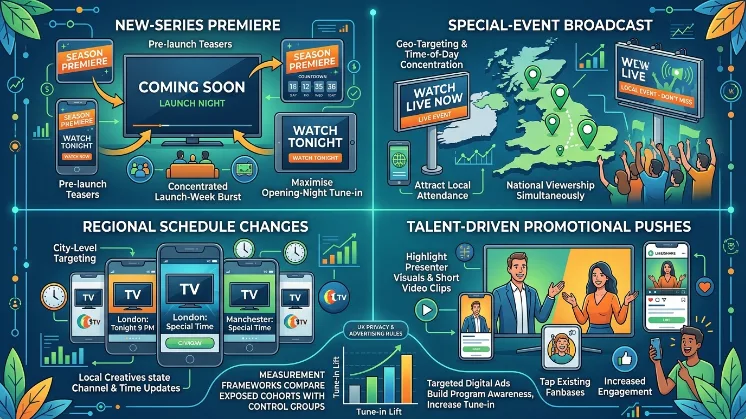
Use cases include new-series premieres, special-event broadcasts, regional schedule changes, and talent-driven promotional pushes. Each use case uses tailored timing, creative, and targeting to achieve distinct awareness outcomes.
For a new-series premiere, campaigns focus on pre-launch teasers and a concentrated launch-week burst to maximise opening-night tune-in. Special-event broadcasts use geo-targeting and time-of-day concentration to attract local attendance and national viewership simultaneously. Regional schedule changes use city-level targeting with local creatives that state channel and time updates. Talent-driven pushes highlight presenter visuals and short video clips to tap existing fanbases. Measurement frameworks compare exposed cohorts with control groups to attribute tune-in lift to the display campaign.
Learn Everything About It Here:
TV Channel Ads That Turn Program Interest Into Viewer Conversions
Display campaigns for TV channels are targeted digital ad efforts that use creative formats, precise targeting, and measurement protocols to build program awareness and increase tune-in. Campaigns follow defined timing windows, use pricing models geared to reach and viewability, and operate within UK privacy and advertising rules. Channels gain measurable reach and viewership uplifts when they align display campaigns with broadcast schedules and digital promotional channels.