Banner ads are static or animated images placed on websites to promote films. Studios use them to increase awareness by targeting high-traffic pages and relevant audience segments.
Banner ads are digital display units that appear inside webpage layouts. Common sizes include 300×250, 728×90, and 160×600 pixels. Studios design banners to show film titles, key art, release dates, and short hooks. Studios run campaigns across news sites, entertainment portals, and niche fan pages to reach broad and specific groups. Campaigns use direct buys, programmatic exchanges, and premium placements inside article content. Targeting variables include geography (city, region, country), demographics (age brackets, gender), and context (pages about cinema, genres, or celebrities).
Banner creatives vary by campaign phase. Early awareness creatives highlight release months and poster art. Later creatives add trailer prompts or countdowns. Animation length typically runs 5 to 15 seconds for HTML5 banners. File sizes follow industry limits: 150 KB for most programmatic platforms and 200 KB for premium buys. Studios test multiple images, headlines, and calls to action to determine which creative yields the highest engagement metrics.
How do banner ad campaigns start and what is the process?
Campaigns start with objectives, audience definition, and media planning; studios then produce creatives, select inventory, and launch phased buys for sequential exposure.
The process begins with three clear objectives, awareness, consideration, and conversion (ticket pre-sales). For TOFU stage emphasis, studios focus on awareness metrics: reach, unique users, and viewable impressions. Audience definition uses first-party data, third-party segments, and contextual signals. Media planners allocate budgets across channels and publisher types. Creative teams produce multiple banner variants sized for desktop and mobile. Trafficking teams tag creatives with click-through URLs and tracking pixels. Launch follows a phased schedule: teaser phase (6–12 weeks before release), trailer phase (4–6 weeks), and final push (1–2 weeks). Measurement systems report daily impressions, viewability rates, click-through rate (CTR), and engagement time.
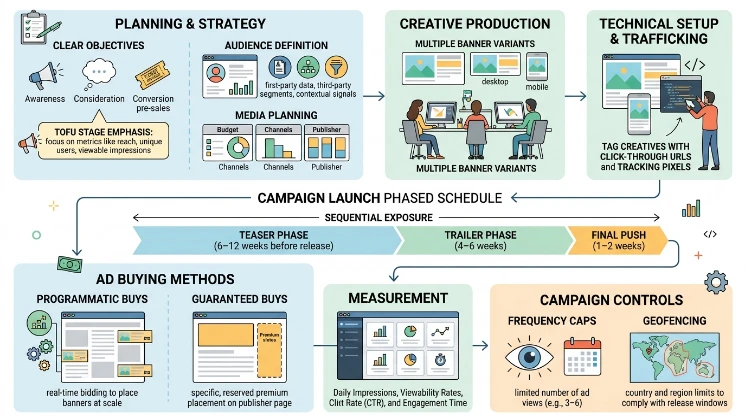
Programmatic buys use real-time bidding to place banners at scale. Guaranteed buys reserve premium placements on specific publisher pages. Both methods require frequency caps to limit impressions per user; typical cap ranges are 3 to 6 impressions per week. Studios enforce geofencing for country and region limits to comply with release windows.
What components make an effective banner ad for a film?
Effective banners combine clear visual hierarchy, concise text, strong release signals, and optimized technical specs to maximise viewability and recognition.
Visual hierarchy places the film title and key art at the top of attention flow. Text uses a single short line, for example a tagline or release date. Release signals include date, rating, and platform type (cinema). Visuals use high-contrast color and a clear focal point such as the lead character or logo. Fonts follow a single family and maintain legibility at small sizes. Include a single data point such as “In cinemas 14 August” rather than multiple dates.
Technical specifications align with publisher requirements, HTML5 format for animation, JPEG/PNG for static images, and 150–200 KB max file size. Banner animations loop no longer than 30 seconds; individual sequences run 5–15 seconds. Click URLs track source parameters using UTM tags for analytics. Accessibility features include alt text for images and captions for animated frames. Ad verification partners measure fraud and ensure correct placement.
Get the Full Insights Here:
How Film Studios Nurture Audience Hype Using Trailer Ads
What metrics do studios use to measure banner ad success?
Studios measure impressions, reach, viewability, CTR, and assisted conversions to evaluate awareness impact and downstream box office influence.
Impressions count how many times banners appear. Reach counts unique users exposed. Viewability reports what percentage of impressions meet industry standards (50% pixels in view for 1 second for display). CTR equals clicks divided by impressions and indicates direct engagement. Assisted conversions measure how many ticket purchases or trailer views followed exposure within a defined attribution window, commonly 7–14 days. Cost metrics include CPM (cost per 1,000 impressions) and cost per thousand viewable impressions (vCPM). Studios also monitor brand lift via surveys that measure recall, interest, and intent before and after campaigns.
Attribution models vary. Linear attribution assigns credit based on impressions only. Time-decay attribution gives greater weight to recent exposures. Multitouch attribution distributes credit across several interactions such as banner exposure, trailer view, and search click. Studios often use a mix of deterministic tracking (UTM, pixels) and probabilistic methods to estimate contribution to ticket sales.
How do banner ads fit within a film’s wider marketing mix?
Banner ads function as top-of-funnel tools that deliver reach and frequency and integrate with trailers, social, and PR to build coherent awareness.
Studios align banner ad timing with trailer releases, press cycles, and festival appearances. Banners amplify trailer launches by pushing trailer links and teaser images on publisher pages. They complement social media by reaching audiences outside social platforms and by targeting dedicated editorial environments. Banners also support earned media by targeting articles that host interviews or reviews to capture reader attention during editorial interest peaks. Measurement integrates across channels to map exposure paths: initial banner exposure, trailer view, and subsequent search or ticket purchase.
Sequenced creatives use progressive messaging. Early banners introduce the title and tone. Mid-campaign banners highlight trailer availability and runtime. Late banners promote opening weekend specifics such as early screenings. This sequencing drives incremental awareness and prepares audiences for conversion-focused tactics such as ticketing promotions handled elsewhere.
What are the legal and regional considerations for UK banner campaigns?
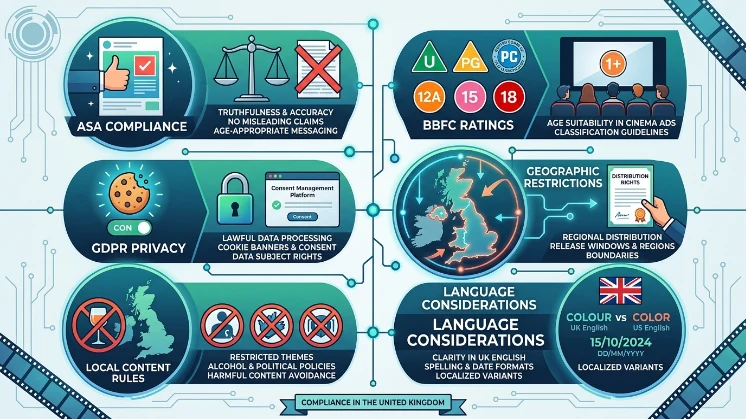
UK campaigns follow advertising standards, privacy regulations, and classification guidelines; studios ensure compliance with ASA rules, GDPR, and local classification ratings.
The Advertising Standards Authority (ASA) enforces rules on truthfulness, harmful content, and age-appropriate messaging. Studios vet creative claims and avoid misleading statements about film content or release status. Privacy compliance requires lawful data processing for targeting and cookies; studios implement cookie banners and consent management platforms in line with GDPR. Regional classification uses the British Board of Film Classification (BBFC) ratings for cinema advertising to indicate age suitability. Local content rules apply for political references, alcohol depiction, and harm-related themes; studios adapt creative assets to meet local restrictions.
Geographic restrictions apply to release windows. Studios restrict banners to regions where distribution rights exist. Language considerations include English text clarity and, where necessary, localised English variants for UK audiences such as date formats and spelling.
Explore More Expert Insights:
How TV Channels Boost Viewership Using Display Campaigns
How Streaming Services Increase Trial Signups Using Banner Ads
What benefits do banner ads deliver for film awareness campaigns?
Banner ads deliver measurable reach, precise audience targeting, and cost-efficient impressions that drive awareness across diverse editorial environments.
Reach scales from thousands to millions of unique users. Targeting reduces wasted impressions by focusing on defined segments, such as ages 18–34 or fans of specific genres. Cost efficiency depends on inventory type; programmatic buys yield lower CPMs while premium placements offer higher viewability and brand-safe contexts. Banners support cross-device exposure across desktop and mobile. They provide quick reporting on performance and enable creative iteration based on early data. When combined with other channels, banners increase the probability that target viewers encounter the film message multiple times before release.
What are typical use cases and examples of banner ad tactics?
Common use cases include teaser placement, trailer promotion, regional release reminders, and partnership co-promotions on editorial or fan sites.
Teaser placement involves running poster-style banners 8–12 weeks before release on lifestyle and entertainment sections. Trailer promotion uses animated banners that link directly to hosted trailer pages or video players. Regional release reminders push city-specific screening dates and early-booking windows 1–2 weeks before opening. Partnership co-promotions place banners inside aligned content such as music, gaming, or genre-specific news to reach niche fandoms. Real examples: banners on major entertainment sections to announce release months, banner sequences promoting a newly released trailer, and geo-targeted banners in major UK cities ahead of opening weekend.
Banner ads serve as a deliberate top-of-funnel tactic for film studios. They deliver broad, measurable reach and precise targeting across UK editorial contexts. Effective campaigns follow a structured process: define objective, produce optimised creatives, select inventory, and measure impressions, viewability, and assisted conversions. Compliance with ASA, GDPR, and BBFC rules ensures legal and regional suitability. Banner ads integrate with trailers and editorial coverage to build coherent awareness that precedes conversion activities such as ticket sales.
Read More to Understand Better:
Film Trailer Ads That Convert Hype Into Box Office Ticket Sales